
Rugby league betting odds in Great Britain, weighed up
 Available in US
Current as of 27 October 2026 · verified against the Gambling Commission’s public register

A Super League price of 1.91 on a home win looks the same as a price of 1.91 at a different firm, and a punter treats them as if they were. They are not. One of them keeps more of every pound staked than the other, and the difference is the only thing the market actually hands a bettor — every price contains it. This page is about that difference, and about the rules of the sport and the offers that shape what a rugby league bet pays out in Great Britain in 2026.
Rugby league is a thirteen-a-side game. A match lasts eighty minutes, two halves of forty, with a six-tackle limit on each possession, and that handful of facts explains almost every market a bookmaker lays on it. Try four, conversion two, penalty goal two, drop goal one — and the way the points come shapes what a handicap line, a totals line or a winning-margin bet actually does. International Rugby League runs the international calendar; Super League is the European club competition, the NRL the Australian and New Zealand one.
Where rugby league betting is legal in Great Britain
In Great Britain there is no government list of sports you may or may not bet on. A bookmaker that serves customers in Great Britain needs a Gambling Commission licence, and the licence is the whole test of who holds one. The Gambling Act 2005 sets the framework, and since the Gambling (Licensing and Advertising) Act 2014 an operator whose remote facilities are used in Great Britain needs a Commission licence wherever the firm itself is based. Sections 33 and 36 of the 2005 Act are the offence provisions; aimed at the operator, not at a customer who merely bets on an unlicensed site. A Curaçao, Maltese or Gibraltar licence does not replace a Commission licence for the British market.

The Commission is a non-departmental public body sponsored by the Department for Culture, Media and Sport. It does not licence advertising — that runs through the CAP Code (non-broadcast) and BCAP Code (broadcast), enforced by the Advertising Standards Authority. The Commission publishes a public register searchable by business name, trading name, domain or account number; that register is what a punter checks when they want to be sure a brand is licensed. A bookmaker running under one licence can put out several brands — Ladbrokes and Coral, Paddy Power and Betfair — so a single licence may carry more than one trading name.
Northern Ireland sits outside the 2005 Act and runs on older legislation, so a “GB-licensed” bookmaker means England, Scotland and Wales only.
What a Commission licence covers
A remote betting licence is one of several categories. The category that matters for sports is remote general betting standard (real events) — the one every operator in the comparison below holds. A separate category, remote betting intermediary, is the licence for betting exchanges, where customers bet against each other rather than against the firm. Financial spread betting sits with the Financial Conduct Authority, not the Commission; Spreadex, for example, runs spread betting under the FCA and fixed-odds betting under the Commission. The categories named on the register are the ones a punter verifies — they tell you what the licence actually lets the firm take.
Pool betting on horse and dog racing is its own category, separate duty, separate rule set; sportsbook pool products fall under it. No statutory cap on stakes exists in sports betting — operators set their own maximum stakes and may restrict individual customers. There is no statutory list of permitted markets either, which is why novelty and politics bets appear at GB bookmakers without breaking any law.
Why the licence matters in practice
A Commission licence brings a package of obligations a punter actually feels at the cashier and the betting slip. Identity verification before the first deposit — name, address and date of birth — has been mandatory since 7 May 2019, and a free bet or bonus counts as gambling for that purpose. There is no anonymous play at a licensed site. Credit cards have been banned for gambling in Great Britain since 14 April 2020, including credit-card-funded payments through an e-wallet; debit cards and bank-based payments are not covered by that ban.
A licensed bookmaker must also belong to GAMSTOP, the national multi-operator online self-exclusion scheme, mandatory for online operators since 31 March 2020. A self-exclusion is for six months, one year, five years, or five years with auto-renewal; after the minimum period the exclusion stays in place for a further seven years unless the customer asks GAMSTOP to remove it. GAMSTOP covers online sites and apps; betting shops use a separate self-exclusion service.
An offshore site offers none of these. No GAMSTOP coverage, no Commission complaints route, no approved dispute-resolution body, no British consumer redress if funds are withheld, and the operator is not bound by the wagering cap or the financial vulnerability check below. That is the honest framing: licensed means checks, limits, GAMSTOP, the cap, and verification before the first bet; unlicensed means none of those protections, and a real risk that a winning balance is not paid out. Neither is “the safe choice” by default — a punter has to weigh both sides.
What responsible gambling looks like under a Commission licence
A licensed bookmaker is required to offer a set of safer-gambling tools, and a punter who plans to use one is well advised to check the cashier before signing up. The headline rule is the financial vulnerability check — LCCP condition 3.4.4, in force since 30 August 2024. Once a customer’s deposits minus withdrawals exceed £150 in a rolling 30 days, the operator runs a public-record check (bankruptcy, county court judgments, the kind of record a search of official registers turns up). It is not an income check and not a credit-reference check. The financial risk assessments the press calls “affordability checks” are a separate, staged plan announced by the Commission on 7 July 2026, with no start date yet.
Deposit limits sit under RTS 12. Operators must offer a gross deposit limit on a fixed time frame — daily, weekly or monthly. The first phase has applied since 31 October 2025; a second phase was postponed to 30 September 2026. Whether that second phase is live in 2026 is not established — a punter who wants to be sure sets the limit themselves.
There is no state-set deposit or loss cap. The ceiling a punter sets on themselves is the ceiling that applies. The minimum age is 18. Help is available outside the bookmaker — GamCare runs the National Gambling Helpline, GambleAware funds treatment and education, NHS gambling clinics treat gambling in certain areas of England, and Gamblers Anonymous runs peer-support meetings.
Marketing rules the punter feels
Promotion rules that came into force on 19 January 2026 cap wagering requirements on bonuses at 10x — a £10 bonus at 50x wagering would have needed £500 of qualifying bets; under the cap no more than £100. Mixed-product promotions, an offer that asks the customer to gamble on two or more product types (betting plus casino, betting plus lottery), are banned. Whether the cap applies to free bets with no wagering condition is not established; the winnings cap on a free bet is set by each operator’s own terms. CAP Code section 16 governs who may appear in an advert rather than who may bet: no-one who is or seems to be under 25 may be featured gambling, with an exception for advertising inside a place where a bet can be placed directly.
“Whistle-to-whistle” — no betting adverts on TV from five minutes before a live sporting event to five minutes after, before the 9pm watershed — has been an industry code since 1 August 2019; horse and greyhound racing are excluded. From 2026/27 the Premier League clubs will withdraw gambling sponsorship from the front of matchday shirts, sleeves and hoardings remaining; that is a voluntary measure, not law. Operators carry responsibility for the marketing of their affiliates. Promo codes are not published here — a punter who wants one reads the offer page directly.
Bonuses, free bets and what they really cost
A “free bet” is a marketing term dressed up as a regulated product, and the price of it sits inside the small print. Three figures decide whether an offer is worth claiming: the qualifying stake, the minimum odds the qualifying bet must be placed at, and the wagering or turnover the bonus carries. A free bet whose stake is not returned with a win — most of them — is worth less than its face value, and the gap is the house edge that lives inside every promotional headline.
For a free bet whose stake is not paid back, value is free-bet amount times (odds minus one) divided by odds, multiplied by the payout share of that market. Place a £10 free bet at 4.00 (3/1) on a market with a 95 per cent payout share: £10 × (4.00 − 1) ÷ 4.00 × 0.95 = £7.13. The £10 face value is not what the bet wins; the £10 face value is what the bet costs the operator. A punter who assumes a £10 free bet returns £10 of value is reading the marketing, not the arithmetic.
Cash bonuses behave differently. A £10 cash bonus at 10x wagering needs £100 of qualifying bets to clear, and the bets count only at the minimum price the offer sets. Stake limits while a bonus is being cleared are common, and so are excluded markets — read the offer terms before picking the team. The 10x cap on wagering from 19 January 2026 is the headline rule, but it does not apply to every bonus: a free bet with no wagering condition sits outside the cap.
Promotions that move prices without cash
Three promotion shapes are common at GB bookmakers and are not the same as a bonus. Enhanced odds is a one-off price on a specific selection — a 6/1 shot offered at 10/1 for new customers, usually capped at a small stake. Price boost is the same shape but available to existing customers and rotated weekly. Accumulator insurance refunds a stake as a free bet if one leg of an accumulator loses. Each carries its own ceiling — a maximum stake, a maximum payout, a minimum number of legs — and a punter who treats the marketing as the offer leaves the ceiling to read the small print for them.
Best Odds Guaranteed is the cleanest of the promotions and the easiest to read. William Hill pays it on UK and Irish horse racing from 8am on race day, on single and multiple bets, not on ante-post, tote or pari-mutuel bets. Fafabet pays it from 9am on race day on UK and Irish racing win and each-way bets: if the starting price is bigger than the price taken, the bigger odds are paid. The promotion is a clean refund of the odds gap; nothing extra to clear, no wagering, no minimum odds.
A worked example of the arithmetic
The 888sport price boost advertises odds larger than the ordinary line on a chosen selection. The boost is a one-off price on one bet, capped at a small stake, paid as cash winnings — there is no wagering condition to clear and no free bet in the middle. Compare with a £10 free bet on the same selection at the same boosted odds: the £10 stake is not returned, so the value is £10 × (odds − 1) ÷ odds × payout share. A 3.00 line on a market at 95 per cent payout share gives £10 × 2 ÷ 3.00 × 0.95 = £6.33 of expected value. The marketing calls both “a £10 boost”; the arithmetic calls them very different products.
Live betting and cash out on rugby league
In-play betting on rugby league is offered by every GB bookmaker in the comparison, and the rules of the sport make in-play workable in a way they are not for, say, baseball. Six tackles, a stoppage for a video review, a conversion attempt — the game has natural pauses that lend themselves to a price update. Midnite shows in-play events on its home page; bet365 runs in-play and live streaming, with Bet Track, Match Live and a Live Golf Tracker for following bets in play. Matchbook, the exchange, runs in-play as a function of its back-and-lay model — the price is set by other punters rather than the firm.
A cash out is the firm buying the bet back from the punter at a price it sets, and the price it sets always sits inside the firm’s edge. Cash out is available at 888sport, at bet365 through its Bet Builder+ product, and at most of the firms below. Matchbook runs cash out on the exchange model: a punter can lay the bet off to another customer rather than the firm buying it back, which is a cleaner shape if the price is right. The firm-set cash out price contains the same margin as the pre-match price — there is no point at which the house gives the edge back.
The rules of in-play settlement
In-play bets settle on the rules each firm writes. A Super League match settled at 80 minutes’ play, extra time excluded for the match and handicap markets, is the rule at one GB bookmaker. Other markets — outright winner, top tryscorer — settle on the official result including extra time. A punter who bets in-play at a firm with a different rule set needs to read the rugby league rules page for that firm before the whistle.
Bets on a postponed match stand for 48 hours from the original kick-off and then become void — the rule at one firm. A handicap line that is hit exactly (a whole-number line tied on the final score) is refunded across all wagers on that line; the punter’s stake is returned in full and the market is treated as if it had not been struck.
How a price is built and what the margin costs
A price is two numbers and one lie. The two numbers are the decimal odds offered on each outcome of a market — 1.91 and 1.91 on a two-way match, say. The lie is that a 1.91 / 1.91 market pays out what a 1.91 / 1.91 market looks like it pays out. The margin — the share of every pound staked that the bookmaker keeps on the market — sits inside both prices.
Take an illustrative two-way market at decimal odds 1.90 / 1.90 (fractional 9/10). Payout share is 1 ÷ (1/1.90 + 1/1.90) = 1 ÷ (0.5263 + 0.5263) = 1 ÷ 1.0526 = 0.9500. Margin is 1 − 0.9500 = 0.0500, or 5 per cent. A 1.90 / 1.90 market keeps 5p of every pound staked. A 1.85 / 1.85 market keeps 7.5p. A 2.00 / 2.00 market keeps 0p — every pound is paid back on a winning bet, and the firm earns nothing on the market — but that 2.00 / 2.00 line is itself a marketing tool: no firm holds 2.00 over many two-way markets.
The honest margin on a typical rugby league match winner market sits in a band, not at one figure. Rugby league match-winner markets at the larger firms run roughly between 4 and 8 per cent of turnover; smaller firms, niche markets and exotic markets push higher. The handicap and totals markets carry a higher margin than the match winner — the firm prices more outcomes and the prices are softer, so the edge is wider. A punter who wants the cheapest price on a rugby league match winner trades that market specifically rather than taking the firm’s full card.
Fractional to decimal, and why the conversion matters
British bookmakers publish fractional odds (5/1, 11/4, evens) and decimal odds (6.00, 3.75, 2.00) on the same market; both forms are exact equivalents. Fractional a/b becomes decimal a ÷ b + 1. Five-to-one is 5 ÷ 1 + 1 = 6.00. Eleven-to-four is 11 ÷ 4 + 1 = 3.75. Evens (1/1) is 1 ÷ 1 + 1 = 2.00. The conversion is exact, and a punter who wants to compare prices across firms does the conversion once and reads decimals afterwards.
Odds-on is shorter than evens — anything below 2.00 in decimal form, anything below 1/1 in fractional form. A bookmaker treats odds-on as the cheapest margin in a market; the margin in an odds-on market tends to be tighter because the price action is on the favourite, and the firm does not want to be best-priced on the favourite any more than the punter wants to be worst-priced on it.
Rugby league bets and how they settle
Three market families carry most of the volume: match result, handicap and totals. Each has a settling rule that depends on the rule of the firm and the sport.
Match result — home win, draw (a draw is rare in rugby league because the standings are settled on points; a draw is possible but the league ranking sorts it out separately), away win. Settles on 80 minutes’ play at most firms; extra time does not count.
Handicap — a line of, say, +8.5 on the underdog or −8.5 on the favourite. The handicap is added to (or subtracted from) the final score and the result with the handicap applied is the bet. A whole-number line (say +8) that lands exactly is refunded in full at one GB bookmaker.
Totals — over or under a line on the match score, usually 38.5 or 40.5. Settles on the official total including extra time at most firms; the totals line is the market where a high-scoring game or a tight, low-scoring one tells on the price most clearly.
Two further markets are widely offered and behave differently. Winning margin — a band of points (1-7, 8-13, 14-19, 20+) — settles on the official margin including extra time. First tryscorer / anytime tryscorer — settles on the official team sheet; a player who does not play is a non-runner and the bet is void. Rule 4 deductions apply when a runner is withdrawn: the price on the remaining runners is reduced by a stated amount depending on the withdrawn runner’s price at the time of withdrawal.
Combination bets
An accumulator (“acca”) multiplies the odds of the legs into a single price. A treble of 2.00, 3.00 and 4.00 is 24.00 — the stake wins 24 times its face value if all three legs win. The margin compounds: the 5 per cent margin on three independent markets is roughly 14 per cent of the combined stake. A Lucky 15 is 15 bets (4 singles, 6 doubles, 4 trebles and a four-fold accumulator) on four selections, total stake = unit stake × 15. A Heinz is 57 bets on six selections; a Goliath is 247 bets on eight. The unit stake is set; the total stake is unit × number of bets. Each combination carries the margin of every leg multiplied, and a punter who builds an acca from four handicap markets is paying for a bigger edge than an acca from four match-winner markets.
Sports and tournaments a GB punter bets on
Super League is the European club competition, with twelve teams across England and (since 2021) one in France. The season runs from February to the Grand Final in autumn. The NRL is the Australian and New Zealand club competition, with seventeen teams, a longer regular season and a finals series through September. The State of Origin is the three-match series between New South Wales and Queensland, played mid-season; origin matches move price in Australia and on the GB market because of the volume bet on them. The Rugby League World Cup is the international tournament, most recently held in 2022 in England, with the next edition in 2026; international matches are scheduled in the windows the IRL sets.
Championship and League One are the second and third tiers of the British pyramid; they trade on the same firms as Super League but with thinner markets and a smaller fixture list. The Challenge Cup is the knockout tournament, played through the spring and early autumn, and the final at Wembley is one of the bigger betting events of the British rugby league calendar.
Where the volume actually sits
The volume on rugby league at a GB bookmaker sits on Super League match winner, NRL match winner, State of Origin and the Rugby League World Cup. Totals and handicap markets carry more volume on the NRL than on Super League because the NRL is the higher-scoring competition and the totals markets are deeper. Handicap volume on the World Cup spikes during the knockout rounds and is thin during the group stage. A punter who bets on Championship or League One is reading smaller markets with wider margins and thinner liquidity; the value, if any, comes from knowing the teams rather than the price.
The ten GB-licensed bookmakers, weighed up
The table lists the ten bookmakers held under a UKGC remote licence, named against the licence number, the licence holder and what the operator’s own terms state about rugby league. The list is not a ranking. It is the set of brands the Commission register names against a remote general betting standard licence.
| Brand | Gambling Commission licence and holder | Rugby league on the operator’s own terms |
|---|---|---|
| 888sport | Remote licence 039028-R-319297-014 (account 39028), 888 UK Limited | Pre-match and in-play betting, Cash Out, Bet Builder, racing streams, BetFinder form tools, a live bet feed and daily boosted odds |
| BoyleSports | Remote licence 039469-R-319383-025 (account 39469), Boylesports Enterprise | Sports welcome offer for UK players is £20 in free bets when a £10 bet is placed (€30 in free bets for a €10 bet for Irish players) |
| Matchbook | Remote licence 039504-R-319407-024 (account 39504), Triplebet Limited — also a remote betting intermediary licence | A betting exchange where customers bet against other users, with Bet Builder, multiples, in-play betting and live streaming of horse racing and greyhounds |
| VBet | Remote licence 044662-R-324273-022 (account 44662), SCGO Limited | Sports welcome offer is a £10 free bet if a new, verified customer stakes £10 or more on a first-ever bet that loses |
| Fafabet | Remote licence 057385-R-333191-006 (account 57385), Taichi Tech Limited | Pays Best Odds Guaranteed on UK and Irish horse racing win and each-way bets from 9am on race days |
| Betfred | Remote licence 039544-R-319290-010 (account 39544), Petfre (Gibraltar) Limited | App covers 21 sports plus over 2,000 casino-style games |
| Geoff Banks | Remote licence 054095-R-330366-010 (account 54095), GB Sports Advisors Limited | Live in-play prices and ante-post prices on future events |
| Octobet | Remote licence 062545-R-337248-006 (account 62545), Octopus Game Limited | Sports welcome offer is 50 per cent back as a free bet up to £50, plus a £10 casino bonus for new customers |
| Tote | Remote licence 054779-R-331321-008 (account 54779), TDCO Limited | Pays Best Odds Guaranteed on UK and Irish horse racing from 8am on the day of the race, on both single and multiple bets |
| DAZN Bet | Remote licence 048756-R-327274-019 (account 48756), DZBT Limited | Deposits start at £5 by debit card, Apple Pay, Paysafecard, Trustly and Skrill, and at £20 by PayPal, with no processing fees |
Two more bookmakers sit alongside this set on terms a punter will read about. bet365 is the official global betting partner of the UEFA Champions League and the most downloaded sports betting app in the UK; its rugby league offer includes Bet Builder+ (combining markets from one event into a single bet, pre-match and in-play), Super Boosts, Winnings Boosts on Bet Builders and selected singles, and daily Bet Boosts, plus in-play and live streaming with Bet Track and Match Live. Spreadex runs spread betting on rugby league under the FCA and fixed-odds betting under the Commission; spread betting losses can exceed the deposit and that is the headline risk a punter reads first. Kalooki Sportsbook, operated by Kalooki Sports Book Ltd under Commission account 57730, is a GAMSTOP member. Midnite cites Commission licence 101839 and shows in-play events, an acca builder, popular accas and price boosts with maximum-stake limits. Unibet UK has operated since 1999 and runs under Platinum Gaming Limited, Gibraltar, on Commission account 45322. Lottoland UK combines casino, lottery betting, sports betting and scratchcards and states it is licensed by the Commission. Fitzwilliam Sports offers instant deposits, fast withdrawals, timeouts and deposit limits, and links to GambleAware, GamStop and Gamblers Anonymous. None of these seven sits inside the table because the headline comparison runs on the ten brands the Commission register names most directly for a remote general betting standard licence; the others belong to the wider licensed set a punter will meet in the register and on the betting slip.
888sport
888sport runs a remote licence held by 888 UK Limited and offers the standard in-play and pre-match card with Cash Out and Bet Builder, plus the live bet feed and daily boosted odds that make the home page busy. The edge a punter reads is the BetFinder form tool — it does not remove the margin, but it shortens the gap between a price and the form behind it. A punter who wants a clean match-winner card and a Cash Out button will find both here; a punter who wants depth on totals lines and handicaps will find a thinner book than the bigger firms.
BoyleSports
BoyleSports’ UK welcome offer is £20 in free bets on a £10 qualifying bet, with a separate €30 / €10 Irish version. The Irish heritage shows in the racing offer rather than the rugby league card; BoyleSports is competitive on Super League match winner but trades a thinner handicap book than the bigger GB firms. The licence is held by Boylesports Enterprise and is on the Commission register under account 39469.
Matchbook
Matchbook is the only exchange in the comparison. The licence covers both remote general betting standard (real events) and remote betting intermediary — a different category, with the firm taking a commission on winning bets rather than building a margin into the price. The price on a Matchbook market is set by other punters backing and laying; the firm adds a commission to winning bets. A punter who can lay a bet off (bet against their own selection at a chosen price) gets a sharper shape than the firm-set cash out. The edge is the commission, the depth is the size of the matched liquidity on the market.
VBet
VBet’s offer is a £10 free bet on a £10 qualifying first bet that loses — the cleanest “second chance” shape on the comparison. The licence is held by SCGO Limited, Commission account 44662. Rugby league card sits inside a wider sportsbook of about thirty sports; the in-play card is the firm’s strongest feature, the handicap book is thinner than the bigger firms. A punter who wants a clean refund-as-free-bet welcome and a wide in-play menu finds it here.
Fafabet
Fafabet pays Best Odds Guaranteed on UK and Irish horse racing from 9am on race day, the standard best-odds-guaranteed shape. The licence is held by Taichi Tech Limited, Commission account 57385. Rugby league is offered alongside a wider sportsbook, with a smaller fixture card than the bigger GB firms; the price is competitive on match winner on the major fixtures and sits wider on the niche markets. The free-bet welcome offer is described only on the operator’s own terms; read them at the cashier before signing up.
Betfred
Betfred’s licence is held by Petfre (Gibraltar) Limited, Commission account 39544; the app covers 21 sports and over 2,000 casino-style games. Rugby league sits inside a wide sportsbook that includes horse racing, football and greyhounds; the firm’s heritage is the shops, and the online card carries that heritage in racing markets more than rugby league. A punter who wants rugby league match winner and totals will find a competitive book; a punter wants the deepest handicap book on the NRL will find a thinner one.
Geoff Banks
Geoff Banks runs under GB Sports Advisors Limited, Commission account 54095, and the firm’s edge is the personal touch — a smaller firm with ante-post prices on future events and live in-play prices on a curated fixture list. Rugby league is part of the card; a punter who wants a personal account manager and a tailored offer finds it here. A punter who wants the widest market depth on Super League finds thinner markets than the bigger firms.
Octobet
Octobet’s welcome offer is 50 per cent back as a free bet up to £50, plus a £10 casino bonus — the bonus-plus-free-bet shape is a mixed-product promotion, and that is now banned under the January 2026 rules. Read the offer terms at the cashier: the offer shape in 2026 is described on the operator’s own terms, and a mixed-product promotion in this shape will not be offered under the new rules. The licence is held by Octopus Game Limited, Commission account 62545.
Tote
Tote runs under TDCO Limited, Commission account 54779, and the firm’s heritage is pool betting on British horse racing; the Tote is the pool-betting brand. Best Odds Guaranteed is paid from 8am on race day on UK and Irish racing, single and multiple bets, no ante-post, no tote, no pari-mutuel. Rugby league is on the card but is not the firm’s main market; a punter who wants racing will find the deepest card, a punter who wants rugby league will find a workable but smaller book.
DAZN Bet
DAZN Bet runs under DZBT Limited, Commission account 48756; the deposit menu starts at £5 by debit card, Apple Pay, Paysafecard, Trustly and Skrill, and at £20 by PayPal, no processing fees. The headline difference is the low deposit ceiling; a punter with a small bankroll finds a lower entry point than most rivals. Rugby league is on the card; the in-play menu is the firm’s strongest feature, the pre-match card is the firm’s weakness. A punter who bets small and live finds a sharp match, a punter who bets pre-match on a deep handicap card finds a thinner book.
Reading the comparison
Three comparisons stand out across the ten. The first is the exchange versus the firm. Matchbook’s commission-on-wins model is structurally different from the margin-built-into-the-price model at every other firm in the table; a punter who reads prices on both sees Matchbook’s headline price at, say, 1.95 where a firm-set line is 1.91, and pays a commission on a winning bet. On a market with low liquidity the commission is the cheaper edge; on a market with deep liquidity the firm’s built-in margin is often the cheaper edge. The second is the welcome offer. A £20-in-free-bets shape on a £10 qualifying bet (BoyleSports) is more generous than a 50 per cent back-as-free-bet-up-to-£50 shape (Octobet) on a £10 losing bet, but both are subject to the offer’s own terms — minimum odds, wagering, expiry — and a punter who reads the terms is the punter who keeps the offer. The third is the best-odds-guaranteed promotion. William Hill and Fafabet both pay it on UK and Irish racing from 9am (Fafabet) and 8am (William Hill); the promotions are a clean refund of the odds gap with no wagering.
The four firms the punter reads first for rugby league match winner are the firms with the deepest card — 888sport, BoyleSports, VBet and DAZN Bet all run wide rugby league menus with in-play and pre-match coverage of Super League, the NRL and the World Cup. Matchbook is the firm’s punter reads for the sharpest exchange price on a major fixture; the price is set by other punters and the firm takes a commission. Geoff Banks and Tote are the firms a punter reads for a personal account or a racing-heavy book; rugby league is on the card but is not the headline market. The four firms — 888sport, BoyleSports, VBet, DAZN Bet — are the four names above; her judgement, not the page’s, picks between them.
The fundamentals of the sport, and how they shape the market
A rugby league team has thirteen players on the pitch. A match is eighty minutes, two halves of forty. The attacking team gets a maximum of six tackles before possession changes; the kick on the sixth tackle is part of the territory game that shapes a lot of the betting. A try is four points, a conversion two, a penalty goal two, a drop goal one (two if kicked from beyond the forty-metre line).
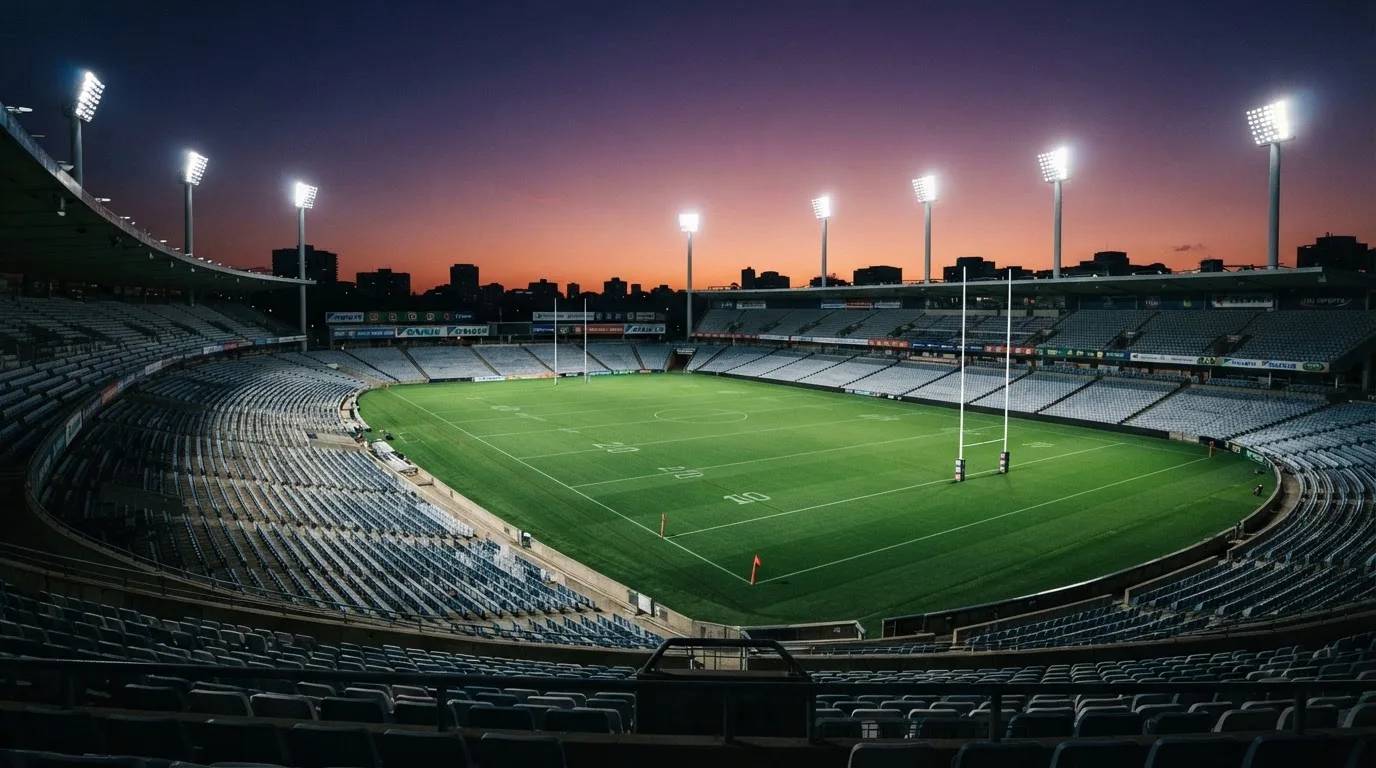
These rules shape the markets. The six-tackle limit and the high completion percentage of modern Super League teams make handicap markets tighter than in rugby union — the favourite is rarely blown out, the underdog rarely kept scoreless, the totals markets hover around the high thirties or low forties. A first-tryscorer market is settled on the official team sheet; a player who does not play is a non-runner and the bet is void. A winning-margin market is settled on the official margin including extra time at most firms, so an extra-time try changes the result.
The international calendar
International Rugby League runs the international windows. The Rugby League World Cup sits every four years, most recently in England in 2022 and in 2026 in the next edition; the European Championship and the Pacific Championships run in the windows between World Cups. State of Origin runs mid-season in Australia and is one of the bigger betting events of the NRL calendar. A punter who follows the international calendar finds windows of opportunity — totals markets on origin matches, match winner on the World Cup, handicap on the group stages — that the firm card offers for a few weeks each year.
Tax, payment and the practical edge
A punter in Great Britain pays no tax on betting winnings. General Betting Duty is the operator’s tax on gross profits, currently 15 per cent; from 1 April 2027 a new remote betting rate of 25 per cent applies within it, while remote bets on UK horse racing, bets on self-service betting terminals in licensed premises, pool betting and in-person betting stay at 15 per cent. Until 1 April 2027 the remote rate stays at 15 per cent; whether operators pass the duty on through odds is not established. Spread betting carries separate rates — 3 per cent financial, 10 per cent other.
The player pays no duty. The punter who acts as a trader — running a price model and betting for a living — is a professional gambler in HMRC’s eyes and pays income tax on profits; that is general information, not tax advice, and a professional gambler asks HMRC or an adviser.
Credit cards are banned for gambling in Great Britain since 14 April 2020, including credit-card-funded payments through an e-wallet. Debit cards, bank transfers, Apple Pay, Paysafecard, Trustly, PayPal, Skrill — the payment menu at a GB bookmaker is the menu that does not include credit cards. DAZN Bet’s deposit ceiling of £5 by debit card and most e-wallets is the lowest in the comparison; a punter who bets small finds the entry point. Identity verification before the first deposit — name, address and date of birth — is mandatory, and the verification happens before any deposit or any free bet or bonus is credited; the rule of 7 May 2019 has held since.
The exchange alternative
Matchbook’s exchange model is a different shape from the firm-book model. A punters backs a selection (bets for it to win) or lays it (bets against it to win) at a price set by other punters. The firm takes a commission on net winnings — Matchbook’s commission is set on the exchange’s own terms — rather than building a margin into the price. A punters who can read a market and lay off a bet at the right price gets a sharper edge than the firm’s built-in margin allows, and the commission is the cost of that edge. The exchange model is also more capital-efficient: a lay bet of £10 at 3.00 needs £20 of liability (the £10 stake at 2/1 implied), not the £10 stake a back bet needs.
The wider picture, and where the edge really sits
A £10 free bet, a 5 per cent margin on a match-winner market, a £5 deposit ceiling, an 8am best-odds-guaranteed promotion — every one of these is a number, and the numbers shape what a rugby league bet really pays out. A punter who reads the numbers is the punter who keeps the edge; a punter who reads the marketing is the punter who hands the edge back.
The margin is the largest number in this market. A 5 per cent margin on a match-winner market is the largest single edge a punter hands a firm; the welcome offer, the deposit ceiling, the best-odds-guaranteed promotion are all smaller numbers. A punter who reads the margin reads the trade-off of the market: a 4 per cent margin at one firm, a 6 per cent margin at another, a 3 per cent margin at a third on a major fixture. The exchange model at Matchbook charges a commission rather than a margin and the commission is the same number on both sides of the bet.
The welcome offer is a marketing budget. A £20-in-free-bets welcome on a £10 qualifying bet is a marketing budget the firm has decided to spend on a new customer; the budget is the firm’s commitment to acquire the customer. A punter who treats the welcome offer as the value of the firm is reading the marketing; a punter who treats the welcome offer as a one-off refund of the first bet is reading the offer.
The best-odds-guaranteed promotion is a clean refund of the odds gap. A punters bets at 5.00 the night before a race; the starting price is 6.00; the firm pays at 6.00. The promotion costs the firm the difference and is paid as cash winnings, not as a free bet, and is paid only on UK and Irish racing.
The deposit ceiling is the entry point for the smallest punters. A £5 deposit ceiling at DAZN Bet is the lowest in the comparison; a £10 ceiling at most rivals is the standard. The deposit ceiling is also a marketing signal: a firm that accepts a £5 deposit is a firm targeting the smallest punters; a firm that accepts a £10 deposit is a firm targeting the standard punters; a firm with no stated ceiling is a firm targeting the larger punters.
FAQ
How do you bet on rugby league?
Pick a licensed bookmaker from the Commission’s public register, complete identity verification before depositing, choose a Super League, NRL, World Cup or other fixture, and place a single, each-way or combination bet at a price the firm publishes. The bet settles on the firm’s own rules — eighty minutes’ play for match winner and handicap, official result including extra time for most other markets. A handicap line that lands exactly is refunded in full at most firms.
How can it be checked that a bookmaker holds a Gambling Commission licence?
Search the Commission’s public register by business name, trading name, domain or account number. The register lists every licence holder and the categories the licence covers — remote general betting standard (real events), remote betting intermediary, and so on. The licence holder and the trading name on the register are the legal parties; a brand may run under a different name to the licence holder, and the register is what ties them together.
How is the return on a bet worked out from the stake and the odds?
Return equals stake times the decimal odds. A £10 stake at 3.50 returns £35, made up of the £10 stake and £25 of profit. Net profit is stake times (odds minus one). For a combination bet the odds of the legs multiply into one price — a treble of 2.00, 3.00 and 4.00 is 24.00, so a £10 stake returns £240.
What is the bookmaker’s margin and how can it be seen in the odds?
The margin is the share of every pound staked that the bookmaker keeps on a market. For an illustrative market at 1.90 / 1.90 (fractional 9/10) the payout share is 1 ÷ (1/1.90 + 1/1.90) = 0.95, so the margin is 5 per cent. A market at 1.85 / 1.85 keeps roughly 7.5 per cent, and a market at 2.00 / 2.00 keeps nothing. The margin is the same number seen from two sides — a 95 per cent payout share and a 5 per cent margin add up to 100 per cent.
How do fractional odds such as 5/1 convert to decimal odds such as 6.00?
The conversion is a ÷ b + 1. Five-to-one becomes 5 ÷ 1 + 1 = 6.00. Eleven-to-four becomes 11 ÷ 4 + 1 = 3.75. Evens (1/1) becomes 1 ÷ 1 + 1 = 2.00. Odds-on is any price below 2.00 in decimal form or below 1/1 in fractional form. British bookmakers publish both, and a punter who wants to compare prices across firms converts once to decimals and reads those afterwards.
Which tools for controlling play does a licensed bookmaker have to offer?
A licensed bookmaker must offer a gross deposit limit on a fixed time frame (daily, weekly or monthly), a self-exclusion option that enrols the customer in GAMSTOP, timeouts, reality checks and links to GamCare, GambleAware and NHS gambling clinics. Identity verification before the first deposit is mandatory, and a customer whose deposits minus withdrawals exceed £150 in a rolling 30 days triggers a financial vulnerability check — a public-record check, not an income check. There is no state-set ceiling on stakes or losses; the ceiling a customer sets is the ceiling that applies.
Rugby, cricket & Gaelic – Footy Tips
Content created by the «Footy Tips» team
