
Online Gaelic Football Betting 2026: What It Costs The Punter
 Available in US
Currency stamp: Current as of 27 October 2026, cross-checked against the Gambling Commission’s public register and each operator’s own published terms.

Senior inter-county Gaelic football throws up some of the most volatile in-running prices in any field sport. A goal swings the scoreboard by three points, the 40-metre arc revalues every shot from distance, and the fixtures cluster around summer weekends with little midweek action to spread the bankroll across. Online Gaelic football betting sits on that combination, and on a market that books thinly outside Ireland, so the punter who reaches for it pays for the privilege in ways the headline price does not show.
This page is about what that privilege costs. It closes ten British-licensed bookmakers against the Gambling Commission’s register, against the operator’s own terms on Gaelic football, and against the arithmetic that decides whether an offer, an in-play price or a margin is worth taking.
The Law On Betting On Gaelic Football From Great Britain
There is no statutory list of permitted sports in Great Britain, so Gaelic football is not specially authorised and not specially forbidden. The whole test sits on the operator: any business taking bets from customers in Great Britain needs a Gambling Commission remote operating licence, whoever runs it and wherever it is incorporated. The Commission’s public register is the only proof that licence exists, searchable by business name, trading name, domain or account number.
The Gambling Act 2005 frames the market. Section 33, as amended by the Gambling (Licensing and Advertising) Act 2014, makes it an offence to provide gambling facilities for use in Great Britain without a Commission licence, with penalties of up to 51 weeks’ imprisonment or a level-5 fine on summary conviction, six months in Scotland. The section is aimed at the operator, not the customer: a punter who simply bets on an unlicensed site commits no offence under the Act found in the materials on this page, though the protection that a Commission licence brings — GAMSTOP coverage, approved dispute resolution, the bonus cap, the vulnerability check — is missing.
Northern Ireland is outside the 2005 Act and runs older legislation. A Great Britain licence does not authorise activity there, and a Northern Ireland customer should treat any “UK-licensed” claim as covering England, Scotland and Wales only. The Commission is a non-departmental public body sponsored by the Department for Culture, Media and Sport, and the licence categories in play for Gaelic football are remote general betting standard (real events), with the betting-exchange category sitting in front of operators such as Matchbook and Betfair. A bookmaker whose licence only covers pool betting, or only virtual events, cannot lawfully offer Gaelic football at all.
The check a punter can run in a minute is to look the operator up by name or domain on the register, note the account number, and read off the categories on the licence. A licence that does not list remote general betting standard (real events) does not cover Gaelic football. The register carries an access date and a “current as of” stamp, and that date is what makes the check meaningful — a licence confirmed six months ago may have been surrendered, varied or put in review since, so the date on the screen is the date that counts. Matchbook sits on Commission account 39504, 888sport on 39028, Betfair on 39439, Sporting Index on 27343, NetBet on 39170, Coral on 54743, Betmaster on 65699, Tote on 54779, Kalooki Sportsbook on 57730 and BetMGM on 39198, each with remote general betting standard (real events) on its licence.
A holder of a Great Britain licence need not use a .co.uk domain. Operators legitimately run on .com, on a Gibraltar or Maltese holding company, on a London front office with servers in Dublin. The domain proves nothing on its own. The licence proves everything.
Responsible Gambling Under A Commission Licence
Every operator in this comparison sits inside a single safety net: the Licence Conditions and Codes of Practice, the Remote Technical Standards, and the duty of care the Commission enforces against them. Gaelic football is small in revenue terms but the rules treat it like any other real-event market, so the customer-protection machinery a punter sees on a Premier League coupon is the same one that runs behind a Munster Championship fixture.

GAMSTOP is the multi-operator online self-exclusion register. Every online operator licensed in Great Britain is a member, including every brand on this page, and registering there blocks new account opening across the whole set. The minimum exclusion is six months; longer choices are one year, five years, or five years with auto-renewal. After the minimum period the exclusion stays in force for a further seven years unless the punter asks GAMSTOP to lift it. Gambling shops use a separate scheme, so an online exclusion does not stop a same-day bet over the counter.
The financial vulnerability check sits beneath that. Since 28 February 2025, when a customer’s deposits minus withdrawals exceed £150 in any rolling 30 days, the operator must run a public-record check for county court judgments, bankruptcies and similar adverse markers. It is not an income check and not a credit-reference check, and the threshold is low enough to catch a casual weekend punter rather than only high spenders. Financial risk assessments — the affordability checks the press calls by that name — were announced in a staged plan in a Commission note of 7 July 2026, with no start date set; the language that fits is “announced, staged, no start date”, not “in force”.
Deposit limits are a separate setting under the Remote Technical Standards. Operators must offer a fixed-time-frame gross deposit limit; the first changes applied on 31 October 2025, a second phase was postponed to 30 September 2026, and whether the second phase is live at the time of writing is not pinned down by the materials on this page. The ceiling itself is the punter’s choice — there is no state-set maximum stake or maximum deposit for sports betting in Great Britain, and the operator’s own maximum-stake rule on a price-boosted acca or a Bet Builder can sit below that by house policy.
Help sits outside the operator. GamCare runs the National Gambling Helpline, GambleAware funds treatment and education, the NHS runs regional gambling clinics, and Gamblers Anonymous runs meetings in person and online. Fitzwilliam Sports is one operator that links to all three on its homepage, and the practice is widespread rather than unusual; an operator that does not link out should be treated as out of step rather than as a red flag on its own.
Identity is the part the punter feels first. Since 7 May 2019 the operator has to verify name, address and date of birth before a deposit or a bet, including with a free bet or a bonus. No anonymous play exists at a licensed site, and source-of-funds questions at higher spend are normal under the money-laundering rules rather than a sign that anything is wrong. That is the cost of the licence the page keeps coming back to: protection in exchange for paper.
Crypto And Anonymity At A Licensed Bookmaker
Anonymity is not a feature the available set of bookmakers offers. Name, address and date of birth are checked before the first deposit or bet, source-of-funds questions appear at higher spend, and the same identity binds the punter across every licensed site through GAMSTOP. A Gaelic football market funded by bitcoin or any other cryptocurrency does not exist in that frame: a deposit from a self-custody wallet into a UK-licensed bookmaker has not been documented in the materials on this page.
A bookmaker licensed outside Great Britain takes bitcoin at its own terms. The Commission’s own materials do not pin down whether cryptocurrency deposits are permitted, restricted or simply absent at Commission-licensed operators, and that silence is the honest answer. Where a brand accepts bitcoin it does so because its own house policy permits it, under the licence it holds elsewhere, and the punter relying on it sits outside GAMSTOP, outside the bonus cap, outside the vulnerability check, and outside the Commission’s complaints route if funds are withheld. The page describes payments qualitatively only, and the right test for any crypto-funded account is the same test that runs for any unlicensed account: what protection does this punt disappear into if the operator decides not to pay out?
Spread betting that runs as a financial product sits on a different regulator. Spreadex’s spread-betting arm is regulated by the Financial Conduct Authority, with its fixed-odds arm regulated by the Gambling Commission, and spread betting losses can exceed deposits. The two licences sit on the same firm and answer to different regimes, and the punter reading “FCA-regulated” on a spread-betting page should read it as covering that activity only, not the fixed-odds book on the same site.
Bonuses And Free Bets On Gaelic Football
A “free bet” on a Gaelic football coupon is rarely what the word says. The headline credit is real, the conditions attached to it are where the cost sits, and the conditions vary enough across the ten brands on this page that the punter who treats two welcome offers as interchangeable has already mispriced them.
The shape of a sports welcome offer in Great Britain has narrowed since 19 January 2026. Wagering requirements on bonuses are capped at 10x, and mixed-product promotions — an offer that asks the punter to bet on football to unlock free spins, or to wager on casino to clear a sports credit — are banned. The cap is on the wagering requirement; it is not a cap on the bonus’s money value. A £10 bonus at 50x needs £500 of qualifying bets; under the cap, no more than £100 is needed. The cap covers bonuses. Whether it covers free bets with no wagering condition, and whether the cap applies to the credit’s stake as well as its winnings, are not pinned down by the materials on this page.
Coral’s headline offer illustrates the cost. A £20 qualifying bet at minimum odds of 2.0 (1/1) returns £40 in free bets, issued within 7 days and expiring 7 days after issue, for new GB customers who opt in. The headline says “£40 in free bets”; the conditions describe a £20 outlay at evens or better, a seven-day window to place the qualifying bet, a further seven-day window to use the free bets, and a stake that is not returned with a win. The arithmetic the punter runs is what the free bets are worth at the prices he actually backs, not the headline value.
BetMGM’s package reads as four £10 free bets — two football accumulators of four selections or more, two sports multiples of two selections or more — issued when the punter deposits £10 or more and places a sports bet within seven days, with a minimum price and an opt-in on each leg. The structure rewards accumulator play, and the punter who would have bet singles anyway pays the cost in higher margin and reduced control over the bet.
The same shape runs across the rest of the field. NetBet runs Daily Boosts, Profit Boosts and free bet offers, with a Bet Builder whose odds update dynamically as the punter adds legs. 888sport runs daily boosted odds and a BetFinder form tool. Betfair runs an in-app stream of price boosts and a Bet Builder alongside its exchange book. The pattern is a headline price, a qualifier, an expiry, and a stake-not-returned clause — and the punter who reads only the headline pays in turnover.
The free-bet value formula is what a £10 free bet at 4/1 (5.00) on a market with a 95% payout share is actually worth. Value = free bet × (odds − 1) ÷ odds × payout share = £10 × 4 ÷ 5 × 0.95 = £7.60, the average worth across many such bets. That is the ceiling, not the floor; the punter who backs at shorter prices collects less, the punter who backs at longer collects more, and the stake of the free bet is not paid back with a win. The punter who treats a free bet as £10 of his own money has already lost the same account.
Live Betting And Cash Out On Gaelic Football
Gaelic football moves in spikes. A goal, a black card, a switch of goalkeeper, a missed penalty at the death — each can move a price several points in seconds, and the in-running market is the place the punter pays for speed. Live betting is permitted at every operator in this comparison, and the controls are the operator’s licence conditions and customer-protection duties rather than any extra rule the Commission writes for in-running markets.
Bet365 runs Bet Builder+ in pre-match and in-play, Super Boosts, Winnings Boosts on selected singles and Bet Builders, and a daily Boost feed that surfaces when the punter opens the app. Betfair runs an in-play book alongside its exchange, with a 90 Minute Payout market on selected football fixtures that pays out on the result at full time regardless of cup ties, an offer that does not transfer cleanly to Gaelic football but shows the operator’s appetite for settlement risk. 888sport runs a live bet feed with Cash Out, racing streams and the same BetFinder form tool used in pre-match. Sporting Index lets the punter switch between fixed odds and spread betting on the same screen, with an auto cash-out and a Multi-Markets view that aggregates related prices.
Cash out is a feature that looks like control and behaves like a margin. The price on a cash-out offer is set by the operator, not the exchange, and the spread between the cash-out figure and a fair exit can be wider than the pre-match margin. The punter who uses cash out as a stop-loss is paying for that stop in margin, and the punter who uses it as a profit-lock is locking in the operator’s take. The honest framing: cash out is a tool for a specific kind of account — one whose bankroll is small enough that an adverse late swing would matter more than the margin lost to closing — and the punter running a serious bankroll gets a better price at an exchange or by holding to settlement.
The in-play margin on Gaelic football is wider than the pre-match margin. Liquidity is thin, particularly outside the All-Ireland series, and a price that holds firm pre-match can drift several points when a goal goes in. The arithmetic the punter runs on a margin is laid out in the section that follows; the practical advice is that the in-running price on a Gaelic football fixture is the place to be sceptical about the headline number, and to back only after a price has stabilised rather than on the move.
Bet Types, Odds And What The Margin Costs
Gaelic football scores in two units. A goal — the ball under the crossbar and into the net — is worth three points; a point — over the crossbar — is worth one point. Since the 2025 rule changes, shots from outside the new 40-metre arc are worth two points, and the market adjusts to that. The total is reported as goals-points, so a 1-20 to 1-17 final reads as a one-goal margin with twenty points to seventeen, and a match winner market pays out on the team with the higher total. The bookmaker’s frame is the same as any other football match: 1X2-style match winner, handicap line, total points, and a small set of player markets on goal-scorers and first scorer.
The margin is the share of every pound staked that the bookmaker keeps. Take a two-way market priced at decimal odds 1.90 and 1.90, an example rather than a quoted price. The payout share is 1 ÷ (1 ÷ 1.90 + 1 ÷ 1.90) = 1 ÷ 1.053 = 0.950, or 95%; the margin is 1 − 0.950 = 0.050, or 5%. A 5% margin means 5p of every £1 staked is the bookmaker’s expected take on this market; the punter wins the rest, on average. The same payout at 1.85 and 1.85 — an even-money overshoot in pure form — gives 1 ÷ 1.081 = 0.925, or 92.5%, and a margin of 7.5%. The punter reading “evens” on a coupon is paying, on a fair two-way market, somewhere between 5% and 8% depending on the bookmaker’s house margin, and the spread widens the further the price moves from 2.00.
The arithmetic on a Gaelic football accumulator runs differently. A treble at 2.00, 3.00 and 4.00 carries odds of 24.00; a £10 stake returns £240 if all three legs win, with a £230 profit. The same treble at the same prices with a 7% margin per leg prices at 1.86, 2.79 and 3.72, with combined odds of 19.31; the £10 stake returns £229.10 with a £219.10 profit if all three win. The accumulator’s promise is the long odds, and the accumulator’s cost is the multiplicative margin — each leg compounds the bookmaker’s take, and a four-fold can carry 25% margin on the combined price without the punter noticing. The punter who would have bet singles at a lower total margin should know what the accumulator is costing before the bet is placed.
The price on an exchange runs differently again. Matchbook is a betting exchange where the punter backs and lays against other users, with a commission on net winnings rather than a margin in the price. The headline price is closer to fair, the only thing the punter pays on a win is the commission, and the back book sits on top of that. The punter who understands both shapes — bookmaker margin in the price, exchange commission on the win — picks the right venue for each bet rather than treating the two as interchangeable.
The conversion from fractional to decimal odds is a one-line operation. A 5/1 fractional price becomes 5 ÷ 1 + 1 = 6.00 decimal; an 11/4 becomes 11 ÷ 4 + 1 = 3.75; an evens (1/1) becomes 2.00. The punter who reads fractional odds — the British standard — and the platform who prints in decimal form run the same arithmetic on every price, and the conversion is the seam between the two rather than a complication.
Each-way bets double the stake for a runner-and-place combination, so an each-way at £10 unit stake costs £20. Place terms vary by sport and operator, and Gaelic football’s each-way markets are limited — most books offer each-way on horse racing and greyhound racing rather than on GAA fixtures, and the punter who sees an each-way button on a Gaelic football match should read the place terms before staking.
Sports And Tournaments: Where The Action Sits
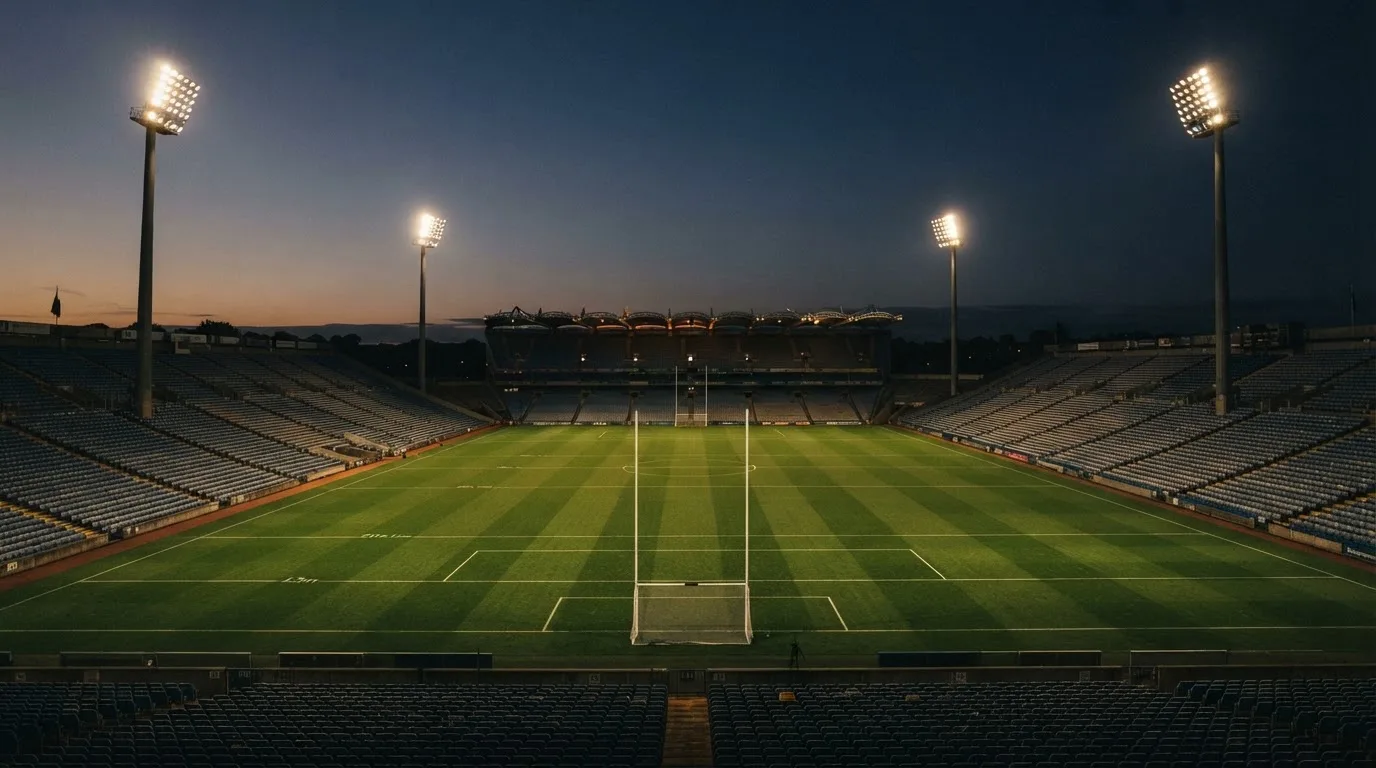
Gaelic football is governed by the Gaelic Athletic Association, the GAA, and the showpiece is the All-Ireland Senior Football Championship, with the final each year at Croke Park in Dublin. The 2026 final on 26 July 2026 at Croke Park saw Mayo beat Kerry 1-20 to 1-17 for their fourth title. Kerry hold the record for most All-Ireland Senior Football Championship titles, with 39.
The senior inter-county championship is the main calendar. Provincial championships feed into the All-Ireland series: the Leinster, Munster, Connacht and Ulster championships sit on top of the qualifier system, with the Sam Maguire Cup at the end. Senior inter-county matches last 70 minutes, two halves of 35 minutes; most other adult matches last 60 minutes, two halves of 30. The 2025 rule changes revalued shots from outside the 40-metre arc to two points, and the effect on in-running prices has been visible since — a long-range point is now worth double what it was, and a goal from distance carries an even larger swing than before.
Below the senior inter-county championship sits a deep club pyramid. County championships feed into provincial club championships and the All-Ireland Club Championship, with the same scoring frame and the same 40-metre arc. The fixtures are less well covered in the British market, and the punter who goes beyond the senior inter-county fixtures is into thinner markets and wider margins. A senior club final may have a half-dozen books; a junior club final may have one.
Gaelic hurling sits alongside Gaelic football on the same fields and the same governing body, with the same fixture calendar and the same scoring frame adapted to a different game. The market treats the two sports as one cluster in British books — Gaelic games, Gaelic sports — and the punter with a position on one tends to find prices on the other on the same app, often with the same offers attached.
The pitch is a rectangular grass surface 130–145 metres long and 80–90 metres wide. That shape matters for in-running markets — a long pitch carries long balls, the ball goes out for a sideline more often than in soccer, and the clock does not stop for minor infringements, so the in-running price on a corner or a sideline kick is set against a flowing clock that does not pause for the punter to read the screen. The punter backing in-running on Gaelic football is paying in margin for the privilege; the punter watching the clock is paying for information the operator has already discounted.
How The Ten Licensed Bookmakers Compare
The licensed set on this page is ten brands, each holding a Gambling Commission remote licence and each offering Gaelic football markets alongside other sports. The table is the spine of the comparison, and the write-ups that follow show where each brand fits the punter’s account.
| Brand | Gambling Commission remote licence | What the operator’s terms state on Gaelic football |
|---|---|---|
| Matchbook | 039453-R-319407-024 — Triplebet Limited | Exchange pricing, bet builder and multiples; commission on net winnings rather than margin in the price |
| 888sport | 039028-R-319297-014 — 888 UK Limited | Pre-match and in-play betting, Cash Out, Bet Builder, racing streams, daily boosted odds |
| Betfair | 039439-R-319330-013 — PPB Counterparty Services Limited | In-app and fixed-odds book with in-play, Bet Builder, free live streaming, 90 Minute Payout |
| Sporting Index | 027343-R-308898-011 — Sporting Index Limited | Switches between fixed odds and spread betting with auto cash-out and Multi-Markets |
| NetBet | 039170-R-319343-032 — Netbet Enterprises Limited | Daily Boosts, Profit Boosts, free bet offers, dynamic-odds Bet Builder |
| Coral | 054743-R-330863-014 — LC International Limited | Sports welcome: £20 at min odds 2.0 returns £40 in free bets within 7 days, expiring 7 days after issue |
| Betmaster | 065699-R-339929-002 — BM Solutions GB Ltd | Football, cricket, horse racing, NFL, eSports (League of Legends, Dota 2) |
| Tote | 054779-R-331321-008 — TDCO Limited | William Hill’s Best Odds Guaranteed on UK and Irish racing from 8 AM on race day |
| Kalooki Sportsbook | 057730-R-333396-005 — Kalooki Sportsbook Limited | GAMSTOP member; identity-verified from the first deposit |
| BetMGM | 039198-R-319450-029 — LeoVegas Gaming PLC | Welcome: four £10 free bets on football accas and sports multiples after a £10 deposit and qualifying bet within 7 days |
The shape that runs through the table is that licence number, licence holder and operator’s headline feature are all on the register, and the column the punter should read first is the third — the one that says what the brand does with Gaelic football, not the one that says it is licensed. A brand can be licensed and still not price Gaelic football, and the table is honest about that by listing only what each operator’s own terms publish.
Matchbook
Matchbook runs as a betting exchange — the punter backs and lays against other users rather than against the book — and the licence sits under Triplebet Limited at Commission account 39504. The price on Gaelic football is set by what other users will back and lay, with a commission on net winnings taken by the platform rather than a margin in the price. The shape suits a punter who has a position he wants to lock in partway through a match: a lay bet on the favourite at half-time is a clean stop, and the exchange handles it without the spread a bookmaker’s cash-out button would charge.
The punter who wants a sportsbook-style experience — boosted odds, a Bet Builder pre-loaded, an acca-insurance product — does not find it here. Matchbook’s product is the exchange book and a Bet Builder that runs alongside it, with a commission rather than a margin as the cost. For the punter running a serious bankroll on Gaelic football, the exchange is the right venue; for the punter running small stakes on a Saturday accumulator, the bookmaker side of the market is closer to his shape.
888sport
888sport’s licence sits with 888 UK Limited at Commission account 39028, with remote general betting standard (real events) covering Gaelic football. The platform publishes pre-match and in-play betting, Cash Out, Bet Builder, racing streams, BetFinder form tools, a live bet feed and daily boosted odds, and the shape is a full sportsbook rather than an exchange.
The punter who picks 888sport for Gaelic football picks it for the live bet feed and the daily boosted odds rather than for any specific feature on GAA fixtures. The boosted odds run across football codes including Gaelic, the in-play book is on the same screen as the racing streams, and the Bet Builder is available on football-style markets. The cost is the margin in the price, and the punter paying it gets the convenience of a single app across codes.
Betfair
Betfair’s licence sits with PPB Counterparty Services Limited at Commission account 39439, with both a remote general betting standard licence and a betting intermediary licence covering the exchange book. The platform runs both sides — a fixed-odds bookmaker and an exchange — and the punter on Gaelic football can pick either, with the exchange commission usually tighter than the bookmaker margin on the same selection.
The fixed-odds book runs in-play, a Bet Builder, free live streaming of UK and Irish horse racing and football within the app, and a 90 Minute Payout market that pays on the result at full time regardless of cup ties. The 90 Minute Payout offer does not transfer cleanly to Gaelic football, but the price-boost feed and the in-play book do. The punter who wants both sides of the market on the same app finds it at Betfair, and the punter who wants the tighter of the two on a given bet finds it on the exchange.
Sporting Index
Sporting Index’s licence sits with Sporting Index Limited at Commission account 27343, and the platform runs both fixed odds and spread betting under the same roof. The punter can switch between the two on the same screen, with an auto cash-out, a Bet Builder for football and a Multi-Markets view that aggregates related prices. Spread betting losses can exceed deposits, and the spread side of the book sits on a different risk profile from the fixed-odds side.
For Gaelic football, the fixed-odds book is the relevant product, with the spread book sitting alongside it for the punter who wants a position on a total-points line or a Supremacy market. The punter who understands both products picks Sporting Index for the choice; the punter who only wants fixed odds picks one of the other nine.
NetBet
NetBet’s licence sits with Netbet Enterprises Limited at Commission account 39170, and the platform publishes Daily Boosts, Profit Boosts, free bet offers and a Bet Builder whose odds update dynamically as the punter adds legs. The dynamic-odds feature is the one that matters on Gaelic football: a Bet Builder on a Gaelic football fixture prices leg-by-leg as the punter builds it, and the headline price is the price the punter takes when he confirms.
The welcome and ongoing offers sit on top of the sportsbook, with a sports-stats layer for major leagues and a thin in-running book on Gaelic football. The punter who likes Bet Builder structures on football codes finds it at NetBet, and the punter who only wants a match-winner market finds the same product elsewhere at a similar price.
Coral
Coral’s licence sits with LC International Limited at Commission account 54743, with both a remote general betting standard licence and a betting intermediary licence covering any exchange-side activity. The headline offer for new GB customers who opt in is a £20 sports bet at minimum odds of 2.0 returning £40 in free bets within 7 days, with the free bets expiring 7 days after issue. The stake of the free bet is not paid back with a win.
The cost on the headline offer is the qualifying bet at evens or better — a 50% probability of winning a £20 bet that returns £40 in free bets, with the free bets themselves priced at the punter’s choice of market. The punter who would have placed the qualifying bet anyway collects the offer at near-zero cost; the punter who backs a long shot just to qualify pays for it in expected value. The £40 in free bets is worth, on a fair two-way market with a 95% payout share, around £19 in expected value across many such bets — closer to £10 than to £40 on the punter’s actual use of the credit.
Betmaster
Betmaster’s licence sits with BM Solutions GB Ltd at Commission account 65699, and the platform publishes football, cricket, horse racing, NFL and eSports betting, with League of Legends and Dota 2 on the eSports side. Gaelic football sits on the football side, and the in-play book runs alongside the pre-match markets.
The punter who picks Betmaster for Gaelic football picks it for the breadth of the sportsbook — a single app covering codes from Gaelic football to League of Legends — and pays the cost in liquidity. A niche market like Gaelic football sits thinner on Betmaster than on a sportsbook dedicated to football codes, and the punter chasing the tightest price on a GAA fixture usually finds it elsewhere.
Tote
Tote’s licence sits with TDCO Limited at Commission account 54779, with remote general betting standard (real events) covering Gaelic football. The platform is closely related to William Hill’s offering, with the Best Odds Guaranteed promotion applying to UK and Irish horse racing from 8 AM on race day on single and multiple bets, and not applying to ante-post, tote or pari-mutuel bets. The Best Odds Guaranteed promotion is a horse-racing product; the punter backing Gaelic football does not collect it on his GAA bets.
The punter who picks Tote for Gaelic football picks it for the pool-betting heritage rather than for any specific GAA feature, and the pricing on Gaelic football matches the British sportsbook average rather than sitting tighter or wider. The punter looking for the tightest in-running price on a GAA fixture usually finds it on a sportsbook with deeper GAA liquidity.
Kalooki Sportsbook
Kalooki Sportsbook’s licence sits with Kalooki Sportsbook Limited at Commission account 57730, and the platform publishes itself as operated by Kalooki Sports Book Ltd (company number 12938274), licensed by the Gambling Commission and a GAMSTOP member. The identity check runs from the first deposit, and the punter who prefers a smaller operator with a clear safer-gambling presence finds it here.
The GAA product sits thinner than on the major sportsbooks, and the punter with a serious bankroll on Gaelic football finds tighter pricing elsewhere. The trade-off is the operator’s relationship with safer gambling — the GAMSTOP membership, the explicit identity check — and the punter who values that relationship picks Kalooki on those grounds.
BetMGM
BetMGM’s licence sits with LeoVegas Gaming PLC at Commission account 39198, with remote general betting standard (real events) covering Gaelic football. The headline offer for new UK customers who deposit £10 or more and place a sports bet within 7 days is four £10 free bets — two football accumulators of four selections or more, two sports multiples of two selections or more — with minimum odds and an opt-in on each leg, and the free bets expiring 7 days after issue.
The structure rewards accumulator play, and the punter who would have bet singles anyway pays the cost in higher margin and reduced control. The £40 in free bets is worth, on the punter’s actual use of the credit, somewhere between £15 and £25 depending on the prices taken, with the stake not paid back with a win. The punter who picks BetMGM picks it for the LeoVegas platform and the MGM branding rather than for any specific GAA feature.
The Picture Behind The Numbers
Three operators in this comparison set prices differently. Matchbook is an exchange, with the punter paying on a win rather than on every bet. Betfair runs both an exchange and a bookmaker, and the punter can pick either on the same fixture. Sporting Index runs spread betting alongside fixed odds, and the spread side sits on a different risk profile.
The rest of the field — 888sport, NetBet, Coral, Betmaster, Tote, Kalooki and BetMGM — run as bookmakers, with the margin in the price and the operator’s take on every bet. The punter paying the bookmaker margin gets the convenience of a single app across codes, the boosted-odds feed, the Bet Builder, the welcome offer and the same payment rails as every other licensed site.
The cost difference between the two shapes is the cost difference between paying a margin and paying a commission. A 5% bookmaker margin on a £100 stake is £5 of expected cost across many bets; a 2% exchange commission on a £100 win is £2 on the bets that win and £0 on the bets that lose. The punter who places 100 bets at an average 5% margin pays £500 of expected cost; the punter who places 100 bets at an average 50% strike rate and a 2% exchange commission pays £100 of expected cost on the wins. The bookmaker makes more sense for the casual punter; the exchange makes more sense for the serious bankroll.
The safer-gambling shape is identical across all ten. Every operator is a GAMSTOP member, every operator runs identity verification from the first deposit, every operator sits under the Commission’s LCCP and Remote Technical Standards. The punter comparing the ten on safer-gambling grounds finds no material difference between them and the punter comparing the ten on price or product finds the difference the rest of this page describes.
Overview Of Online Gaelic Football Betting In 2026
Gaelic football sits on a licensed British market that has narrowed around it rather than opened. The bookmakers pricing GAA fixtures are the same ones pricing Premier League and Champions League fixtures, with a sportsbook product that adds Gaelic games to the same app rather than a dedicated GAA product. The exchange market is thinner, with Matchbook and Betfair’s exchange side carrying the bulk of the liquidity outside Ireland.
The fixture calendar concentrates the action. Summer weekends are when the All-Ireland series sits at its busiest, with provincial finals, All-Ireland semi-finals and the All-Ireland final clustered from June to August. The 2026 final at Croke Park on 26 July 2026 saw Mayo beat Kerry 1-20 to 1-17 for their fourth title. The punter with a long-term position on GAA markets pays for the privilege in a calendar that gives him little to bet on for half the year.
The margin on Gaelic football is wider than on mainstream football. Liquidity is thinner, in-running books are smaller, and the bookmaker’s take on every pound staked runs a couple of percentage points higher than on a Premier League match winner. The punter who backs at the headline price pays the cost in margin, and the punter who backs in-running pays it twice — once in the wider margin, once in the spread on the cash-out button.
The offers on Gaelic football mirror the offers on every other sport. A £20 qualifying bet at minimum odds of 2.0 returning £40 in free bets at Coral; four £10 free bets on football accas and sports multiples at BetMGM; Daily Boosts, Profit Boosts and free bet offers at NetBet; daily boosted odds at 888sport; the price-boost feed at Betfair. The shape is the same, the cost is the same, the wagering cap of 10x applies to all of them, and the mixed-product ban applies to all of them. The punter who reads the welcome offer carefully knows what he is buying.
The rule changes in 2025 revalued shots from outside the 40-metre arc to two points. The market adjusts — the long-range point carries a higher price in any player-points market, the goal from distance carries a higher swing in any in-running market — and the punter running a position from before the change pays for not reading the new rule book.
The punter reading this page is the punter who has decided that Gaelic football is worth betting on, that the British licensed market is the right venue, and that the cost is worth the protection. The next decision is which operator, and that decision runs on price, on product, on offer, and on the punter’s own bankroll. The page has laid out each on its own terms; the choice sits with the punter.
Frequently Asked Questions
How do you bet on Gaelic football?
Pick a licensed bookmaker from the Commission’s register, open an account, verify name, address and date of birth, deposit by debit card or bank transfer, and place a bet on a senior inter-county fixture. The markets sit on a match winner, handicap, total points and a small set of player markets. A goal pays three points, a point pays one, and a shot from outside the 40-metre arc pays two points since the 2025 rule changes.
How is it checked that a bookmaker holds a Gambling Commission licence?
Look the matchbook on the Commission’s public register, by business name, trading name, domain or account number. Note the access date, the licence categories on the licence, and the account number on the licence. A licence that does not list remote general betting standard (real events) does not cover Gaelic football. The register is the only proof, and a licence confirmed six months ago may have changed since.
How is the return on a bet worked out from the stake and the odds?
The return is stake × odds. At decimal odds 4.00 on a £10 stake, the return is £40, with a £30 profit and the £10 stake returned. At fractional odds 5/1 on the same £10 stake, the return is £60, with a £50 profit and the £10 stake returned. For a combination bet the odds of the legs multiply into one price, and the return is stake × the combined odds.
What is the bookmaker’s margin and how can it be seen in the odds?
The margin is the share of every pound staked that the bookmaker keeps. For a two-way market priced at decimal odds 1.90 and 1.90, the payout share is 1 ÷ (1 ÷ 1.90 + 1 ÷ 1.90) = 95%, and the margin is 5%. The punter reading 1.90 on both sides of a market is paying 5% on every bet, on average, and the spread on either side of 2.00 describes the bookmaker’s take on that market.
How do fractional odds such as 5/1 convert to decimal odds such as 6.00?
The conversion is decimal = a ÷ b + 1. A 5/1 fractional price becomes 5 ÷ 1 + 1 = 6.00; an 11/4 becomes 11 ÷ 4 + 1 = 3.75; an evens (1/1) becomes 2.00. The conversion is the same for every price, and the punter reading fractional odds and the platform printing decimal odds run the same arithmetic on every bet.
Which tools for controlling play does a licensed bookmaker have to offer?
GAMSTOP self-exclusion for six months to five years with auto-renewal, deposit limits set by the punter, timeouts, reality checks, identity verification before the first deposit, and a financial vulnerability check at £150 of net deposits in a rolling 30 days. Help sits outside the operator: GamCare, the National Gambling Helpline, GambleAware, the NHS gambling clinics, and Gamblers Anonymous. The mix is the licence condition rather than the operator’s choice.
Rugby, cricket & Gaelic – Footy Tips
Content created by the «Footy Tips» team
