
Golf betting odds — the cost inside the price
 Available in US
A golf betting odds page is not a fixtures list. The fixtures change every Thursday morning from January through to the Ryder Cup in autumn. What does not change is the mechanism: a price carries a margin, a stake carries a risk, and a market carries a structure the punter pays for whether or not a ball drops. This page is built around that. It maps where golf can be bet on legally in Great Britain, how the Gambling Commission frames that market, what a “boosted” or “best odds” headline actually pays back, and which of ten licensed bookmakers earn their place on a shortlist when the arithmetic is done. The ten are not interchangeable — Betfred, Sporting Index, VBet, Bar One Racing, BetVictor, Betfair, 888sport, Betway, Bet Ahoy and Swifty Sports. Some are spread-book specialists, some are accumulator houses, some lean hard into horse racing and only carry golf because the season requires it. The angle through every section is the same: what does this cost the reader, and where does the price stop mattering once another sits beside it.

Data current as of 27 October 2026, checked against the Gambling Commission’s public register for each operator listed.
How Great Britain regulates a golf bet
Golf in Great Britain is not on a permitted-sports list. There is no such list. A bookmaker taking remote bets from customers in Great Britain needs a Gambling Commission licence for the category “remote general betting standard (real events)” or an equivalent peer category, and that licence is what the Commission’s public register records. The 2005 Gambling Act (as amended by the 2014 Act) pushed the test to the point of consumption, so a Curaçao or Malta registration on its own does no work for GB customers; the operator must hold a Commission licence wherever it sits.
The ten bookmakers reviewed below all appear on that register, each tied to a Commission account number and a licence holder. Betfred runs through Petfre (Gibraltar) Limited, Sporting Index through Sporting Index Limited, VBet through SCGO Limited, Bar One Racing through Bar-One Racing Limited, BetVictor through BV Gaming Limited, Betfair through PPB Counterparty Services Limited, 888sport through 888 UK Limited, Betway through Betway Limited, Bet Ahoy through Bet Ahoy Ltd, and Swifty Sports through Swifty Global (UK) Ltd. Several UK-facing brands run under one licensee — Paddy Power and Betfair share PPB Counterparty Services, Ladbrokes and Coral share another — so reading “two licensed operators” off a register without that wrinkle double-counts parent companies rather than distinct gambling businesses.
Spread betting splits the picture in two. Where the bet is a financial contract on a price index, the regulator is the Financial Conduct Authority, not the Commission; Spreadex is the standing example, regulated by the FCA for spread bets and the Commission for fixed-odds. The Commission’s own register, not the FCA’s, is what counts for the standard golf book. Where a spread book offers a sports spread, the margin and the maximum loss differ from a normal each-way and the loss on a single position can exceed the original deposit.
There is no state-set cap on stakes. Operators set their own maximum stakes, and a bookmaker may restrict a customer it judges to be acting outside its risk appetite. There is no statutory ceiling on a single payout. What the Commission does enforce is a set of licence conditions and codes of practice — the LCCP — that govern identity checks, marketing, and how the operator behaves when a customer’s spend pattern changes.
Identity is the first cost that lands on the punter, not the last. Since May 2019 licensed operators verify name, address and date of birth before the first deposit or stake — including where the first action is a free bet or a bonus claim. There is no anonymous play at a GB-licensed site. That single fact rules out the entire “bet with bitcoin, no KYC” framing that offshore sites still trade on: the regulatory bargain in Great Britain is verification up front, with consumer protection downstream.
What a GB licence buys the punter — and what it does not
A licence is not a quality mark. It is the floor. The Commission lays down a set of conditions every licensee must meet, and the punter receives them as a bundle of protections the offshore alternative cannot match.

GAMSTOP is the headline. Since 31 March 2020 it has been a mandatory licence condition for online operators, and every GB-licensed remote bookmaker — all ten reviewed here — is a member. Self-exclusion periods are six months, one year, five years, or five years with auto-renewal; after the minimum term the exclusion continues for a further seven years unless the customer asks GAMSTOP to remove it. The scheme covers online sites and apps. The high-street betting shop uses a separate multi-operator self-exclusion service, which is why GAMSTOP alone does not catch a punt that slips into a shop.
A financial vulnerability check sits on top of GAMSTOP for higher spend. Under LCCP condition 3.4.4, in force since 30 August 2024, a licensed remote operator must run a public-record check once a customer’s deposits minus withdrawals exceed £150 in any rolling 30-day window — the threshold was set on 28 February 2025. The check looks at court records, bankruptcies, county court judgments and the like; it is not an income check and not a credit reference check. The further “affordability” or financial risk assessments the Commission announced in July 2026 are part of a staged plan with no published start date — “announced, staged, no start date” is the only honest framing.
Deposit limits are an RTS-12 control on the operator, not a cap the punter receives by default. The first phase of changes has applied since 31 October 2025; a second phase was postponed to 30 September 2026, and whether it is live now is not settled from the public record. There is no state-set ceiling on deposits or losses for sports betting — what a punter caps themselves at is their own choice through the operator’s safer-gambling tools.
Marketing is not licensed by the Commission; the ASA polices it under the CAP Code for non-broadcast and the BCAP Code for broadcast, alongside the LCCP marketing conditions. From 19 January 2026, wagering requirements on bonuses are capped at 10x the bonus, and mixed-product promotions that require gambling across two or more product types (betting plus casino, betting plus bingo, and so on) are banned. Whether the 10x cap applies to free bets with no wagering condition, and whether there is a cap on the money value of a bonus itself, are not established from the public record.
The player pays no tax on betting winnings in Great Britain. General Betting Duty is the operator’s tax on gross profits at 15% — from 1 April 2027 a 25% remote betting rate sits alongside the 15% rate, while remote bets on British horse racing, self-service betting terminals in licensed premises, pool betting and in-person betting stay at 15%. Until that date the remote rate holds at 15%. Spread betting carries its own rates: 3% financial, 10% other. Tax is the operator’s problem; the punter does not see it on a winning slip.
Where the safety net has holes
The single most important thing to know about an offshore golf book is what the customer loses by sitting outside GB regulation. There is no GAMSTOP coverage — a self-excluded punter who drifts to an offshore site will not be stopped. There is no Commission complaints route and no approved alternative dispute resolution, no British consumer-protection law to fall back on if the operator withholds funds. The 10x bonus cap, the £150 vulnerability check and the verification-before-deposit regime do not apply. Enforcement is not blocking. The Commission issues cease-and-desist notices, works with search engines and payment providers, and has been given or is about to be given court-order DNS blocking powers; ISP-level blocking is not in operation. “Legal to use” is not the right framing for an unlicensed site aimed at British customers — “permitted to advertise and operate in Great Britain without a Commission licence” is the offence under section 33 of the Gambling Act 2005, aimed at the operator, not the punter. The punter’s cost is the absence of every protection above, and the risk that funds held by an unlicensed operator are not recoverable through any British route.
Credit cards, crypto, and the payment picture in Great Britain
Credit cards are banned for gambling in Great Britain, in force since 14 April 2020 under LCCP condition 6.1.2. The ban covers credit-card-funded payments through an e-wallet — a punter cannot load a digital wallet with a credit card and then push those funds into a bookmaker, because the second hop is still caught. Debit cards and bank-based payments sit outside the ban.
Cryptocurrency is a different question. There is no statutory ban on crypto deposits in the Commission’s published framework, and no Commission-issued list of permitted payment methods to check one against; what governs it is each operator’s own terms plus the standard anti-money-laundering and source-of-funds controls. A crypto deposit, if the operator accepts one, still runs through identity verification before the first stake — the same KYC regime that catches every other payment type. There is no route to anonymous play at a licensed bookmaker through crypto, and no licensed bookmaker among the ten reviewed here advertises crypto acceptance. Where a punter sees a “bitcoin golf betting” framing in marketing, it points to offshore operators outside the Commission’s reach, with the consequences set out above.
The British named-account rule is the operative constraint: withdrawals go back to a method in the punter’s name, and the operator must satisfy itself about source of funds at higher spend. That single rule is what makes the offshore “anonymous play” pitch a paper one in practice, even where the marketing does not mention it.
Safer gambling tools the punter actually uses
GAMSTOP is one tool. It is the bluntest, and once it is on it is hard to come off. Day-to-day safer gambling on a single account runs through the operator’s product: deposit limits, timeouts, reality checks, session reminders, and the ability to self-exclude from one brand for a fixed period without involving GAMSTOP at all.
GamCare runs the National Gambling Helpline. GambleAware funds treatment and education. NHS gambling clinics offer specialist face-to-face care in several regions. Gamblers Anonymous runs peer-support groups. The licensed operators reviewed here link to these services from their safer-gambling pages; Fitzwilliam Sports is a standing example, exposing GambleAware, GAMSTOP and Gamblers Anonymous directly from its homepage. A licensed bookmaker is required to make those links visible and to act on the safer-gambling signals it sees — a customer whose deposits have triggered the £150 vulnerability check should expect a conversation, not silence.
The punter’s checklist before opening an account, in the order that matters: confirm the operator is on the Commission’s public register; check that GAMSTOP membership is in place; look for the deposit-limit tool and the timeout tool; understand the verification the operator will run before the first deposit; know how to raise a dispute through the operator’s complaints route and, if that fails, the approved ADR body. None of those steps is onerous. Together they describe what a GB licence actually buys.
Bonuses and free bets — where the marketing meets the maths
The marketing word on a free bet is “free”. The arithmetic on a free bet is the odds minus one, divided by the odds, multiplied by the market’s payout share. For a £10 free bet at decimal odds of 4.00 on a market that returns 95 pence in the pound, the expected value is £10 × (4.00 − 1) ÷ 4.00 × 0.95 = £7.13, before the cost of the qualification. That is the average value across many such bets; no single bet pays that exact figure, and the free-bet stake itself is usually not returned with a win — a £10 free bet at 4.00 returns £30 in profit, not £40. Where a free bet does return the stake, the value calculation shifts.
The 10x wagering cap that took effect on 19 January 2026 applies to bonuses with a wagering requirement: a £10 bonus at 50x turnover would have required £500 of qualifying bets before withdrawal; under the cap, no more than £100 of qualifying bets is required. Free bets with no rollover are a separate case, and the public record does not settle whether the cap reaches them. Mixed-product offers — “bet on football to get free spins” — are banned outright.
The offers reviewed on this page sit in three clusters. The first is a sign-up offer: VBet gives a £10 free bet if a verified new customer stakes £10 or more on a first bet that loses; Bet Ahoy gives a “Bet £10, Get £10 in Free Bets” split into a £5 sports token and a £5 acca token. The second is a recurring free-bet club: Betway runs a Free Bet Club where £25 of sports spend in a week earns 2 × £5 free bets, up to £10 weekly. The third is odds-enhancement mechanics: Best Odds Guaranteed on horse racing at BetVictor and Swifty Sports, daily price boosts at 888sport, Bet Builder+ at Betfair and 888sport, acca insurance at the accumulator houses. The 10x cap does not change what those mechanics are; it changes what the customer has to do before withdrawing any associated bonus funds. Where the bookmaker’s terms state a higher rollover than 10x, that is the older offer set, and the operator has had to retire it or re-cut it.
The cost the punter pays is not the headline bonus. It is the multiplier on qualifying bets at a minimum price the operator sets. A 5x rollover on a £20 bonus at minimum odds of 1.50 (3/2) means £100 of bets at 1.50 or higher before withdrawal, and the £100 carries whatever margin the golf market runs at — typically 5% to 8% on outright winner markets and wider on each-way and prop markets. The bonus pays its headline value only after that £100 of betting is done; the expected cost of doing it is the £100 multiplied by the market margin, plus the time.
Mobile apps and the golf betting experience
The ten reviewed bookmakers all run mobile apps, and the experience is largely converged: pre-match odds, in-play odds, a bet slip, cash-out, deposits and withdrawals, safer-gambling tools, and a link to live streaming where the operator has rights. Where they diverge is in the depth of the golf product and in the price-enhancement mechanics layered on top.
Betfred’s app is published by Done Brothers (Cash Betting) Ltd and covers 21 sports with over 2,000 casino-style games on the side; golf sits inside the 21, with outright, each-way and tournament match-ups the standard shelf. Sporting Index’s app carries both fixed-odds and spread betting, with in-play betting, Bet Builder for football, auto cash-out and Multi-Markets — the spread book difference matters because a sports spread is a separate product with its own margin and a maximum loss that can exceed the deposit. Betfair’s app carries in-play, Bet Builder, free live streaming for UK and Irish racing and football, and the 90 Minute Payout market for football — the golf product is the Sportsbook arm rather than the Exchange, but the app surfaces both. 888sport’s app carries pre-match and in-play, Cash Out, Bet Builder, racing streams, BetFinder form tools, a live bet feed and daily boosted odds. BetVictor’s app carries Best Odds Guaranteed on UK and Irish racing, enhanced live race streaming, a BetFinder feature and Smart Stats. Swifty Sports’ app carries Best Odds Guaranteed, Cash Out, daily price boosts, live streaming and in-play betting, with Bet Builder listed as coming soon.
Live streaming of golf is rarer than live streaming of football. The four majors and a handful of PGA Tour events carry broadcast rights in jurisdictions where free-to-air or subscription coverage sits with established partners; GB bookmakers typically stream selected secondary tours and European Tour events where rights allow, and rely on broadcast rights holders for the marquee weeks. A punter comparing apps should check the streaming tab on a quiet week — if golf coverage is greyed out, the punter is reading the wrong operator for that week.
bet365 is the most downloaded sports betting app in the UK and an official global betting partner of the UEFA Champions League; its golf product carries Bet Builder+ (combining markets from one event pre-match and in-play), Super Boosts, Winnings Boosts on Bet Builders and selected singles, and daily Bet Boosts. The point of naming it here is the benchmark, not a recommendation — the Commission register lists many more brands than any one review can carry, and a punter’s best app is the one that carries the markets they actually use.
Live betting and cash-out on a moving golf market
Golf is a four-day sport with a moving leaderboard. Live betting on golf is built around three windows: round-one position after the morning draw, halfway cut position, and final-round charge on Sunday afternoon. In-play betting is offered by all ten reviewed operators and is fully legal under a GB licence; what governs the controls is the operator’s licence conditions and customer-protection duties, not a separate statutory rule.
Cash-out on golf is the operator’s offer to settle a position before the tournament finishes, at a price the book sets live. The price moves with the player’s position and the operator’s view of remaining risk. Auto cash-out — the punter sets a threshold, the system closes the position when it is reached — sits at the more sophisticated end and is available at Sporting Index and on Betfair’s app among the ten reviewed. The cost of cash-out is the gap between the live cash-out price and the true price of the position; that gap is wider at volatile moments and tighter in steady scoring conditions. A punter who cashes out on a Saturday evening leader after a third-round 67 has paid for the certainty, and the price reflects it.
In-play on golf tends to settle quickly when a player holes out for eagle or worse, and slowly on pars the wire; the market depth is shallow relative to football or tennis, and on a small field the price can move several ticks on a single hole. The punter’s edge in live golf is information — current form, pin positions, weather, the player’s comfort on the hole type — more than it is timing the cash-out button.
Tips, predictions and the “system that wins”
There is no system that wins at golf betting. A tournament is a four-day event with a moving leaderboard, weather, course set-up and a field of 156 players; any system that promised a win-rate above the market’s long-run margin is selling a system, not a method. Tips, predictions and “this week’s pick” content is editorial; the value of a tip is the punter’s confidence in the tipster, not the tip itself.
What a punter can do is pay for information that the market has not yet priced in. A withdrawal the morning of the tournament, a pinsheet read against the player’s historical performance on that hole type, a forecast of wind that flips a coastal course from scorable to brutal — those are inputs the market adjusts to over the day, and an early read can carry a half-tick of edge. That edge is small, it is competed away by professionals, and it does not survive contact with a bookmaker’s margin.
Bankroll management is the discipline a system can carry. Staking a fixed unit — 1% to 2% of bank on an outright, 0.5% on a match-up — keeps a bad week from ending a season. The punter’s job is to survive long enough for the edge, however small, to compound. The bookmaker’s margin is the tax on every bet; a punter who prices their own book against the market at 5% to 8% on outrights and wider on props knows what they are paying for the privilege of being in the market.
What a golf bet actually is
A golf betting market is one of three structures, sometimes combined. Outright winner is the simplest: the punter backs one of the field to win the tournament; the field is typically 156 players at a major, fewer at regular PGA Tour and DP World Tour events. Each-way is the most common punt on golf: two equal-stake bets, one on the win and one on the place; the place terms vary by tournament and operator, with majors typically paying 1/4 odds for the first four places, regular PGA events 1/5 for the first five to eight, and smaller events running shorter. Match-ups and group bets pair one player against another for a round or for the tournament, settle on aggregate strokes, and are popular where outright odds are long. Props and specials cover leading position at end of round, top-10 finish, nationality markets, and the made-cut market.
Decimal odds show the total return per unit stake — odds of 4.00 mean £4 back for every £1 staked, including the £1 stake. Fractional odds show the profit per unit stake — 3/1 means £3 profit for every £1 staked, returning £4 in total. Conversion is fractional plus one: 3/1 → 4.00, 11/4 → 3.75, evens (1/1) → 2.00. A price shorter than evens is “odds-on”. GB bookmakers quote in fractional by default and offer decimal in the settings.
A combination bet — a double, treble, accumulator or “acca” — multiplies the odds of the legs into one price. An acca with three legs at 3.00, 4.00 and 5.00 has combined odds of 60.00; the stake is at risk on all three. The acca insurance some operators offer refunds the stake as a free bet if one leg loses, but the stake on the free bet is not returned with a win; the effective value is the free bet’s expected value at the offered odds.
Rule 4 is a bookmaker’s rule for deductions when a runner withdraws after the market is formed but before the start. The deduction scales with the withdrawn runner’s odds: a non-runner at 2.00 or shorter triggers a deduction of 70p in the £ from winning stakes; the deduction falls to 45p for a non-runner in the 2.01 to 2.50 band, and lower again further out. Rule 4 does not apply to outright golf markets in the same form it applies to horse racing — golf bookmakers apply their own equivalent, typically expressed as a reduction on each-way terms or a re-priced outright board. A punter should read the golf Rule 4 equivalent in the bookmaker’s terms before staking.
Ball coupons are a betting-shop staple and an online carry-over: a list of 2-ball or 3-ball matches for the day, each settled on the lowest score in the group. The odds are short — typically 2/5 to 5/4 — and the margin is wider than outright markets because the punter backs one player in a three-ball with limited differentiation. The structure is the same as a match-up; the name is the British bookmaker’s term for the printed list.
The shape of a golf tournament and what the market knows
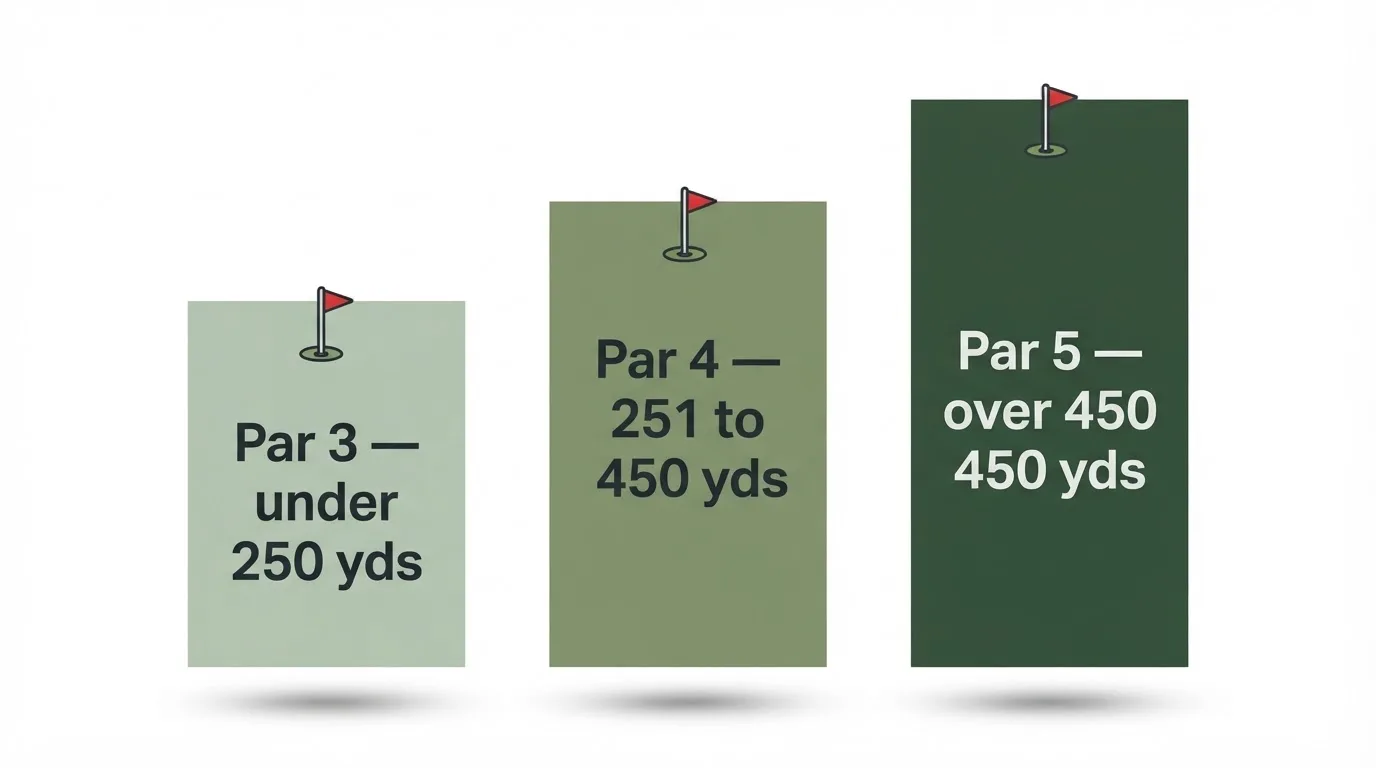
A regular course has 18 holes. The par structure runs par 3 holes under 250 yards for men, par 4 holes from 251 to 450 yards, and par 5 holes over 450 yards, with an 18-hole course typically totalling par 70 to 72. A player may carry a maximum of 14 clubs in a stipulated round. Stroke play is the most common format at elite level — the lowest total strokes wins; match play, where the player or side winning the most holes wins, runs the Ryder Cup, the WGC-Match Play and a handful of invitation events.
The four men’s majors are the Masters, played in April at Augusta National Golf Club in Georgia; the PGA Championship; the US Open; and The Open Championship, played on a rota of links courses in the United Kingdom. Jack Nicklaus holds the men’s record of 18 major championships, a benchmark no player has approached in the modern era. The 2026 Open Championship was played from 16 to 19 July 2026 at Royal Birkdale, Southport; Ryan Fox of New Zealand won with 270 (−10), one stroke ahead of Cameron Young. The market on Royal Birkdale going into the week priced Fox in the 80/1 to 100/1 band; the winner’s share of the prize fund moved with the leaderboard through the four days.
The market’s job is to price 156 players before a ball is struck. The punter’s job is to find a price the market has mispriced, or to accept the market’s price and pay the margin for the privilege of being in it. Where a price looks long, the reason is usually visible — a recent missed cut, a course the player has not played well on, an injury the market has priced in. Where the price looks short, the reason is usually visible too. The mispricing is the small one, not the large one, and it is competed away fast.
Ten licensed bookmakers, head to head
| Brand | Gambling Commission account | What the operator’s own terms state on golf |
|---|---|---|
| Betfred | 39544 | 21 sports on the app, golf among them with outright, each-way and tournament match-ups; Best Odds Guaranteed on UK and Irish horse racing. |
| Sporting Index | 27343 | Fixed odds and spread betting in one app; in-play, Bet Builder for football, auto cash-out and Multi-Markets; spread bets carry their own margin and can lose more than the deposit. |
| VBet | 44662 | £10 free bet on a first bet that loses for a verified new customer; sports welcome offer; golf sits inside the standard sportsbook. |
| Bar One Racing | 56516 | Irish independent bookmaker rebrand to BAR 1 Betting; sponsorships at Dundalk, Fairyhouse, Navan, The Curragh, Curraheen Park and Cork; horse racing focus with golf alongside. |
| BetVictor | 39576 | Best Odds Guaranteed on UK and Irish racing; BetFinder for racing bets; Smart Stats; live race streaming; golf book sits beside racing. |
| Betfair | 39439 | In-play, Bet Builder, free live streaming for UK and Irish racing and football, 90 Minute Payout for football; Betfair Sportsbook carries golf; the Exchange carries separate markets and liquidity. |
| 888sport | 39028 | Pre-match and in-play, Cash Out, Bet Builder, racing streams, BetFinder form tools, a live bet feed and daily boosted odds. |
| Betway | 39372 | Free Bet Club: £25 of sports spend earns 2 × £5 free bets, up to £10 weekly after opt-in. |
| Bet Ahoy | 100094 | “Bet £10 & Get £10 in Free Bets”, split into a £5 sports token and a £5 acca token. |
| Swifty Sports | 58957 | Best Odds Guaranteed, Cash Out, daily price boosts, live streaming, in-play; Bet Builder listed as coming soon. |
Betfred’s golf product sits inside a wide sports book with Best Odds Guaranteed on racing; the value for the punter is breadth, and the offer does not concentrate specifically on golf. Sporting Index is the spread specialist — useful for a punter who wants to back a player to finish in a band rather than to win outright, but the loss on a spread can exceed the deposit and the product is a different discipline. VBet’s sign-up free bet is conventional and the qualification stake is modest; the cost is the rollover and the minimum odds on the qualifying bet. Bar One Racing is horse-racing-first with golf carried for the season; a punter whose book is golf will find the depth thinner than Betfair or 888sport.
BetVictor and Swifty Sports both carry Best Odds Guaranteed on racing, which is a horse-racing promotion and does not extend to golf — a punter looking for guaranteed pricing on golf outrights will not find it here. Betfair’s Sportsbook arm carries the golf product the punter is looking for, and the Exchange arm carries separate markets on the same events with the punter able to back and lay; the two are priced differently and settle differently. 888sport’s product is broad with daily boosted odds, Bet Builder and Cash Out; the golf product is mainstream and the boosted-odds shelf is where the marketing spend lands. Betway’s Free Bet Club is recurring rather than a one-off sign-up; the cost is the £25 weekly spend at the qualifying terms.
Bet Ahoy’s sign-up offer splits the £10 free bet into a £5 sports token and a £5 acca token, which constrains how the punter uses it — the acca token is only useful on a combination bet. Swifty Sports’ golf product is mainstream with Bet Builder on the way; the Best Odds Guaranteed is for racing, not golf.
The licensed list is not exhaustive. The Commission’s register carries hundreds of remote licences for general betting standard (real events) alone; the ten reviewed here are a sample chosen to cover the spread of the market, from the high-street giants to the racing specialists to the spread book. A punter’s best book is the one that carries the markets they use, settles on the terms they want, and is on the register they can check.
The cost the marketing hides — what a margin really looks like
A bookmaker’s margin is the cut of every pound bet that the book keeps, in the long run. The market has three prices in a 1X2 (home / draw / away) — golf’s equivalent on outright is the field’s three leading prices, but the easier illustration is a two-way match-up where the prices are decimal 1.90 and 1.90, fractional 9/10 each. The payout share for that market is 1 ÷ (1/1.90 + 1/1.90) = 1 ÷ (0.5263 + 0.5263) = 1 ÷ 1.0526 = 0.9500, or 95.00 pence in the pound. The margin is 1 − 0.9500 = 0.0500, or 5.00%. The book keeps 5p of every £1 staked on that market, on average, across a long run of bets.
State the result as a band with its condition: a balanced two-way market at decimal odds of 1.91 / 1.91 carries a margin of about 4.7%, at 1.85 / 1.85 about 8.1%, and at 2.00 / 2.00 exactly 0.0% with the book breaking its neck on the price. The margin of one market is not the margin of another: an outright winner market on a 156-player field runs at a wider margin than a two-ball match-up, because the bookmaker is pricing more runners and must protect more positions; an each-way market runs at the margin of the win and place combined; a props market on top-10 finish or nationality runs wider still.
The margin of one bookmaker is not the margin of another at the same event. Two books on the same tournament can carry different margins, and the difference is the punter’s edge before any pick is made — a punter who can move their book to the lower-margin operator is paying less for the same bet. The price the punter sees is the price the punter pays; the price the punter sees at the higher-margin operator is the price the punter overpays.
This is the arithmetic the marketing hides. A “best odds” headline on a boosted player is best against that operator’s own previous price, not against the market. A “100% bonus” headline is 100% of the deposit in bonus funds, subject to the rollover and the minimum odds on qualifying bets. A “risk-free” first bet is a free bet if the first bet loses, and the free bet’s stake is usually not returned with a win. Each of those marketing words translates to a number, and the number is on the page in this section, in the table above, and in the formula the punter can run against the bookmaker’s offer.
How to read the table without being misled
The table carries what the operator’s own terms state on golf and what the Commission’s register records. It does not carry margin figures for each brand, because the margin on golf is not a fixed number — it varies by event, by market and by the time of the week. A punter comparing books for the same tournament should price the same player at the same bookmaker in the same market and look at the difference. The book with the higher decimal price on the same player is the book returning more to the punter.
The licence column is the punter’s check, not the punter’s seal of approval. A bookmaker on the Commission’s register is the floor. A bookmaker off the register is the alternative the punter has been warned about, with no GAMSTOP coverage, no Commission complaints route, no approved ADR and no British consumer-protection backstop. A “licensed” book is not by that fact a good book; an unlicensed book is by that fact outside the British regulatory bargain.
The offers column is descriptive, not promotional. The £10 free bet at VBet, the £25 weekly spend at Betway’s Free Bet Club, the “Bet £10, Get £10” at Bet Ahoy — each of those is a description of the operator’s own terms, not an instruction to claim it. The 10x rollover cap that took effect on 19 January 2026 applies to bonus wagering; a punter reading any bonus headline should check the rollover, the minimum odds on qualifying bets, the deadline, and any cap on the free bet’s winnings.
Picking between the ten
The honest framing is that ten is too many to pick between on golf alone. The punter’s choice is downstream of their book — whether they want outright, each-way, match-ups, in-play, props, or a combination. The cost of the book is downstream of the punter’s staking — how often they bet, at what unit, and what they need from the bonus shelf to make the book pay for itself.
For a punter whose book is outright winner on the majors and a handful of regular PGA and DP World Tour events, Betfair’s Sportsbook, 888sport and Betfred cover the outright, each-way and match-up shelf with daily boosted odds on the headline names. The price the punter sees is the comparison to make: same player, same tournament, same time of week, the book with the higher decimal price wins on margin.
For a punter whose book is live golf and the cash-out window, Betfair’s in-play product, 888sport’s live feed and Swifty Sports’ in-play shelf are the points of comparison; auto cash-out at Sporting Index is a separate discipline. The cash-out gap is the cost to measure against the certainty the punter is buying.
For a punter whose book is horse racing first and golf second, BetVictor’s Best Odds Guaranteed, Swifty Sports’ Best Odds Guaranteed and Bar One Racing’s racing focus are the natural homes; the golf product will be thinner and the punter should price-check before staking.
For a punter who wants to back a player to finish in a band rather than to win outright, Sporting Index’s spread product is the one shop in the sample; the loss on a spread can exceed the deposit, and the spread book is a separate discipline. Spreadex is a separate comparator for the financial-spread side, regulated by the FCA rather than the Commission.
For a punter whose book is a recurring free-bet club rather than a one-off sign-up, Betway’s Free Bet Club is the standing option; the £25 weekly spend is the qualification cost.
For a punter whose book is a sign-up offer with modest qualification, VBet and Bet Ahoy are the points of comparison; the rollover and the minimum odds on the qualifying bet are the cost to measure.
The right book is the one that fits the punter’s book. The wrong book is the one the marketing picked.
What this page is not
This page is not a tip sheet. The four men’s majors offer nobody a guaranteed outcome, and the 156-player field that tees it up at Augusta in April and at the Open in July does not lend itself to a system. Tips, predictions and “this week’s pick” content is editorial; a punter who acts on a predicted outcome loses real money on the page’s word.
This page is not a comparison of offshore books. The Commission’s register is the test of who is licensed for Great Britain; the ten reviewed here are the ten on that register chosen for this sample, and the unregistered alternative is the unprotected alternative described in the section on the safety net.
This page is not an audit of any one bookmaker’s settlement record or complaints handling. The ADR body, the Commission’s enforcement log, and the operator’s own safer-gambling page are the records the punter reads; this page describes what each operator’s own terms state.
This page is not a substitute for the Commission’s register. The register is searchable by business name, trading name, domain and account number; a punter who wants to verify a book checks it there. The licence numbers on this page are the Commission’s own, and they should match what the register shows today.
The question a GB punter asks before staking
The question is not “is this the best odds”. The question is “what is the price, what is the margin inside the price, and what is the cost of the offer on top of the price”. A 5% margin on a two-way at 1.90 / 1.90 is 5p in the £ the book keeps on average; an outright winner market on a 156-player field carries a wider margin again; a free bet is worth the odds minus one divided by the odds multiplied by the payout share; a bonus carries a rollover and a minimum price on qualifying bets. Each of those numbers is on the page above, and each is what the punter pays for the privilege of being in the market.
The ten licensed bookmakers reviewed here are the floor of the British market and a sample of the wider Commission register. The cost the marketing hides is the cost the punter pays whether or not a ball drops. The arithmetic on golf betting odds is the same on every tournament, every week and every book.
Frequently asked questions
How is a golf bet placed?
A punter selects a tournament and a market — such as outright winner, each-way, or a prop — then stakes a unit on the displayed price. Each-way bets are two equal stakes, one on the win and one on the place; the bet confirms before placement and settles when the tournament ends.
What is Rule 4 in golf betting?
Rule 4 is a deduction applied when a runner withdraws after the market forms but before the event starts. While horse racing uses a scale based on the runner’s odds, golf bookmakers apply an equivalent, such as a reduction on each-way terms or a re-priced outright board. The punter should read the bookmaker’s specific terms before staking.
What are ball coupons in golf betting?
Ball coupons are British bookmaker lists of two-ball or three-ball matches at a tournament, settled on the lowest score in the group. The structure mimics a match-up, but the name is specific to the printed list. Because the punter backs one player in a small group with limited differentiation, the odds are typically short and margins wider than outright markets.
How is a Gambling Commission licence checked?
The Commission’s public register is searchable by business name, trading name, domain, or account number. A punter should check that the entry is in force and covers the specific betting category desired — remote general betting standard for a sportsbook. A licensed operator may use .com or .co.uk domains, so the register is the only definitive proof.
How is the return on a bet worked out from the stake and the odds?
For a single bet, the return is the stake multiplied by the decimal odds. For instance, a £10 stake at 4.00 returns £40. In combination bets, the odds of each leg are multiplied together to create a single, combined price; the stake is then put at risk on every leg of the accumulator.
Tennis, darts & cue sports – Footy Tips
Content created by the «Footy Tips» team
