
How a Trixie works — three picks, four bets, and what the betting slip actually pays
 Available in US
As of 27 October 2026, every operator featured in this guide has been checked against the Gambling Commission’s public register.
A Trixie is a small, structured bet that takes three selections and turns them into four separate wagers: three doubles and one treble. It belongs to the family of “full cover” wagers, which means the bookmaker builds every possible combination from a fixed set of picks and prices each one. The bettor’s job is to pick three events, choose a unit stake, and accept that the four bets ride together. Two wins are enough to see a return, although how much that return is depends entirely on the prices attached to the winning selections — which is where the arithmetic, the margin and the cost of doing things this way all come in.
The page that follows works through what a Trixie actually costs the reader. It does the payout mathematics with worked examples, places the bet alongside its cousins in the full-cover family, then sits ten licensed bookmakers side by side and judges them on what their own terms say about Trixies and similar bets. The angle throughout is cost: how much you need to stake to clear an offer, how the margin eats into a price, what a Trixie leaves on the table compared with a straight treble. A reader finishing the page should know not just how a Trixie is built but what it asks of their wallet.
Legality and the licence frame around Trixie betting in Great Britain
The whole commercial market in Great Britain sits under the Gambling Act 2005. The Gambling Commission, a non-departmental public body sponsored by the Department for Culture, Media and Sport, is the regulator. Since the Gambling (Licensing and Advertising) Act 2014 an operator whose remote facilities are used in Britain needs a Commission licence wherever that operator is based — Gibraltar, Malta, Curaçao, anywhere. The licence test for a brand serving British customers is therefore straightforward: it appears on the Commission’s public register, which anyone can search by trading name, business name, domain or account number. A British domain tells you nothing on its own: licensed operators use .com as well as .co.uk.
A Trixie, like any sports bet, is offered under a remote general betting licence (the standard real-events category on the register). There is no separate Commission sign-off for multiple bets, full-cover wagers or any particular combination structure. The market sits inside the operator’s own house rules, and those rules are the ones the Commission oversees through its Licence Conditions and Codes of Practice. The Commission does not approve individual bet types, and it does not keep a list of “permitted” markets: there is no such list. What the operator may offer is governed by its licence category and the LCCP; everything else is the operator’s own decision.
This matters for a Trixie specifically because full-cover bets amplify the book’s margin. A treble carries one margin. A Trixie carries the margin four times — three doubles, one treble. The page that follows returns to this point at the worked example and at the comparison table, because it is the difference between the price a bookmaker quotes and the price the bettor effectively receives.
A second piece of frame is minimum age and identity. The legal age for betting in Britain is 18. Since 7 May 2019 every licensed remote operator has had to verify name, address and date of birth before a customer can deposit, place a bet or use a free bet or bonus. Anonymous play is therefore not an option at any of the brands reviewed here, and it is not a Trixie-specific rule: it applies to every wager, every market and every promotion.
A third frame is the licence types the register distinguishes. Sports books operate under “remote general betting standard (real events)”; virtual sports under a separate category; betting exchanges under “remote betting intermediary”. Spread betting is regulated by the Financial Conduct Authority, not the Commission, which is one reason Spreadex carries two regulators for two different products. None of this changes how a Trixie is constructed, but it is what the Commission’s register is showing when it lists a brand under more than one category or under more than one account.
Northern Ireland is outside the Gambling Act 2005 and runs under its own older law. A “Great Britain licence” or “GB-licensed” framing is correct throughout this page; no GB licence regulates Northern Ireland.
Responsible gambling and the safeguards attached to a Trixie
The Trixie is a small bet by British sportsbook standards — a unit stake of a few pounds on four wagers is enough to get into it — but the safeguards around it are the same as for any other wager. GAMSTOP, the national multi-operator online self-exclusion scheme, is a mandatory licence condition for every online operator since 31 March 2020. Exclusion periods are six months, one year, five years, or five years with auto-renewal, and the exclusion stays in place for a further seven years after the minimum period unless the customer asks GAMSTOP to remove it. GAMSTOP covers sites and apps; betting shops use a separate service. A Trixie placed from a self-excluded account is a breach the operator will refuse.
A financial vulnerability check has applied since 30 August 2024 (LCCP 3.4.4) and bites once a customer’s deposits minus withdrawals cross £150 in any rolling 30 days, with the threshold in force since 28 February 2025. The check is a public-record search — bankruptcy, county court judgments — not an income check, not a credit reference check. It is the same check for every bet type. A heavier affordability framework, often called the “financial risk assessment”, was announced in staged form in a Commission article of 7 July 2026, with no start date set. The status is “announced, staged, no start date”, not “in force”.
Deposit limits sit under Remote Technical Standard 12. Operators must offer a gross deposit limit on a fixed time frame. The first changes have applied since 31 October 2025; a second phase was postponed to 30 September 2026 and whether it is live is not established from the public register. There is no state-set ceiling on stake or loss — limits are the customer’s choice, and the operator’s house rule is what stops a stake going higher than the slip accepts.
Advertising around a Trixie offer is governed by the CAP Code for non-broadcast and the BCAP Code for broadcast, both enforced by the ASA, alongside the LCCP marketing rules. Section 16 of the CAP Code: marketing must be socially responsible, must not be of strong appeal to under-18s, and no one who is or seems to be under 25 may be featured gambling or play a significant role in an ad. That is an advertisement rule — about who may appear, not who may bet. Since 1 August 2019 betting ads are not shown on TV from five minutes before a live sporting event to five minutes after it, before the 9pm watershed. The Premier League clubs’ voluntary withdrawal of gambling sponsorship from shirt fronts (sleeves and hoardings remain) applies from the 2026/27 season; it is voluntary, not statute. None of these rules shapes how a Trixie is built; they shape how a Trixie offer may be marketed.
Where to get help. GamCare runs the National Gambling Helpline. GambleAware signposts treatment. NHS gambling clinics operate in several regions. Gamblers Anonymous runs peer-support meetings. Each is free and confidential. GAMSTOP is the self-exclusion route for anyone who wants their account closed across every GB-licensed online operator at once.
Bonuses, free bets and what a Trixie does to an offer
A Trixie and a free bet are a poor combination, and the operator terms across the featured set make that plain. The way a free bet works is that the bookmaker credits the bettor a stake, settles the wager as if that stake had been used, and pays only the winnings — the stake itself is not given back if the bet wins. A Trixie is four bets, so the bettor is up against that stake-not-returned rule four times. QuinnBet’s free-bet terms are explicit: Trixies, Patents and Yankees are not eligible markets. Straight accumulators are. That rule is on the help page in plain English. Several of the other brands reviewed run similar exclusions on their free-bet terms; the bettor reads the brand’s own page before placing the bet.
Free-bet time limits also shape what a Trixie can do. QuinnBet’s free bets are valid for seven days from credit and may be used on any market at odds of 1/2 (1.50) or greater, with maximum odds of 50/1. Dabble’s welcome free bet has the same seven-day expiry and a minimum-odds rule. BetUK’s free bets exclude virtual sports, esports and non-UK/IE horse racing, with minimum odds on the rest. None of these rules are unusual; all of them mean a Trixie built from selections whose prices are short — heavy favourites — will fail the minimum-odds check, and the free bet loses eligibility.
The bigger picture is the wagering requirement. From 19 January 2026, a Commission rule caps wagering requirements on bonuses at 10x. A £10 bonus at 50x used to require £500 of bets; under the cap no more than £100. The cap applies to bonuses with a wagering condition. Whether it covers free bets that carry no wagering condition — the credit-bet-token — is not established from the public register and the bettor reads the brand’s terms. Mixed-product promotions, where an offer forces the customer to gamble across two or more product types — for instance a sports bet to unlock a casino bonus — are banned under the same rule. A Trixie is a sports bet and that side of the offer is unaffected; the rule bites only when the operator tries to drag a sports bettor into slots, bingo, casino or lottery to clear a bonus.
The offer side of the comparison table below carries a column on what the operator’s own terms say about Trixies and similar bets. The reader looking to use a free bet on a Trixie will find the answer there.
Predictions and strategy — what a Trixie actually bets on
A Trixie does not change which events are worth backing. It changes how the picks are combined. The bettor still picks three outcomes, in the same way they would pick three for a straight treble. The difference is the structure: a straight treble is one bet; a Trixie is four. Two wins in a Trixie still pay something — every double that lands pays — whereas a straight treble with one loser pays nothing.
That sounds like an advantage. It is, in two narrow ways, and it costs something in two others.
The first cost is stake. A straight treble at £1 costs £1. A Trixie at £1 per line costs £4, because the unit stake is multiplied by four. If the bettor’s bankroll is set, a Trixie on the same three picks at the same unit stake burns through four times the money. The advantage of two-out-of-three paying is paid for up front in stake.
The second cost is margin. Every price a bookmaker quotes carries its margin. A Trixie carries the margin four times — once for each of the four bets. The longer the bet, the more margin compounds into the final price. A straight treble carries one margin; a Trixie carries more. The compounded price is what makes a winning Trixie return less than four separate winning doubles and a winning treble built on the same picks would suggest at first glance.
The first narrow advantage is partial recovery. With two winners, the bettor gets paid on whichever doubles include those two winners. With three winners, the bettor gets paid on all three doubles plus the treble. A straight treble with one loser pays nothing. The Trixie’s structure means a near-miss is not a wipeout.
The second narrow advantage is variance smoothing. A Trixie spreads the bettor’s risk across four bets instead of one, which flattens the variance a little. It does not change the expected return — the margin gets you in the end — but it does change the shape of the outcomes. More losing weeks, fewer zero-return weeks, and the rare large payout from the treble when all three land.
None of this is a “system that wins”. It is a structure. The bookmaker’s margin sits inside every price and there is no combination of bets that removes it. Strategies that claim otherwise, including the “trixie system bet” framing the search engines pick up, are describing the structure; the arithmetic underneath has not changed.
The single piece of advice worth keeping is the obvious one. Three picks the bettor is genuinely confident in is the starting point. The Trixie rewards confidence across the set rather than in one leg. A Trixie built from a banker, a near-certainty and a longshot behaves like a bet where the longshot runs four times — because the longshot’s price is in every double and the treble, and the margin on that longshot compounds four times over.
The Trixie as a bet type, in the wider family of multiple wagers
What a Trixie is, mechanically
A Trixie is built from three selections. The bookmaker constructs four bets: three doubles, one treble. The doubles cover every pair from the three selections; the treble covers all three. The unit stake is the bettor’s choice; the total stake is the unit stake times four. A £1 Trixie costs £4; a £5 Trixie costs £20. Returns are paid line by line: a double that wins pays its own double at its own price; the treble pays if all three win.
A Trixie needs a minimum of two selections to win to gain any return. One winner returns nothing.
The worked example, to fix the arithmetic in the reader’s head. Three selections at decimal odds of 2.0, 3.0 and 4.0, with £1 on each of the four bets, £4 staked in total. If all three selections win:
- Double on selections 1 and 2: 2.0 × 3.0 = 6.0, stake £1, return £6.
- Double on selections 1 and 3: 2.0 × 4.0 = 8.0, stake £1, return £8.
- Double on selections 2 and 3: 3.0 × 4.0 = 12.0, stake £1, return £12.
- Treble on selections 1, 2 and 3: 2.0 × 3.0 × 4.0 = 24.0, stake £1, return £24.
The total return is £6 + £8 + £12 + £24 = £50 from a £4 stake. The net profit is £46.
The same three selections priced 2.0, 3.0 and 4.0 as a straight treble at £4 stake — the same money riding on the same three picks — returns £24 × 4 = £96. Net profit £92. The straight treble pays almost twice as much on three winners. The Trixie’s lower maximum is the price of paying out on two winners — which the straight treble cannot do.
If only selections 1 and 2 win, the Trixie returns £6 on the winning double; the other three bets are losers. A straight treble on the same picks at the same stake returns nothing. That is the trade, exactly: £4 stake to keep the door open on partial wins, against a lower ceiling when all three win.
Trixie alongside its cousins in the full-cover family
A full-cover bet is one that builds every possible multiple from a fixed set of selections. The Trixie is the smallest of them. Adding the singles produces a Patent, which is a Trixie plus three singles — seven bets over three selections. A Yankee is four selections and 11 bets: six doubles, four trebles, one fourfold. A Lucky 15 is four selections and 15 bets: four singles, six doubles, four trebles, one fourfold. A Canadian or Super Yankee is five selections and 26 bets. A Heinz is six selections and 57 bets. A Goliath is eight selections and 247 bets.
The pattern is plain. Each step adds selections, doubles, trebles, and the higher multiples. The stake grows with the number of bets. A Lucky 15 at £1 per line costs £15; a Goliath at £1 per line costs £247. A Trixie at £1 per line costs £4 and is the smallest stake in the family.
The same trade-off the Trixie makes against the straight treble repeats at every scale: more bets, higher total stake, smoother variance, lower ceiling when everything wins. A Lucky 15 is more generous than a Trixie in the partial-win case because the singles carry weight. A Goliath is more generous still — but a £247 unit stake is a £247 stake whether the bettor’s bankroll is £500 or £5,000.
The bettor who finds the Trixie too tight and the Lucky 15 too loose often settles on the Patent, which is a Trixie plus the singles. Seven bets at a unit stake of £1 is a £7 total. The singles pay if a single selection wins, which no Trixie does. The doubles and the treble pay the same way the Trixie’s do. The Patent is the Trixie’s natural upgrade in the same family.
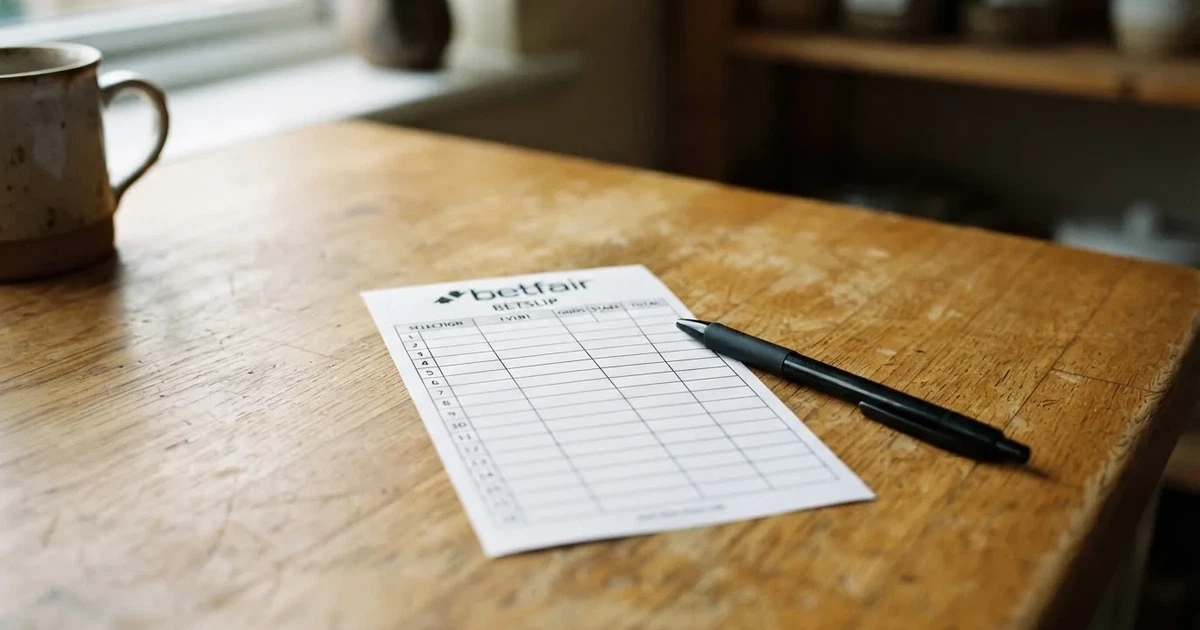
The betting slip, settled
The Trixie is built and staked on the bookmaker’s bet slip. Three selections are added. The bet type is set to Trixie. The unit stake is entered; the slip shows the total stake as four times the unit. Confirmation places the four bets. If one selection voids — a non-runner in horse racing, a postponed match under the operator’s rules — the bet usually recalculates: a four-bet Trixie becomes a three-bet structure with one fewer leg, settled as the operator’s house rules state. Rule 4 deductions apply on horse racing as on any other multiple.
Cash out, where the operator offers it, settles the four bets at the prices available at the cash-out moment. Cash-out availability is not guaranteed and bets stand if it is unavailable — DAZN Bet’s own help page says so plainly, and the rule is the same across most operators. Each-way, the British two-bet structure (a win bet and a place bet at the same stake) doubles every line: a £1 each-way Trixie is a £2 per line bet, £8 total.
The ten licensed bookmakers, side by side
Betfred — Best Odds Guaranteed on UK and Irish racing covers Trixies
Betfred sits on a remote general betting licence under account 39544, held by Petfre (Gibraltar) Limited. The site offers a sportsbook with Bet Builder, Racing Post data, Extra Places on selected races, live casino and bingo. Best Odds Guaranteed applies on UK and Irish horse racing from 8 AM on the day of the race, on both single and multiple bets — which means a Trixie built partly from morning runners can have its early prices matched if the SP drifts shorter. The feature is among the most useful on the British market for racing multiples, and it applies across the four bets of a Trixie without extra steps from the bettor. The bet-builder tool inside the sportsbook is a same-game multi product; the same-game multi is a separate bet type from the Trixie and does not combine with it.
Verdict. Betfred’s racing product is the strongest reason to pick it for a Trixie built partly from UK or Irish runners; for a Trixie with no racing leg the brand competes on price and the rest of the sportsbook, which is competitive but not distinctive.
BetMGM UK — familiar brand, separate bettor
BetMGM UK is published by LeoVegas Gaming p.l.c., the same Maltese group that runs BetUK, and lists a Commission account number 39198 on the app. The two brands share an operator behind them, which the reader should know. The bettor’s account, the KYC documents and the safer-gambling tools are run from the LeoVegas platform; the marketing and the front-end product are BetMGM-branded.
Verdict. The LeoVegas link is the single fact that changes the comparison: a reader already with a BetUK account is not opening a brand-new relationship by also trying BetMGM, and the safer-gambling limits and self-exclusion are joined across the two. For a Trixie specifically, the product is the standard sportsbook product; nothing on the public-facing page differentiates a Trixie offer from another.
BetTom — sports welcome and the casino cross-sell
BetTom runs under a remote licence held by Bet Tom Limited, Commission account 64959. The sports welcome is 50% back as a free bet of up to £50, paired with a matching 50% back up to £50 as free slot funds for casino play. Two offers, two products. The sports half sits in the form described in the section above; the casino half is the cross-sell. Full terms apply and the bettor reads them.
Verdict. BetTom’s pairing of a sports free bet and a casino credit is a textbook mixed-product offer — one product to gamble on to unlock the other. From 19 January 2026, mixed-product promotions are banned under the Commission rule described above. Whether BetTom has redesigned the offer under that rule is not established from the public register and the brand’s own terms page settles it. A Trixie cannot be used on the casino half, and the bettor reads the sports half’s terms before staking four lines.
BetUK — the same operator as BetMGM, different front
BetUK is run by LeoVegas Gaming PLC, Commission account 39198, the same Maltese operator as BetMGM UK. The app is the same engine dressed in different colours. Free-bet terms exclude virtual sports, esports and non-UK/IE horse racing, with minimum odds on the rest; the Trixie structure is not specifically named and the bettor reads the offer page for the minimum price.
Verdict. The brand is best understood as a LeoVegas product rather than as a separate bookmaker. The free-bet exclusions are specific — three categories shut out — and the Trixie bettor who leans on virtuals or esports should expect to be turned away from a BetUK free bet.
DAZN Bet — cash out and bet builder, with the cash-out caveat
DAZN Bet operates under a remote licence held by DZBT Limited, Commission account 48756. The sportsbook offers Cash Out, Bet Builder, daily bet boosts and in-play betting. Cash out availability is not guaranteed and bets stand if it is unavailable — DAZN’s own help page says it in plain English, and the same rule applies across most of the market. A Trixie settled through cash out prices the four lines at the prices the operator offers at that moment, and the bettor either takes the figure or lets the bet ride.
Verdict. The cash-out caveat is the load-bearing fact. A reader who plans to manage a Trixie by trading it out partway through should expect the option to vanish at busy moments and the four bets to settle at the result. For a Trixie, where four prices have to be available at once, the same risk is sharper than for a single.
Dabble — the social-feed sportsbook
Dabble runs under a remote licence held by Dabble Sports UK Ltd, Commission account 65677. The welcome offer is “Bet £10, Get £10 in Free Bets” on a first deposit, with a 7-day free bet expiry and the stake not returned — the standard free-bet structure. Minimum odds apply, and the bettor reads the offer page for the price. The product is the social-feed sportsbook model, with a chat layer over the betting slip.
Verdict. The stake-not-returned rule and the seven-day expiry are the cost. A Trixie placed against a Dabble free bet is only eligible if the bet is on the brand’s eligible markets list — QuinnBet has explicitly shut Trixies out, and the bettor reads Dabble’s terms for the equivalent line.
Fitzdares — premium positioning, antepost focus
Fitzdares is held by Fitzdares Limited, Commission account 400, and runs on a remote general betting licence. The app offers cash out, accumulators, Lucky 15s, specials and antepost markets on horse racing, football, tennis, rugby, cricket, golf and American football, with in-play live odds. Lucky 15s sit on the same shelf as Trixies in the full-cover family, and a brand that names them in its app description is one where the multiple-bet menu is solid.
Verdict. The premium positioning shows up in the antepost racing and the specials. A Trixie on football and tennis uses the same product as anywhere else; a Trixie with a horse-racing antepost leg benefits from a brand whose racing product is built around it. No brand-specific Trixie terms are documented, and the standard house rules apply.
NetBet — bet builder and price boosts
NetBet runs under a remote licence held by Netbet Enterprises Limited, Commission account 39170. The sportsbook carries Daily Boosts, Profit Boosts and free bet offers, a Bet Builder with instant dynamic odds, and sports stats for major leagues. The bet builder is a same-game multi; a Trixie is the cross-event multiple. The two are separate products on the slip and do not combine.
Verdict. The boosts are the cost-shaping feature. A boosted price on one leg of a Trixie feeds into the doubles and the treble that contain it, which is where the bettor gets the boost’s value. Whether a particular boost counts toward Trixie bets is a question the bettor settles from the brand’s offer page.
QuinnBet — explicit Trixie exclusion on free bets
QuinnBet is held by QuinnBet (Gibraltar) Limited, Commission account 61011. The free-bet rules are explicit: Trixies, Patents and Yankees are not eligible markets for QuinnBet free bets. Straight accumulators are. Free bets are valid for seven days from credit at minimum odds of 1/2 (1.50) and maximum odds of 50/1.
Verdict. The Trixie exclusion is the load-bearing fact. A bettor holding a QuinnBet free bet cannot use it on a Trixie at all — neither as a walk, patent, yankee, lucky 15, canadian, heinz, goliath nor any other full-cover structure that contains the multiple-bet lines. Straight accumulators only. That is the clearest rule on the comparison list, and the bettor who wants to use a QuinnBet free bet on a multiple bet rewrites it as a straight acca or chooses another brand.
Tote — pool-betting heritage, sportsbook as a second product
Tote sits under a remote general betting licence held by TDCO Limited, Commission account 54779. The brand’s heritage is pool betting on British and Irish racing; the sportsbook is the secondary product. The Tote is not a typical sportsbook and the Trixie bettor reads the slip carefully: some sportsbook brands offer the same bet types as the rest, and some have specific multiple-bet menus built around the racing pool products.
Verdict. A Trixie on the sportsbook uses the standard structure; a Trixie using pool bets is a different wager and the brand’s own rules apply. The pool-betting heritage is the brand’s strength; the sportsbook is the place where the Trixie’s mechanics are the same as elsewhere.
The landscape, on one page
| Bookmaker | Gambling Commission licence (account · holder) | What the operator’s own terms say on Trixies and similar bets |
|---|---|---|
| Betfred | 39544 · Petfre (Gibraltar) Limited | Best Odds Guaranteed covers UK and Irish racing from 8 AM on race day on single and multiple bets; Trixie terms not stated |
| BetMGM UK | 39198 · LeoVegas Gaming p.l.c. | Standard sportsbook product; no brand-specific Trixie terms documented |
| BetTom | 64959 · Bet Tom Limited | Sports welcome 50% back as a free bet of up to £50 plus 50% back as casino free funds up to £50; full terms apply |
| BetUK | 39198 · LeoVegas Gaming PLC | Free bets exclude virtual sports, esports and non-UK/IE horse racing, with minimum odds |
| DAZN Bet | 48756 · DZBT Limited | Cash out availability not guaranteed; bets stand if cash out is unavailable |
| Dabble | 65677 · Dabble Sports UK Ltd | Welcome free bet stake not returned; 7-day expiry; minimum odds apply |
| Fitzdares | 400 · Fitzdares Limited | Lucky 15s and accumulators named in the app; no brand-specific Trixie terms documented |
| NetBet | 39170 · Netbet Enterprises Limited | Daily Boosts and Profit Boosts; Bet Builder is a separate same-game multi product |
| QuinnBet | 61011 · QuinnBet (Gibraltar) Limited | Free bets exclude Trixies, Patents and Yankees explicitly; 7-day expiry; min 1/2 (1.50), max 50/1 |
| Tote | 54779 · TDCO Limited | Pool-betting heritage; sportsbook Trixie terms not stated |
The table is the comparison’s bones; the verdict under each bookmaker is its muscle. The patterns across the set are plain. Six of the ten brands run their own version of the standard free bet with the standard seven-day expiry and stake-not-returned rule. QuinnBet is the one brand that names the Trixie in its exclusion list, which is the strongest statement in the comparison. Betfred is the strongest bookmaker on racing-specific features that touch Trixies through BOG. BetUK’s free-bet exclusions are the most restrictive by category — three product types shut out.
LeoVegas Gaming PLC’s double appearance under BetMGM UK and BetUK is the single piece of operating-company plumbing that affects the comparison, because a single GAMSTOP registration and a single set of safer-gambling limits covers both brands, and the bettor looking for two unrelated relationships does not get two from the operator side.
What the Trixie costs — the worked payout
A worked payout, with the arithmetic in plain prose. Three selections at decimal odds of 1.50, 2.00 and 2.50, and a Trixie with a unit stake of £2 on each of the four lines — £8 staked in total.
If all three selections win:
- Double on selections 1 and 2: 1.50 × 2.00 = 3.00. Stake £2, return £6.
- Double on selections 1 and 3: 1.50 × 2.50 = 3.75. Stake £2, return £7.50.
- Double on selections 2 and 3: 2.00 × 2.50 = 5.00. Stake £2, return £10.
- Treble on selections 1, 2 and 3: 1.50 × 2.00 × 2.50 = 7.50. Stake £2, return £15.
Total return: £6 + £7.50 + £10 + £15 = £38.50. Net profit: £30.50 from an £8 stake.
If only selections 2 and 3 win (selection 1 loses):
- Double on selections 2 and 3 wins: return £10.
- The other two doubles and the treble lose.
Total return: £10. Net profit: £2 from an £8 stake. The Trixie returns something on two-out-of-three; a straight treble on the same three picks at £8 stake returns nothing.
If only selection 3 wins:
- No double includes only one winner. No double pays. The treble loses.
- Total return: £0. Net profit: −£8.
The same three picks at the same prices as a straight accumulator at £8 stake:
- If all three win: return 1.50 × 2.00 × 2.50 × 8 = £60. Net profit £52.
- If only selections 2 and 3 win: return £0.
- If only selection 3 wins: return £0.
The result, stated as a band with its condition: a Trixie at £2 per line on selections priced 1.50, 2.00 and 2.50 returns between £0 (zero or one winner) and £38.50 (all three winners), with the meaningful partial return — £10 — sitting on the two-winner case. A straight accumulator at the same £8 stake returns between £0 (fewer than three winners) and £60 (all three winners). The Trixie smooths the variance and pays less at the top; the accumulator has a higher ceiling and a lower floor. The £30.50 profit on a £8 Trixie with three winners, against £52 profit on a £8 accumulator on the same picks, is the cost the structure imposes.
The unit stake of £2 per line is illustrative and the prices are illustrative. A Trixie at £1 per line costs £4; at £10 per line costs £40. The arithmetic scales linearly with the unit stake: every line’s return is the unit stake multiplied by the product of the relevant decimal odds, and the total return is the sum of the four lines.
The overview, in one read
A Trixie is a four-bet structure on three selections: three doubles, one treble. The bettor picks the three events, picks a unit stake, and pays four times the unit stake as the total cost. Two winners pay the double that contains them; three winners pay all three doubles plus the treble. The trade against a straight treble is stake for partial-win recovery: more money up front in exchange for some return on two-out-of-three.
The bookmaker’s margin compounds inside the structure. A Trixie carries four margins against a straight treble’s one, which is why the worked example’s Trixie returns £38.50 on three winners against the straight treble’s £60 on the same picks at the same stake. The trade-off is the partial-win payment, and the margin is the price of that trade.
The British regulatory frame sits around the bet. The Gambling Commission licenses the operator; the bet type itself is not licensed, only the operator’s category. Identity is verified before the first deposit, GAMSTOP is the self-exclusion route, financial vulnerability checks bite at £150 of net deposits in a rolling 30 days. Free-bet terms, including QuinnBet’s explicit Trixie exclusion, are the cost-shape for a bonus-led Trixie.
The ten licensed bookmakers above are the comparison set. Betfred’s Best Odds Guaranteed, QuinnBet’s Trixie exclusion on free bets, BetUK’s product exclusions and LeoVegas Gaming’s twin appearance under BetMGM UK and BetUK are the four patterns that change the bettor’s calculation. Everything else is the standard British sportsbook product.
Frequently asked questions
What is a Trixie bet?
A Trixie is a four-bet structure built from three selections: three doubles (one for each pair) and one treble. The unit stake is multiplied by four to give the total stake. The bet pays line by line; two winners are enough to see a return, although only on the doubles that include both winners. A three-winner Trixie pays all three doubles plus the treble, and is the only configuration that returns the full structure.
How does a Trixie bet work in practice?
Add three selections to the betting slip, set the bet type to Trixie, enter the unit stake and confirm. The slip shows the total stake as four times the unit. As results come in, each line settles: a double pays when both its selections win, and the treble pays when all three win. Cash out, when offered, settles all four lines together at the operator’s current prices; cash-out availability is not guaranteed and a missed cash-out window leaves the bets to settle at the result.
What is the difference between a Trixie and a Lucky 15?
A Trixie is four bets over three selections: three doubles and one treble, with no singles. A Lucky 15 is fifteen bets over four selections: four singles, six doubles, four trebles and one fourfold. The Lucky 15 costs more at the same unit stake (15 lines rather than 4) and pays on singles, which a Trixie does not, which is why the Lucky 15 is the gentler structure on partial wins. The Heinz, at the next step up, is fifty-seven bets over six selections.
Can a Trixie be placed with a free bet?
It depends on the operator’s terms. QuinnBet explicitly excludes Trixies, Patents and Yankees from its free-bet markets; straight accumulators are allowed. Several other brands run similar exclusions, although the specifics vary and the brand’s own offer page settles it for a given promotion. A free bet’s stake is usually not returned with a winning bet, which is a separate cost the bettor carries on top of any market exclusion.
How is the return on a Trixie worked out from the stake and the odds?
Each line’s return is its unit stake multiplied by the product of the decimal odds on its selections: a double at 2.00 and 3.00 returns the unit stake multiplied by 6.00, a treble at 2.00, 3.00 and 4.00 returns the unit stake multiplied by 24.00. The Trixie’s total return is the sum of the four lines. Net profit is the total return minus the total stake (four times the unit). Worked example: £1 per line on selections at 2.0, 3.0 and 4.0 returns £50 from a £4 stake if all three win, a net profit of £46.
What is the bookmaker’s margin and how can it be seen in the odds?
A bookmaker’s margin is the slice of every unit staked on a market that the book keeps on average; the rest, the payout share, is returned to bettors as winnings. The margin is built into every quoted price. For a three-outcome market like a 1X2 football match priced 2.10 / 3.40 / 3.60, the payout share is 1 ÷ (1/2.10 + 1/3.40 + 1/3.60) ≈ 0.953, and the margin is about 4.7%. The higher the margin, the worse the prices are for the bettor over the long run. A Trixie carries the margin four times — once per line — which is why its returns trail those of an uncombined accumulator on the same picks at the same stake.
Bet types & in-play – Footy Tips
Content created by the «Footy Tips» team
