
What online snooker betting really costs in 2026
 Available in US
The price on a snooker frame looks small. A £10 bet at 1.90 pays £19 back, a clean nineteen pounds for a correct call on a sport that runs for hours on end. The number on the slip is not, however, what the bettor is buying. What the bettor is buying is the chance to win nineteen pounds, and the chance is set by the bookmaker’s margin: the slice of every pound wagered that the operator keeps, whatever the result. That margin, plus the conditions wrapped around any “free” or “boosted” offer, plus the cost of being on the wrong side of a self-exclusion scheme, is what online snooker betting costs in 2026. This page works through each of those costs, names the bookmakers that hold a Gambling Commission remote licence for the sport, and explains where the arithmetic that decides a punter’s year-end numbers is actually done.
As of 27 October 2026, all licence and operator details were checked against the Gambling Commission’s public register.
As of October 2026, every licence number and operator detail below was checked against the Gambling Commission’s public register.
The licence and the rule: what governs online snooker betting in Great Britain (2026)
There is no list of sports a British bookmaker may or may not offer. The Gambling Act 2005 does not name snooker as a permitted or excluded event. Instead, the Act requires any operator whose remote facilities are used in Great Britain to hold a Gambling Commission licence, wherever that operator is based. A Curaçao or Malta or Gibraltar authorisation, on its own, is not a substitute. The Gambling (Licensing and Advertising) Act 2014 closed the loophole that used to let an offshore brand serve British customers from a non-GB base; since then, the Commission’s public register has been the whole test of who holds a licence to take a bet from someone in England, Scotland or Wales. Northern Ireland sits outside the 2005 Act under older law, so a “GB licence” is precisely that and no more.
The register can be searched by business name, trading name, domain or account number. Every brand reviewed further down this page has a Commission account number, a named licence holder and a category on the register — in each case *remote general betting standard (real events)*. Betting exchanges run under a separate category, *remote betting intermediary*. A bookmaker’s use of .co.uk rather than .com proves nothing either way; licensed operators use both, and the domain is the address, not the authorisation.
The test for a punter is therefore narrow and answerable: a brand’s name and its account number are on the register, and that fact is the only thing that makes a “GB-licensed” claim true. Anyone who is not on it — including a brand that markets itself to British customers, accepts deposits in pounds and pays out in pounds — is operating outside the regime. The Commission has powers to issue cease-and-desist notices, work with payment providers and refer matters to search engines, and the body has been given, or is about to receive, court-ordered DNS blocking powers. The framing that matters for a punter, though, is not the threat of enforcement against the customer: betting with an unlicensed site simply means the loss of every protection the British framework provides, from GAMSTOP coverage to approved dispute resolution.
Financial spread betting, where winnings and losses are computed on the difference between a quoted price and a realised number, is regulated by the Financial Conduct Authority rather than the Commission; a single firm can hold both authorisations and use one for one product and the other for the rest. A spread bet on a sporting outcome can lose more than the stake deposited, and the marketing pages of any firm offering it must state that fact plainly.
Where player protection actually sits in 2026
Two pieces of the British framework matter for anyone staking money online: GAMSTOP, and the financial checks that have come in around deposits.

GAMSTOP is a national multi-operator online self-exclusion scheme, and a mandatory licence condition for every online operator since 31 March 2020. Once a customer registers, the exclusion is applied across every licensed online brand — and only licensed online brands; betting shops run a separate service. Exclusion periods run from six months to five years, with an option to renew automatically; after the minimum period the exclusion stays in place for a further seven years unless the customer asks GAMSTOP to remove it. Searchers of “snooker betting not on gamstop” will find sites that promise exactly that — and any such site is, by definition, not on the Commission’s register.
A “financial vulnerability check” runs under Licence Conditions and Codes of Practice condition 3.4.4, in force since 30 August 2024, and applied to licensed remote betting from 28 February 2025. The trigger is a customer’s deposits minus withdrawals exceeding £150 in a rolling 30 days. The check itself is a public-record search — bankruptcy, county court judgments, similar entries — not an income check, not a credit-reference check. Further “financial risk assessments” — the affordability checks discussed in the press — have been announced in a staged plan, with no start date yet published. The honest description of that second layer is *announced, staged, no start date*.
Deposit limits, under the Remote Technical Standards, are an obligation the operator owes the customer rather than a ceiling the state sets: the operator must offer a gross deposit limit on a fixed time frame. The first changes have applied since 31 October 2025; a second phase was postponed to 30 September 2026. No state-level maximum stake or maximum loss exists for sports betting. The £2 daily cap the press sometimes describes, or any figure of that shape, is the *customer’s* limit, not the regulator’s.
Identity verification runs before a first deposit at every licensed site, including before a customer can use a free bet or bonus. Name, address and date of birth are checked, and the rule has been in place since 7 May 2019. Anonymous play at a GB-licensed snooker bookmaker is therefore not available, and a “bet without ID” page describes an unlicensed offer, with the loss of protection that goes with it.
Help lines exist for the customer who needs them: GamCare runs the National Gambling Helpline, GambleAware funds treatment and education, the NHS runs gambling clinics, and Gamblers Anonymous runs peer-support meetings. Several of the brands reviewed below link directly to these services from their safer-gambling pages; a self-excluded customer who finds a way to open a new account with the same brand is dealing with an operator that has failed in its duty, and the Commission’s complaints route is the place to take that.
Crypto, anonymity and the British point of consumption
Search volume for “crypto snooker betting” and “snooker betting with bitcoin” is real and growing, and the British framework’s response to it is direct. There is no rule on the Commission’s side that says a licensed operator may or may not accept a cryptocurrency deposit: a brand’s own terms set that, and a GB-licensed bookmaker offering snooker that does take crypto is unusual. Where a customer lands on a site that does take bitcoin, ethereum or stablecoins and pays out in the same, the test that matters is the same as for any other site — the Commission’s public register. If the brand is not on the register, the crypto angle does not change anything else: the customer still has no GAMSTOP coverage, no Commission complaints route, no approved dispute resolution, and no British consumer redress if funds are withheld. The pseudonymity of a blockchain ledger is a different shape of risk from a debit-card deposit, and it does not by itself make the site safer; it makes the loss of a different shape when the site disappears.
Two practical points follow. First, identity verification at a licensed brand means a customer cannot open an account anonymously in the first place, so the “anonymous crypto” offer in the snooker market is, at the licensed end, a contradiction. Second, the credit-card ban for gambling in Great Britain, in force since 14 April 2020, covers credit-card-funded payments through an e-wallet, so a deposit that starts as crypto is not the same kind of clean-money concern as a credit-card deposit through a third party; the question of whether crypto is accepted at a given brand is, again, a question of that brand’s own terms.
Bonuses and “free” bets: what the offer actually costs
A “100% bonus” is the most repeated phrase in the marketing of sports betting, and the one that does the most work to disguise a cost. The shape of the offer is well known: deposit, receive a bonus, clear the bonus by wagering it, withdraw. The cost sits in three places — the wagering factor, the minimum price for a qualifying bet, and the deadline — and the three together decide what clearing the bonus is actually worth.
The wagering factor, sometimes called the rollover, is the multiple of the bonus the customer must stake before any winnings become withdrawable. A £10 bonus at a 50x factor needs £500 of qualifying bets before withdrawal; a £10 bonus at 10x needs £100. From 19 January 2026, the Commission’s promotion rules cap the wagering factor on bonuses at 10x; a brand offering more is in breach. The cap covers bonuses; whether it covers a free bet that has no wagering condition attached is not established, and neither is any cap on the money value of a bonus.
The minimum qualifying price — the shortest odds at which a bet counts towards the wagering — is the second cost. A bonus that requires bets at 2.00 (even money) or longer is harder to clear than one that takes 1.50, because fewer markets qualify, and the bets that do qualify carry a higher margin on average. The minimum price is a number to look for before claiming, not a number to find out about at withdrawal.
The deadline, usually seven or fourteen days, is the third. A short window forces the customer to bet the bonus at a pace that suits the operator’s margin rather than the customer’s preferred markets. Clearing a £100 bonus at 10x means £1,000 of bets in two weeks, or about £70 a day, and a missed day extends the rest of the schedule.
Free bets, which are a different mechanism from a bonus, pay the winnings but usually not the stake. A £10 free bet at 3.00 pays £20 in winnings, not £30; the £10 is the operator’s money, kept whatever the result. The arithmetic of what a free bet is worth on average is a separate calculation from what it wins, and is a question the section on what the offer is worth later in this page works through.
Enhanced odds, price boosts and acca insurance are each a different offer. A price boost raises the price of one outcome; an acca insurance refunds a stake (usually as a free bet) if one leg of a multiple loses; a “best odds guaranteed” promise on horse racing pays the higher of the price taken and the starting price. Each is described as it is in the operator’s own terms, and is never restyled into something it is not. The 10x cap applies to bonuses; the other offers sit on their own rules.
The mix-and-match ban in force from 19 January 2026 is the rule most often missed: a mixed-product promotion that requires gambling on two or more product types — “bet on football to get free spins”, “deposit to play casino and bet on snooker” — is banned. An offer that asks the customer to bet on a snooker match to get a casino bonus is no longer a licensed offer at any Commission bookmaker. A pure snooker-to-snooker offer, a deposit bonus on sportsbook credit, is unaffected by the mix ban; the cap on the factor is the rule that governs it.
The honest summary of the bonus and free-bet category in 2026 is that the headline number is the smallest of the costs. A reader who knows the factor, the minimum price and the deadline before claiming is a reader who knows the offer’s real shape; a reader who knows only the headline has been told the price, not the cost.
In-play and cash out: what “live” snooker actually delivers
Snooker is an unusually good fit for in-play betting, for a structural reason that has nothing to do with marketing. Frames are long — a best-of-19 first-round match at the World Championship runs to ten frames and several hours — and the in-game state is rich: frame score, points in the current frame, the break on the table, the balls left. A bookmaker that prices frames in play has something to update every few minutes, and a snooker tournament generates hundreds of markets per session for a customer who wants to bet through the day.
Cash out, the feature that lets a customer close a bet before the final result, is offered on snooker at most major bookmakers. The cash-out value the operator displays is its own estimate of the bet’s current worth, less a spread, and the bettor’s edge is in the operator’s estimate being wrong — which is a different kind of skill from picking the original outcome. The honest framing of cash out is that it is a tool the punter can use or refuse, and the price the operator offers is the price the operator offers, not the price the market would clear at.
The bookmaker’s in-play offer on snooker tends to be thinner than its pre-match offer. Outright markets on tournaments, match winner, frame handicap, total frames and first-frame winner are standard; a customer looking for in-play century breaks, a market on who pots the next colour, or a market on the highest break in a session is looking at a smaller subset of brands. The structural reason is the cost of pricing and updating those markets frame by frame, and the marketing reason is that the headline sports do most of the volume. A snooker-specific customer checks the in-play page on the day, not the operator’s marketing for the week.
The bookmaker’s own margin does not vanish in-play. The margin inside an in-play price is the same shape of margin as in the pre-match price — the operator keeps a slice of every pound wagered whatever the result — and the value to a punter is in finding a market where the operator’s estimate is mispriced, not in finding a market where the margin is smaller. That is a search the in-play screen makes possible, but it does not make the margin disappear.
Predictions, tips and the search for an edge
The “snooker betting tips” search is one of the most popular searches in the sport, and it deserves an honest answer. No tipster, model, podcast, or paid service can tell a punter the outcome of a snooker match before it is played. A model can tell a punter that the price on one player is, in some sense, larger than the model’s estimate of the probability of that player winning, and that is the start of a bet — but the model is a model, the player’s true probability is unknown, and the next frame is not decided on paper.
What a tipster or model can offer, in declining order of what they actually sell: (1) information the punter does not have, such as the form of a player in qualifying rounds that the punter did not watch; (2) a frame of reference, so the punter’s view of a match has something to compare against; (3) entertainment, dressed as analysis. The first is the only one of the three that has a chance of moving a price. The second is a kind of reading list. The third is what most of the “snooker betting predictions” content on the open web is, and the value it adds to a punter’s bankroll is the same as the value of any other tip that is not actionable.
A punter’s own edge, where one exists, comes from knowing the sport better than the bookmaker’s trader on a specific question. A regular viewer of the World Championship has watched Ronnie O’Sullivan play the Crucible for two decades and has watched the pattern of his first-round matches; the trader has watched the data. A regular viewer of the Players Championship has watched Kyren Wilson’s run in the 2024 event; the trader has watched the data. A punter who knows the schedule of a ranking event, the format of the venue and the recent form of a qualifier is in a different position from one who does not, and that is the long way around saying that a punter who watches the sport will have a better sense of which price looks wrong than one who does not.
The most useful thing a tipster can tell a punter about a specific match is which market to look at, and which to leave alone. The World Championship final, the UK Championship final, the Masters final: the bookmaker’s prices on the favourite in these are tight, and the margin the operator keeps on the favourite is small in absolute terms but hard to beat because the favourite is the favourite. The first-round match between two unseeded qualifiers is a different problem: the operator’s data is thinner, the price is set by fewer inputs, and a punter who has watched the qualifying round is in a different position from the trader. The first-round match is where the regular viewer’s edge, if it exists, sits; the final is where the trader’s edge sits.
What a snooker bet pays, and how the odds are built
A snooker bet pays in the same arithmetic as any other fixed-odds bet: the stake multiplied by the decimal odds gives the return (stake plus winnings), and the winnings alone are the stake multiplied by the odds minus one. A £10 bet on a player at 3.75 returns £37.50; the winnings are £27.50. A £10 accumulator of three legs at 1.80, 2.10 and 1.95 returns £10 × 1.80 × 2.10 × 1.95 = £73.71. The price on a multiple is the product of the legs’ prices, which is also the reason a four-leg acca at four short prices pays a smaller multiple than it looks: 1.50 × 1.60 × 1.70 × 1.80 = 7.34, not the headline number the marketing copy implies.
Fractional odds, the British form, are the working language of the betting shop and the older online interface: 5/1, 11/4, evens. The conversion to decimal is straightforward: a divided by b, plus one. 5/1 becomes 6.00. 11/4 becomes 3.75. Evens, written 1/1, becomes 2.00. An “odds-on” price — shorter than evens — is written 4/6, 8/11, 1/2; the decimal form is 1.67, 1.73, 1.50. The British punter who can read fractional and the international punter who reads decimal are reading the same numbers in two notations; the conversion is a line of arithmetic, not a re-pricing.
The bookmaker’s margin is built into every set of odds on a market, and the easiest way to see it is on a two-way market. Take an illustrative two-way snooker market priced at 1.90 / 1.90 — neither outcome favoured, the kind of price a trader might quote on a coin-toss frame between two roughly equal players. The implied probability of each outcome is 1 / 1.90 = 0.5263, or 52.63%. Add the two probabilities and the total is 105.26%. The 5.26% above 100% is the overround — the total of the probabilities minus 100%. A market at 1.85 / 1.85 has an overround of 8.1%. A market at 1.95 / 1.95 has an overround of 2.6%. The “tighter” the prices, the smaller the margin, and the larger the punter’s expected share of a pound wagered.
The same arithmetic on a three-way market — a typical match result with a draw or a handicap option — gives a larger margin in absolute terms because the third outcome is harder to price. The single number to look at is the overround, and the price on the favourite is the most misleading price on the page: the favourite’s price is the tightest, and the outsider’s price carries most of the margin. A punter who always backs the favourite is paying the smallest margin per bet but losing the most per losing bet, which is the structural shape of an account that runs towards the operator at the end of the year.
The formula is simple. The payout share of a market is 1 divided by the sum of the reciprocals of the odds of every outcome. The margin is 1 minus that share. A 1.90 / 1.90 two-way market has a payout share of about 95.0% and a margin of about 5.0%. A 1.80 / 2.00 market has a payout share of about 94.7% and a margin of about 5.3%. A 1.50 / 2.75 two-way market has a payout share of about 94.6% and a margin of about 5.4%. The lower the margin, the more of every pound wagered finds its way back to the punter on average, and the more important a customer’s selection becomes, because the operator’s cut is smaller.
The sport: what snooker is, and what a punter is actually betting on
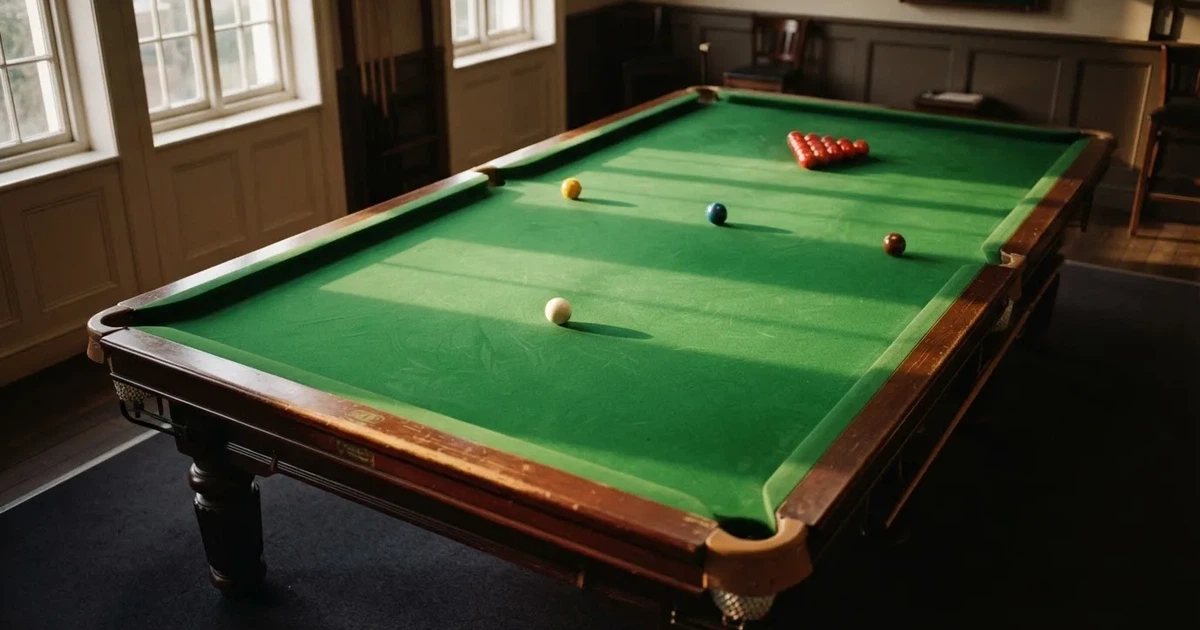
Snooker is played with 22 balls: a white cue ball, fifteen reds worth one point each, and six colours — yellow 2, green 3, brown 4, blue 5, pink 6 and black 7. A player pots a red (one point) and then a colour (the colour’s value), and the cycle continues until all reds are potted, after which the colours are potted in ascending order. The maximum break in a single visit to the table is 147: all fifteen reds with fifteen blacks (15 × 1 + 15 × 7 = 120), followed by the six colours in order (2 + 3 + 4 + 5 + 6 + 7 = 27). The 147 is a tournament storyline as much as a sporting feat; the bettor’s price on a maximum in any one match is a long one.
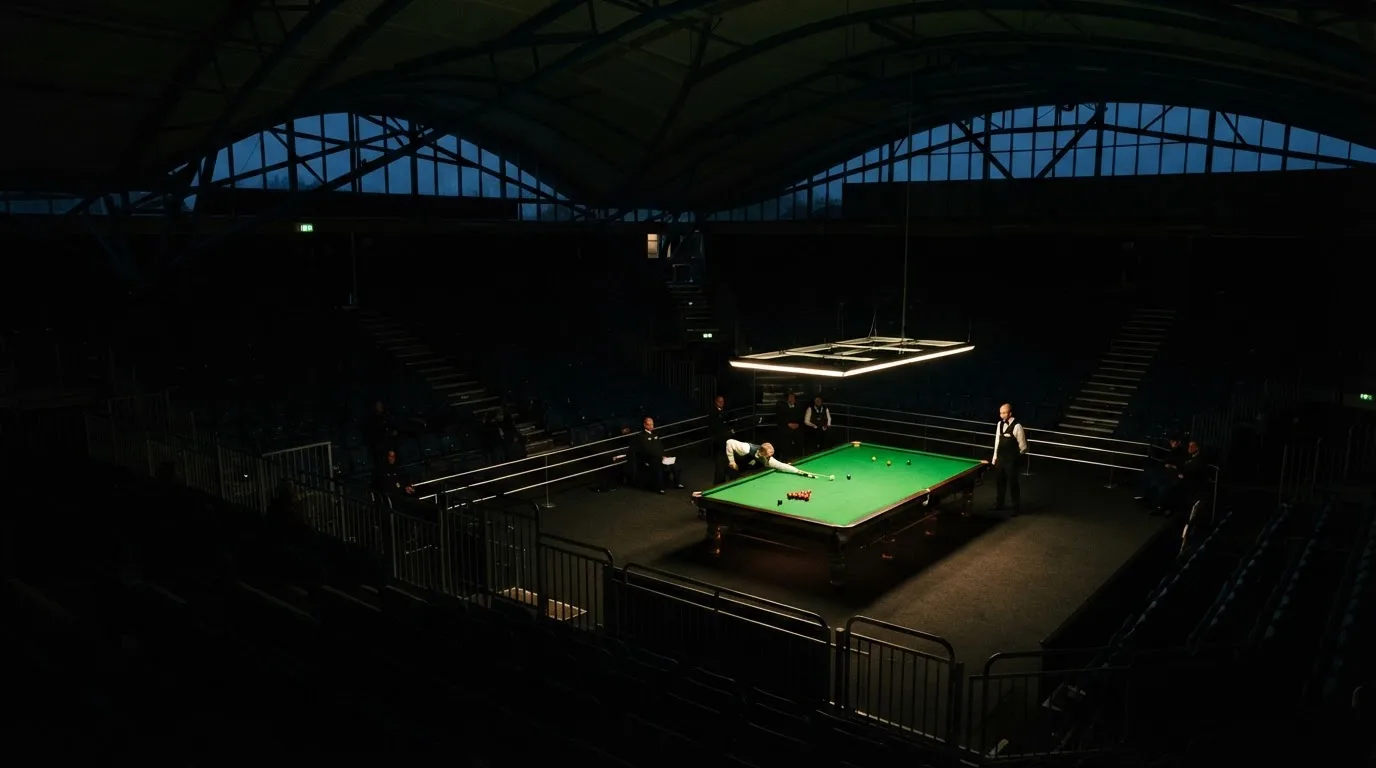
A full-size snooker table is 12 ft by 6 ft with six pockets, the same dimensions as a billiards table but smaller than a pool table. Most professional matches are best of 7, 9 or 11 frames; the World Snooker Championship at the Crucible Theatre, Sheffield, ranges from best of 19 in the first round to best of 35 in the final, and the venue has staged the event since 1977.
The names a punter is most likely to bet on: Ronnie O’Sullivan, with seven world titles; Stephen Hendry, also with seven; Joe Davis, who won fifteen in a row from 1927 to 1946, an era in which the field was so much smaller that the record is, and is not, comparable. The 2026 World Snooker Championship, held 18 April to 4 May at the Crucible, was won by Wu Yize, who beat Shaun Murphy 18-17 in the final. The winner’s cheque was £500,000 from a total prize fund of £2,395,000 — a number that places the modern World Championship comfortably above the historic field in money, even as Davis’s fifteen straight remains the longest streak.
The amateur and professional structures are split. The World Professional Billiards and Snooker Association (WPBSA) governs professional snooker and owns the official rules; the International Billiards and Snooker Federation (IBSF) governs the amateur game. A punter betting on a ranking event in the professional calendar is betting inside the WPBSA structure; a punter betting on the World Amateur Championship is inside the IBSF structure. The distinction matters because the field depth, the production and the streaming access are not the same.
The reviewed bookmakers: what each one brings, and what each one costs
Ten bookmakers carry a Gambling Commission remote licence for general betting on real events and are listed on the Commission’s public register. Each is described below as its own terms state it, and the verdict on each is this page’s own reading of those terms. No bookmaker here is “the only” licensed one; the register lists many more than these ten, and the brands below are a sample of the licensed field, not a ranking by safety or trust.
The table that follows brings the licences and the sport-specific terms side by side. The first column carries the brand. The second carries the Gambling Commission remote licence number and the licence holder as the register records them. The third carries a one-line read of the operator’s own terms on the subject of this page. The “subject” is what the operator’s own pages state about snooker, in-play, cash out, bet builder, and the conditions on offer — read as each brand states it, not as this page interprets it.
| Brand | Gambling Commission remote licence (account, holder) | What the operator’s own terms state on the subject |
|---|---|---|
| DAZN Bet | 048756, DZBT Limited | Deposits start at £5 by debit card, Apple Pay, Paysafecard, Trustly and Skrill, and at £20 by PayPal, with no processing fees stated. |
| Swifty Sports | 058957, Swifty Global (UK) Ltd | Best Odds Guaranteed, Cash Out on markets including horse racing and football, daily price boosts, live streaming and in-play betting; Bet Builder listed as coming soon. |
| Ladbrokes | 054743, LC International Limited | App published by Entain Operations Limited; covers the standard racing and sports markets under the Entain UK licence. |
| QuinnBet | 061011, QuinnBet (Gibraltar) Limited | Best Odds Guaranteed on Irish and UK horse racing from 10:00 daily on singles, multiples and system bets, capped at £150 benefit per customer per race. |
| DragonBet | 064908, DragonBet Ltd | Welsh football and rugby markets, racing, American football, in-play and bet builder markets. |
| Copybet | 053774, Copybet UK Limited | Best Odds Guaranteed all day, every day on all UK and Irish racing, with first past the post paid even on later disqualifications. |
| Bet600 | 044731, Tyche Tech Limited | Best Odds Guaranteed on horse racing — the bet is paid at the starting price if the SP is bigger than the early or show price taken. |
| Sporting Index | 027343, Sporting Index Limited | Switches between fixed odds and spread betting; in-play, Bet Builder for football, auto cash-out and Multi-Markets. |
| William Hill | 039225, WHG (International) Limited | Best Odds Guaranteed on UK and Irish horse racing from 8:00 on the day of the race, on singles and multiples; excludes ante-post, tote and pari-mutuel. |
| LiveScore Bet | 056859, LiveScore Betting and Gaming (Gibraltar) Limited | Bet Builder up to 10 selections covering match result, both teams to score, corners, total goals, player scoring and card markets. |
The first column is a sample, not a shortlist. A reader looking for snooker-specific terms on each brand checks that brand’s own snooker page and the operator’s own snooker rules; the table is the licence, the licence holder and the headline of the offer side of the brand, not the snooker page.
DAZN Bet
DAZN Bet is the sportsbook arm of the streaming service, and its deposit floor is a useful number to start on: £5 by debit card, Apple Pay, Paysafecard, Trustly and Skrill, and £20 by PayPal, with no processing fees the operator states. A low floor at a licensed brand is useful to a snooker punter who wants to bet through a World Championship session without committing a large bankroll, and the spread of accepted methods means a customer whose bank blocks gambling transactions has a non-card option. The licensed-and-newer side of DAZN Bet’s profile is the reason to read the offer terms more carefully than at a longer-established brand; the snooker market depth is established but the operator’s own snooker-specific house rules are best checked at the brand’s own page.
Swifty Sports
Swifty Sports is one of the newer names on the register, and the in-play offer is the headline. Best Odds Guaranteed applies to racing markets; daily price boosts are listed; live streaming is part of the package. Bet Builder is listed as “coming soon”, which means the same-game-multi on snooker frames is not yet shipped. A snooker punter who values the in-play screen and the streaming window above the bet-builder will find the offer shaped to them; a punter who wants a snooker-specific bet builder is looking elsewhere for now.
Ladbrokes
Ladbrokes is one of the longest-running names on the British high street, and the app is published by Entain Operations Limited under LC International Limited’s Commission licence. The Ladbrokes app is rated 4.66 from a large body of GB App Store ratings, which is a useful indicator of polish but not of value. The snooker offer is the standard Entain UK pricing across match winner, frame handicap, total frames and outright tournament markets; the in-play offer on snooker is established. A punter who already holds a Ladbrokes account has no reason to switch for snooker specifically.
QuinnBet
QuinnBet’s Best Odds Guaranteed is a tight, specific promise: Irish and UK horse racing, from 10:00am daily, on singles, multiples and system bets, with a maximum benefit of £150 per customer per race. The cap is a useful number to know: a punter whose intended stake would yield a benefit above £150 is being clipped at the cap, and the cap is per race, not per day. The cap is not a snooker term; it is a racing term, and the snooker offer sits in the standard bookmaker shape. A punter who bets heavily on Irish and UK racing and on snooker in the same week is paying attention to the cap on the racing side and not on the snooker side.
DragonBet
DragonBet is a Welsh-focused brand, and the markets reflect it: Welsh football, Welsh rugby, racing, American football, in-play and bet builder. The snooker market is the standard bookmaker set rather than a snooker-specialist’s depth. A Welsh-rugby or Welsh-football customer who also bets on snooker has the brand for both; a snooker-only customer is in a market where several other brands carry a similar or deeper offer.
Copybet
Copybet is a betting exchange and bookmaker combination, and the racing side carries the unusual promise: Best Odds Guaranteed all day, every day, on all UK and Irish racing, with first past the post paid even on later disqualifications. The first-past-the-post rule is a real edge for a punter who suspects a horse is going to be disqualified and the price has not yet moved; the racing offer is the headline. The snooker market is the standard bookmaker set, and a punter who wants the racing-rule book on snooker will not find it.
Bet600
Bet600’s Best Odds Guaranteed on horse racing is the simple version: the bet is paid at the starting price if the SP is bigger than the early or show price taken. The brand’s snooker offer is the standard bookmaker shape, and a punter whose main interest is the SP-on-racing mechanic will not see that mechanic on snooker.
Sporting Index
Sporting Index is a fixed-odds and spread-betting hybrid, and a punter on the platform can switch between the two. The in-play offer, Bet Builder for football, auto cash-out and Multi-Markets are part of the package. Spread betting on a sporting outcome can lose more than the deposit, and that fact is the first thing to read on a Sporting Index page before staking. A punter who wants a fixed-odds snooker bet and the same platform’s spread-betting on a different market is in the right place; a punter who wants only fixed-odds snooker is in a brand with a more focused offer.
William Hill
William Hill’s Best Odds Guaranteed on UK and Irish horse racing runs from 8:00 on the day of the race, on singles and multiples, and excludes ante-post, tote and pari-mutuel. The early time of the 8:00 kick-off is a useful number to a punter who plans to take an early price; an ante-post bet is not covered, and a tote or pari-mutuel bet is not covered. The snooker offer is the standard bookmaker shape, with the same brand name and licence that have sat on the high street for decades. A punter already on William Hill has no reason to switch for snooker; a punter new to the brand is choosing between William Hill and the other nine on the basis of snooker-specific terms, not on the basis of the racing rules.
LiveScore Bet
LiveScore Bet’s Bet Builder allows up to 10 selections and covers match result, both teams to score, corners, total goals, player scoring and card markets. The selection cap of 10 is high for a bet builder; the markets covered are football-shaped rather than snooker-shaped, and the bet builder on snooker specifically is not part of the standard list. A football bettor who also bets on snooker is in the right place; a snooker-only bettor is looking for a brand whose bet builder applies to frame-level markets.
The honest reading of the ten is that a snooker punter has a market to choose from rather than a single best answer. The licence is the same shape on every one, and the spread of offer terms is wider than the spread of licence terms. The decision is on the offer, on the in-play depth, on the bet builder’s fit to snooker markets, and on the operator’s snooker-specific house rules — all of which are best read at the brand’s own snooker page before any stake is committed.
What the offer is actually worth: the calculation behind a £10 free bet
A free bet whose stake is not paid back is worth less than the headline number suggests, and the headline number is what most marketing copy uses. A £10 free bet at 2.00 pays £10 in winnings, not £20. The winnings are the operator’s prize for the bet, the stake is the operator’s spend. The arithmetic of what a free bet is worth on average is a function of the odds it is taken at and the margin of the market the bet is on, and the calculation runs as follows.
A free bet at decimal odds of *d*, in a market with a payout share of *p*, has a value of *free-bet amount × (d − 1) / d × p*. Take a £10 free bet at 3.00 on a market with a payout share of 94.7% (the same 1.90 / 1.90 two-way shape used in the margin calculation). The expected value is £10 × (3.00 − 1) / 3.00 × 0.947 = £10 × 0.667 × 0.947 = £6.31. The £10 free bet is, on average, worth about £6.31. The same £10 free bet at 1.90 on the same market is worth £10 × (1.90 − 1) / 1.90 × 0.947 = £10 × 0.474 × 0.947 = £4.49. The same £10 free bet at 6.00 on the same market is worth £10 × (6.00 − 1) / 6.00 × 0.947 = £10 × 0.833 × 0.947 = £7.89.
The pattern is the shape of a free bet: the higher the price, the more of the free bet’s nominal value the customer captures, because the stake’s non-return is a smaller fraction of the eventual winnings. A £10 free bet is, in expected-value terms, most worth at a long price, and least worth at a short price. The brand that offers a £10 free bet at a minimum price of 1.50 has structured the offer around a stake the customer is not going to use at 1.50 — because the expected value at 1.50 is the worst on the table.
The expected-value answer is an average over many free bets at the stated assumptions, not a guaranteed outcome for any one use of the free bet. The customer who takes a £10 free bet at 6.00 and the horse wins collects £50 in winnings, not £6.31; the customer who takes it at 6.00 and the horse loses collects nothing. The £6.31 is what the offer is worth in the long run, and the long run is a statistical estimate, not a forecast of the next race.
A “deposit bonus” has a different arithmetic, because the bonus is a real money balance with a wagering condition attached. A £10 bonus at 10x wagering needs £100 of qualifying bets; a £10 bonus at 50x needs £500. The 10x cap, in force from 19 January 2026, places the maximum cost of clearing a £10 bonus at £100 of qualifying bets, and the expected cost of clearing that bonus on a market with a 5% margin is £100 × 0.05 = £5. The expected cost on a market with a 10% margin is £100 × 0.10 = £10. The bonus’s expected value is its headline minus the expected cost of clearing it, and the expected cost depends on the margin of the market the bonus is cleared on. A punter who clears a bonus on a high-margin market (a novelty market, an exotic market) is paying more to clear the bonus than the bonus is worth, on average, and the offer is, in expected-value terms, negative from the start.
How a snooker punter reads a market in 2026
The honest first step is to look at the operator’s snooker rules before staking. The frame-format of the event in question, the dead-heat rules on outright bets, the settlement of bets on a player who withdraws before the match, the Rule 4 deduction on a non-runner — these are operator-specific and event-specific, and the operator’s own page on snooker is the place to find them. A punter who has read the snooker rules before staking is in a different position from one who has not, and the cost of not reading them is paid in disputes at settlement, not in the bet itself.
The second step is to read the licence. The Commission’s public register is searchable by brand name, and the register entry is the proof the brand is licensed for the activity the punter is using it for. The licence number is on every licensed brand’s safer-gambling or terms page, and a brand that does not display a Commission account number is not, on this page’s reading, a brand the punter should be staking with at all.
The third step is to read the offer. The wagering factor, the minimum qualifying price, the deadline, the market exclusions, the maximum stake per bet or per day, the maximum benefit per offer — each is a number on the brand’s own terms, and each is a cost the headline number does not include. A punter who knows all six before claiming is a punter who knows the offer’s real shape.
The fourth step is to read the in-play screen. A snooker punter who bets in-play has a thinner market to choose from than a football punter, and the brands with the strongest in-play offer on snooker are the brands whose traders price frame by frame. The bookmaker’s margin in-play is the same shape of margin as the pre-match margin, and the value is in finding a market where the trader’s price is mispriced, not in finding a market where the margin is smaller.
The fifth step is to keep a record. A punter who logs every bet — stake, odds, market, result — has a year-end number that the punter who does not keep a record does not have. The Commission’s deposit-limit tools, the safer-gambling pages, the GAMSTOP self-exclusion and the National Gambling Helpline are the protection that sits around the activity; the record is the protection that sits inside it. A punter’s year-end number, after the margin, after the offer costs and after the in-play and pre-match bets, is the number the punter is actually playing for, and the number is the only one that does not get dressed up in marketing copy.
The arithmetic, in one sentence
The bookmaker’s margin sits inside every price a punter takes, the wagering factor sits inside every bonus, the minimum price sits inside every qualifying bet, and the deadline sits inside every offer window. A £10 bet at 1.90 returns £19 if the bet wins and £0 if it loses; a £10 bonus at 10x needs £100 of qualifying bets before withdrawal, and the expected cost of clearing it on a 5% market is £5; a £10 free bet at 3.00 on a 94.7% market is worth about £6.31 on average. The numbers are not forecasts. They are averages over many bets, under the assumptions stated, and the assumptions are the assumptions of the British licensed market in 2026.
Frequently asked questions about online snooker betting
How do you bet on snooker?
A snooker bet is a fixed-odds bet on the outcome of a frame, a match or a tournament, placed with a bookmaker at a price the bookmaker sets and a stake the bettor chooses. The bettor picks a market (match winner, frame handicap, total frames, first-frame winner, outright tournament), picks a selection within it, enters a stake, and confirms. The bookmaker’s price at confirmation is the price paid if the bet wins; the stake is the amount the bettor loses if the bet does not. In-play bets on snooker are placed during a frame or between frames, and the price updates as the match progresses.
Is it legal to bet on snooker online in Great Britain?
Yes, at a bookmaker that holds a Gambling Commission remote licence, which is the only kind of authorisation that allows an operator to take bets from customers in Great Britain. The Commission’s public register lists every licensed brand by name, domain and account number, and the register is the test of whether a brand is licensed. A brand that is not on the register is not licensed to take bets from a customer in Great Britain, and the customer has no Commission complaints route and no GAMSTOP coverage at that brand.
How can a punter check a bookmaker’s Gambling Commission licence?
The Commission’s public register at the regulator’s own website is searchable by business name, trading name, domain or account number. The brand’s own safer-gambling or terms page carries the Commission account number, and the account number on the page should match the register entry exactly. A brand that does not display a Commission account number, or whose number does not match the register, is not a brand the punter should be staking with.
How is a return worked out from the stake and the odds?
For a single bet at decimal odds *d*, the return (stake plus winnings) is *stake × d*, and the winnings alone are *stake × (d − 1)*. A £10 bet at 3.75 returns £37.50, of which £27.50 is winnings and £10 is the stake returned. For a multiple bet, the odds multiply: a £10 accumulator of three legs at 1.80, 2.10 and 1.95 returns £10 × 1.80 × 2.10 × 1.95 = £73.71.
What is the bookmaker’s margin, and how is it seen in the odds?
The bookmaker’s margin is the slice of every pound wagered that the operator keeps on average, whatever the result. It is seen by adding the implied probabilities of every outcome in a market (1 / odds for each) and subtracting 1. A two-way market at 1.90 / 1.90 has implied probabilities of 0.5263 + 0.5263 = 1.0526, an overround of 5.26%, which is a margin of 5.0%. A market at 1.85 / 1.85 has an overround of 8.1%, which is a margin of 7.5%. A market at 1.95 / 1.95 has an overround of 2.6%, which is a margin of 2.5%. The lower the margin, the more of every pound wagered finds its way back to the punter on average.
How do fractional odds such as 5/1 convert to decimal odds such as 6.00?
The conversion is *a / b + 1*, where *a* and *b* are the two numbers in the fractional price. 5/1 becomes 5 / 1 + 1 = 6.00. 11/4 becomes 11 / 4 + 1 = 3.75. Evens, written 1/1, becomes 1 / 1 + 1 = 2.00. An odds-on price such as 4/6 becomes 4 / 6 + 1 = 1.67. The two notations are the same number in two forms, and a British punter who reads fractional and an international punter who reads decimal are reading the same market.
Tennis, darts & cue sports – Footy Tips
Content created by the «Footy Tips» team
