
Heinz bet: the full-cover bet that hides 57 lines behind one slip
 Available in US
A Heinz is a full-cover multiple bet on six selections. Behind the single name sit 57 separate bets that the bookmaker strikes in one go: 15 doubles, 20 trebles, 15 four-folds, 6 five-folds and 1 six-fold. There are no singles. The unit stake multiplies across all 57 lines, so a “£2 Heinz” really costs £114 before the first selection kicks a ball.
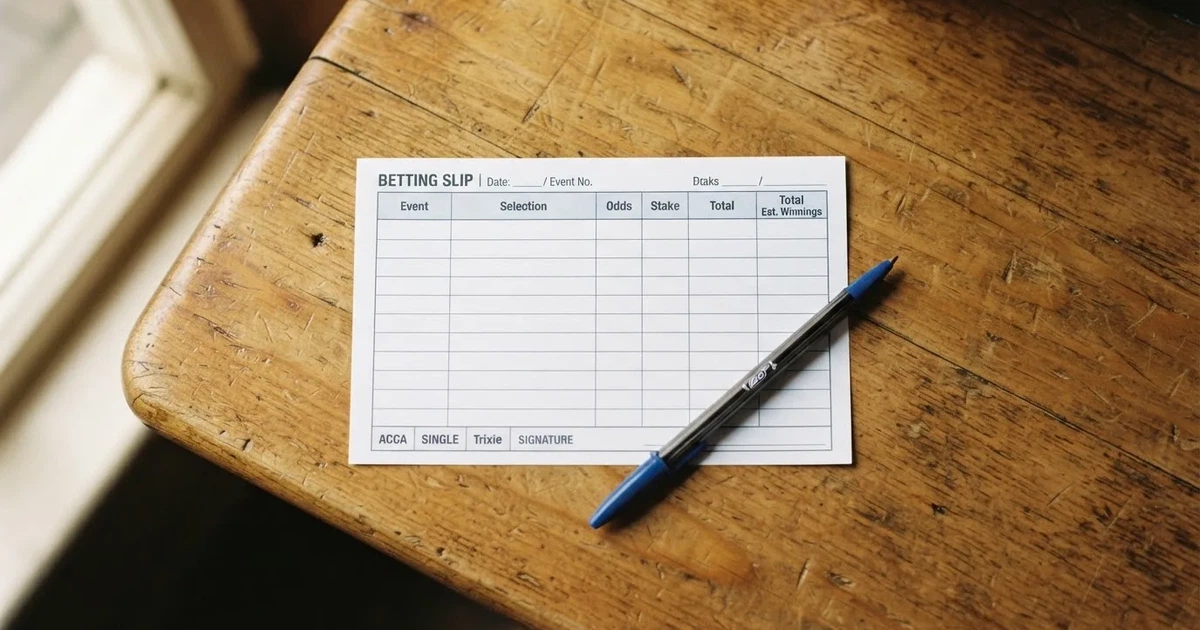
That single line is the reason the bet looks friendlier than it is. On a paper betting slip it reads as one wager. On a settled account it shows up as fifty-seven. The cost, the upside, and the ruinous middle ground — where one leg wins and fifty-six lines die — all live inside that gap.
This page walks through how a Heinz is built and settled in Great Britain, what the 57 lines actually mean in pounds at the till, and how to tell whether the bookmaker taking the bet holds a Gambling Commission licence at all. The maths is the page’s own; the figures below come from a single illustrative set of odds, not a quoted price.
*Current as of 27 October 2026. Licence claims verified against the Gambling Commission’s public register.*
The Heinz sits inside Great Britain’s wider rules — and the rules reach into your slip
Betting in Great Britain runs on the Gambling Act 2005. Any operator offering its site to customers in England, Scotland or Wales needs a Gambling Commission licence, and that licence is matched to a category. The categories that cover a Heinz include remote general betting standard (real events), the licence most online sports bookmakers hold. Spreadex is the one clear exception inside this set: financial spread betting on the same site is regulated by the Financial Conduct Authority, not the Commission, and Spreadex reminds customers in plain type that spread-betting losses can exceed the deposit.

Licences are not awarded to a domain; they are awarded to a company. Several well-known brands run from a single licence holder — Ladbrokes and Coral under one, Paddy Power and Betfair under another — and counting those as independent bookmakers is a mistake the page avoids. A brand without a Commission licence in Great Britain is operating illegally at the point of consumption, even if it holds a Curaçao, Maltese or Gibraltar licence somewhere else. The Commission’s public register is the test of who holds one and who does not; it can be searched by business name, trading name, domain or account number, and no other check beats it.
Northern Ireland is the awkward neighbour. The 2005 Act covers Great Britain only; Northern Ireland sits under older legislation, so a “GB licence” is a GB licence and nothing more. Anyone in Belfast who bets with a GB-licensed bookmaker is still using a GB-licensed bookmaker — that is fine — but it is worth knowing whose law governs the bookmaker before the law governs you.
What the law does not do is list permitted bets. There is no statutory schedule saying “you may offer a Heinz”. An operator licensed for general betting standard decides its own markets under its own rules and the Licence Conditions and Codes of Practice, and a Heinz falls out of that as one of the standard multiple-bet formats that nearly every GB bookmaker supports.
Verification starts before the first bet, not after the win
Since 7 May 2019, name, address and date of birth have to be verified before a customer can deposit — including before claiming a free bet or bonus. The rule exists to keep under-18s and excluded players out, and it is the same reason there is no anonymous play at a licensed site. Identity is checked against public records, not against your bank.

Alongside the basic check there is a financial vulnerability check, in force since 30 August 2024. It triggers when deposits minus withdrawals cross £150 across a rolling 30-day window (since 28 February 2025) and looks at public-record markers such as bankruptcies or county-court judgments. It is not an income check and not a credit-reference check. A second stage, the affordability checks that the press calls “affordability”, has been announced in a staged plan with no start date — write “announced, staged, no start date”, not “in force”.
From the regulator’s mouth — what to do before you deposit
The Commission’s register and its consumer-facing guidance sit on its site. A bettor who wants the registration check done properly can do it themselves in under two minutes: search the brand name, confirm the legal entity (often a parent company the brand does not advertise on the homepage), note the account number, and check that the activity listed includes “remote general betting standard” or “remote betting intermediary”. The account number on the operator’s own terms page should match the register entry. Where it does not, the page that carries the number is the more reliable one to trust.
The safer-gambling cage around the slip
A Heinz draws 57 small bets, and any one of them going wrong is enough to keep dozens of lines at zero. The temptation to “chase” by adding another leg, or to add funds after two legs have landed, is the exact trap the protections are built around — and the protections are mandatory for any licensed GB bookmaker, not optional.
GAMSTOP is the national online self-exclusion scheme and has been a licence condition for online operators since 31 March 2020. Exclusion periods run six months, one year, five years, or five years auto-renewed, and after the minimum period the exclusion sticks for a further seven years unless the customer asks GAMSTOP to lift it. The scheme covers online sites and apps only; high-street betting shops run their own separate system. Every GB-licensed online operator takes part, and Midnite, 888sport, Paddy Power and the rest of the licence-holders in the ranking below all carry the GAMSTOP mark.
Deposit limits work differently from self-exclusion. Under Remote Technical Standard 12, a licensed operator must offer a customer-set gross deposit limit on a fixed time frame. The first changes have applied since 31 October 2025; a second phase was postponed to 30 September 2026, and whether that phase is live is not settled. The point is straightforward: the ceiling is yours to set, and the operator has to honour it without persuasion. There is no state-set deposit or loss ceiling for betting; the limit is the limit you chose, not the law.
If gambling stops being a pastime, the routes out are free and confidential. GamCare runs the National Gambling Helpline. GambleAware signposts treatment. The NHS runs specialist gambling clinics across the regions. Gamblers Anonymous runs local groups. None of those services is run by the bookmaker, and the bookmaker is paid nothing for referring a customer into them.
For offshore sites the cage is missing. A brand without a GB licence does not sit inside GAMSTOP, has no Commission complaints route, no ADR body, no British consumer redress if funds are withheld, and is not bound by the £150 vulnerability check or the 10x bonus cap. The site may still pay out — most do — but the safety net under the bet is gone.
Marketing messages live under their own rules
Wagering requirements on bonuses have been capped at 10x since 19 January 2026: a £10 bonus no longer needs more than £100 of qualifying bets to clear. Mixed-product promotions — the “bet on football to get free spins” kind — are banned outright. Those rules tighten what a Heinz-tied bonus can ask of a bettor, and they apply at every GB-licensed operator.
The advertising rules underneath run through the ASA’s CAP Code (non-broadcast) and BCAP Code (broadcast), with the Commission’s marketing conditions sitting on top. The CAP Code’s section 16 sets the rules: marketing for gambling must be socially responsible, must not be of strong appeal to under-18s, and no one who is or appears to be under 25 may feature as a gambler or take a significant role (with one narrow exception for marketing placed where a bet can be placed directly). On TV, betting ads are not shown from five minutes before a live sporting event to five minutes after, before the 9pm watershed. Horse and greyhound racing are exempt from that window. None of this controls the slip; it shapes the advert a punter saw before opening the slip.
What a Heinz “free bet” or bonus is actually worth
The Heinz is the bet, but it is also the lever that bookmakers use to sell bonuses. A “Heinz free bet calculator” is a phrase punters search for, and the questions it answers split into the same shape every time: how much does the offer pay, what does it cost to clear, and what is left at the end.
The rules around those offers just got tighter. Wagering requirements on bonuses are capped at 10x as of 19 January 2026, and mixed-product promotions are banned. So a bonus tied to a Heinz now needs no more than £100 of qualifying bets per £10 of bonus, and it cannot be contingent on a casino spin or a bingo card as well. Anything beyond those rules is the operator’s own choice, and that is where the conditions live that turn a “free” offer into a grind.
A free bet is nearly always paid back as winnings only — the stake of the free bet is not returned when the bet wins. That detail changes the arithmetic of any free-bet Heinz. A £10 free-bet line on a six-fold at combined odds of, say, 120 returns £1,200 in winnings, not £1,320 in total. For a customer used to the £1320 figure from a cash stake, the difference is the cost of the word “free”.
Some books offer acca insurance as a side offer on the same slip. BoyleSports runs a specific version: opt-in, minimum stake £5, minimum leg odds of 1/2 (1.50 decimal), maximum refund £20 as a free bet that expires in 7 days, and the bet has to be placed and settled on the same day. If one leg of an accumulator lets you down, the stake comes back as a free bet — which carries its own wagering cost. That kind of offer softens one kind of bad beat and sharpens another.
The shape of a “Heinz free bet” once it lands on the slip
The bettor does not claim the free bet, place 57 lines, and walk away with winnings. The free bet sits on the slip as stake, settles like any other line, and the winnings — not the stake — are withdrawable. The rest of the offer — the terms, the expiry, the min price, the wagering — is in the operator’s small print and is what determines what the bonus actually returns. Read those before the bet, not after the losing leg.
“Heinz betting tips” sell what the maths won’t pay for
Search any bookmaker-tinged site for “heinz betting tips” and the page that comes back will name six selections, picture a jackpot payout, and end with a price. It is the genre. The maths underneath says most weeks that page is wrong, and the cost of acting on it is paid in 57 lines per bet at minimum £2 each.
Heinz betting tips exist because the structure of the bet demands six picks that all win. The product of six average-priced selections, even at modest odds of 1.50 per leg, gives a six-fold of about 11.4. A £1 line on that six-fold returns about £11.40 if all six win, and the other 56 lines settle around it — most at zero, because the structure pays only when every leg wins. The same six selections at evens (2.00 each) compound to a six-fold of 64.00 — a £1 line returns £64. A £10 Heinz at those odds costs £570 and, in the all-win case, returns £5,760 on the six-fold alone, plus every lower multiple that also lands. The kicker is the cost: £570 to find out whether six picks were right.
No betting system turns that around. There is no staking plan that makes a Heinz a positive-expectation bet at typical margins, and there is no “form” angle that beats a 5% to 8% margin across 57 lines. The “tips” pages sell the chance of a big payout at the price of a frequent small loss, and that is the trade a Heinz bettor is making every time the slip is filled in.
What a Heinz does give is variance. A six-fold at meaningful odds (anything over 30/1) pays thousands for a £1 line, and even a partial — landing five of six — gives back several four-fold lines, a fistful of trebles and a stack of doubles. Bankroll-wise that is a feature, not a bug: a punter who wants one big hit for a small stake builds a Heinz. A punter who wants steady turnover builds an accumulator with fewer legs, or a single.
For the responsible gambler the rule is simple. The Heinz is a high-variance structure. Bankroll a Heinz sized for the loss you can take on the 56 lines that will die, not the one line that pays. Set a deposit limit with the operator, honour it, and don’t reload to chase two landed legs.
How the Heinz is built, settled and paid out
A Heinz is a multiple bet in which the bookmaker strikes every combination of doubles, trebles, four-folds, five-folds and the single six-fold across six selections. There are no singles in a Heinz, and that distinguishes it from a Lucky 15 on four selections, which includes four singles among its fifteen bets. The Heinz is also called a full-cover bet, meaning it covers every available multiple across the given number of picks: full cover on six.
The table puts the Heinz in its family. Each line is a full-cover bet on a different number of selections:
| Bet | Selections | Bets |
|---|---|---|
| Trixie | 3 | 4 |
| Yankee | 4 | 11 |
| Heinz | 6 | 57 |
| Super Heinz | 7 | 120 |
| Goliath | 8 | 247 |
The bet sizing is mechanical. Total stake = unit stake × number of bets. So a £2 Heinz costs £114, a £5 Heinz costs £285, and a £10 Heinz costs £570. Inside the bookmaker’s system this looks like one click on the betting slip; on the account it is fifty-seven.
When a selection voids — a non-runner on the horses, an event pulled before the off — the bet drops one tier and re-prices. A four-fold becomes a treble on the remaining legs, a treble becomes a double, and a double becomes a single. A six-fold with one void leg lands as a five-fold; with two it lands as a four-fold, and so on. Refunds are paid in line with the Rule 4 deduction schedule, a bookmaker rule rather than a statute: the more runners pulled from a race, the heavier the deduction on the survivors’ odds.
Settling happens once every leg has run. The payout arrives as a single figure into the account, with a breakdown showing which lines paid and which lost. For all six to win is rare; for five of six to win is more common but still the exception; for one of six to win is the typical outcome, and that outcome returns the stake on the winning double lines and zeroes everywhere else.
The bookmaker’s margin lives inside every leg
The margin is what the bookmaker keeps from every unit staked across the market. It is built into the price of every selection, which is why two firms can offer different odds on the same leg and both be honest in their advertising. The wider the margin, the less of each pound comes back as winnings over the long run.
For a single-result market such as a football match (home, draw, away) the payout share across all three outcomes works out as 1 ÷ (1/odds_home + 1/odds_draw + 1/odds_away), and the margin is 1 minus that share. If the home–draw–away prices are 2.10 / 3.40 / 3.60, the implied probabilities sum to (1/2.10 + 1/3.40 + 1/3.60) = 0.476 + 0.294 + 0.278 = 1.048 — an overround of about 4.8% and a margin of about 4.6%. The match result is the simplest market to read. A market such as total goals or Asian handicap carries a different margin; one market’s margin is not another’s.
A Heinz compounds the margin across all 57 lines. If each leg carries a 5% margin independently, the six-fold’s all-win margin sits higher than that; the lower multiples carry the legs’ margins through them. That is the trade the Heinz bettor signs up for in exchange for the chance of a six-fold payout.
Worked payout — what a winning line returns
Set the example plainly. Take six illustrative selections at odds of 1/2 (1.50), evens (2.00) and 6/4 (2.50), with a mix that gives a six-fold of, say, 90.00. Stake £10 total on an accumulator (a single bet whose price is the product of the six odds) and the return is stake × odds = £10 × 90.00 = £900, of which £890 is net profit. The same six selections through a full-cover bet at £2 per line costs £114 to stake, and the return still rides on which lines landed — a six-fold pays 180, a five-fold pays a portion of the four lower multiples, and so on, with the lower-multiple lines paying only when their particular combination is intact.
For a combo, the price multiplies through. Two selections at 1.50 and 2.00 give a double of 3.00; a £5 double returns £15 (£10 net). Three selections at 1.50, 2.00 and 2.50 give a treble of 7.50; a £3 treble returns £22.50 (£19.50 net). That is the unit the Heinz is built from.
The condition behind any worked example: the prices must all win, and any push or void collapses the relevant lines to the next tier. The maths that says “the bet paid back £X” depends on every leg landing as priced. On any given weekend most Heinz slips land one of two outcomes — a handful of doubles and very little else, or a near-miss where five of six land and the all-win payout is tantalisingly close.
The licensed bookmakers offering a Heinz — comparison
Every bookmaker in this ranking holds a remote Gambling Commission licence, and the comparison is about what each one’s own terms say about the Heinz and the markets that surround it. A column of dashes tells the reader nothing, so a row covers what each operator’s licence and terms genuinely clear; the rest of the operator’s profile sits in its dedicated write-up further down.
| Bookmaker | Gambling Commission remote licence | Terms on the Heinz and the wider multiple-bet offer |
|---|---|---|
| Midnite | 101839 — Midnite Limited | Site lists in-play events, acca builder, popular accas and price boosts with maximum-stake limits; welcome offer is a fixed-odds sportsbook promotion, free bets credited on qualifying bets at EVS (2.0) or greater within 14 days |
| Smarkets | 39173 — Smarkets (Malta) Limited | Exchange-style betting intermediary; standard commission 2% on eligible bets, with new customers running on 0% commission for 60 days and a first deposit of £10 |
| 888sport | 39028 — 888 UK Limited | Pre-match and in-play betting, Cash Out, Bet Builder, racing streams, BetFinder form tools, live bet feed and daily boosted odds across the markets that feed a Heinz |
| BoyleSports | 39469 — Boylesports Enterprise | Acca Insurance requires opt-in, min stake £5, min odds 1/2 (1.50), max refund £20 as a free bet expiring in 7 days, bets placed and settled the same day |
| William Hill | 39225 — WHG (International) Limited | Best Odds Guaranteed on UK and Irish horse racing from 8 AM on race day, on single and multiple bets; the rule excludes ante-post, tote and pari-mutuel bets, so a Heinz with a horse leg can be affected |
| LiveScore Bet | 56859 — LiveScore Betting and Gaming (Gibraltar) Limited | Bet Builder allows up to 10 selections across match result, BTTS, corners, total goals, player scoring and card markets — the building blocks a Heinz-style combination sits on top of |
| Betboro | 44181 — Webmedia Development N.V. | In-play markets, cash-out on football, racing and tennis, boosted odds on selected singles from £10 stakes and safer-gambling tools (deposit limits, reality checks, self-exclusion) |
| Spreadex | 8835 — Spreadex Limited | Fixed-odds and spread betting on the same site; FCA-regulated spread betting with losses that can exceed the deposit; the firm’s own terms split the two offers and book them under different regulators |
| Lottoland | 38991 — EU Lotto Limited | Mixed-product site combining casino, lottery betting, sports betting and scratchcards; the Heinz falls under the sportsbook arm and is treated as any other multiple |
| Paddy Power | 39439 — PPB Counterparty Services Limited | Bet Builder+, Popular Bet Builders, Super Sub (a substituted player’s bet rolls over to the replacement), expanded Win More markets, plus player and ACCA stats relevant to a six-pick slip |
That table is the licence column and the operator’s own terms, set side by side. The licence column is verifiable at the Commission’s public register; the terms column is verifiable at each operator’s site. Where the comparison does not help a bettor decide — and most do not, on this page — the write-ups below add what the table cannot, which is a verdict on what each operator’s profile costs or saves a Heinz bettor in practice.
Midnite
Midnite runs under Gambling Commission licence 101839, held by Midnite Limited. The site’s sportsbook is a remote general betting standard licence and the pages list in-play events, an acca builder, popular accas and price boosts with maximum-stake limits that vary by event and bet type. The welcome offer aimed at sports is a fixed-odds promotion: a £5 or more qualifying bet at EVS (2.0) or greater within 14 days of sign-up returns £25 of free bets and 50 free spins, the free bets usable for 7 days.
For a Heinz bettor the relevant detail is the acca-builder footprint. An acca builder on Midnite is the bit that lets you stack six selections from one match (a same-game multi), and the wider Heinz — six picks across multiple events — is built the conventional way on the slip. The terms on min price, max stake and the expiry are the bits to read before betting, not after. Midnite is registered with GAMSTOP and the verification checks at sign-up include the standard name-address-DOB process the Commission mandates. Verdict: a GB-licensed sportsbook with the standard acca infrastructure and a fast-expiring free-bet welcome — the Heinz works, the welcome is short-windowed and the max-stake limits on boosts are the chief place where the bettor reads the terms twice.
Smarkets
Smarkets is a betting exchange under Commission licence 39173, held by Smarkets (Malta) Limited. The 2% standard commission on eligible exchange bets is the most quoted number on the site; new customers run on 0% commission for 60 days on a minimum first deposit of £10. A Heinz on an exchange is a different animal from a Heinz on a sportsbook: back the same six selections, or mix back and lay across a structure — the exchange’s commission is taken from net winnings, not from the stake, and the all-win payout is the backer’s liability less the layer’s liability.
For a Heinz bettor the attraction is structural. The exchange carries a narrower margin than a typical sportsbook on most football and horse-racing markets, and that narrower margin is the cheaper end of the same 57-line bet. The trade is volume: an exchange needs liquidity in the selections you want to back, and a six-leg Heinz across six distinct events is harder to fill at high stakes than the equivalent on a sportsbook. The platform is exchange-only on sports — there is no acca-builder convenience here, no boosted-odds price — and the 0%-for-60-days window is the practical reason a bettor trying an exchange for the first time does so on Smarkets. Verdict: the cheapest way to put a Heinz on, given you can find the liquidity and are happy with the exchange mechanics.
888sport
888sport runs under Gambling Commission licence 39028, held by 888 UK Limited. The product list covers pre-match and in-play betting, Cash Out, Bet Builder, racing streams, BetFinder form tools, a live bet feed and daily boosted odds. The Heinz on 888sport is built the conventional way; the supporting features — Bet Builder for same-game multiples, racing streams for live viewing, daily boosted odds — sit beside it.
The Heinz bettor’s case for 888sport is the breadth of supporting infrastructure. A Bet Builder reduces the number of distinct events a six-leg Heinz needs, which tightens the structure but adds complexity on void settlements. Daily boosted odds shift the price on named selections by a small margin in the bettor’s favour, and on a six-fold the boost compounds across the leg it touches. None of that changes the underlying margin on the wider Heinz, and the boosts typically come with their own max-stake terms. Verdict: a standard GB-licensed sportsbook whose Heinz sits on a wide product base — strong when a bettor wants bet-builder legs, average when they do not.
BoyleSports
BoyleSports holds Gambling Commission licence 39469, under Boylesports Enterprise. The headline multiple-bet feature is Acca Insurance: opt-in, minimum stake £5, minimum leg odds 1/2 (1.50), maximum refund £20 paid as a free bet expiring in 7 days, with the bet placed and settled on the same day. The Heinz is the natural shape for that protection — six legs, one failing leg, and a free bet on the stake back, subject to the cap.
The arithmetic at that offer’s edge is the read. Cap of £20 means a refund is worth up to £20 — any stake above £20 returns only £20 as a free bet. The free bet expires in 7 days and is not redeemable as cash. One-leg minimum odds of 1/2 (1.50) rules out anything shorter, and the same-day settlement requirement stops the offer from carrying over weekends. The terms’ day-window is the kind of detail a Heinz bettor only catches by reading them. Verdict: an acca-insurance offer that fits a Heinz-sized slip but whose £20 cap binds below modest stakes — useful as a partial hedge, expensive as a full one.
William Hill
William Hill holds Gambling Commission licence 39225, under WHG (International) Limited. The marquee horse-racing feature is Best Odds Guaranteed: from 8 AM on the day of UK and Irish races, the bookmaker pays the bigger of the price taken and the starting price, on single and multiple bets. The offer excludes ante-post, tote and pari-mutuel bets.
For a Heinz bettor who builds the slip with one or more horse-racing legs, BOG is a material tailwind. The multiple-bet payout can rise on the morning of the race if the starting price drifts, which it does often enough to be a real edge. A Heinz heavy on football or tennis does not benefit; the offer is racing-only. The other side of William Hill is the long licence history and the traditional bookmaker setup, which means the slip behaves the conventional way and the voids follow Rule 4 cleanly. Verdict: a Heinz built around a UK or Irish racing leg takes the SP if it drifts — worth it for those slips, neutral for the rest.
LiveScore Bet
LiveScore Bet runs under Commission licence 56859, under LiveScore Betting and Gaming (Gibraltar) Limited. The Bet Builder accepts up to 10 selections across match result, both teams to score, corners, total goals, player scoring and card markets. The Heinz itself is a multiple on six selections, but a same-game-multi pulled from a Bet Builder can sit inside one or more legs.
For a Heinz bettor, LiveScore Bet’s bet-builder ceiling of 10 selections is wider than the industry norm and goes deep into player-specific markets — useful for a bettor who wants an exact-match leg they would not find on a smaller sportsbook. The Heinz is built around those legs the conventional way. Like every other operator here, LiveScore Bet is GAMSTOP-registered and the verification is standard. Verdict: the bet-builder depth is the edge for a same-game-multi inside a six-leg Heinz; less differentiated elsewhere on the slip.
Betboro
Betboro holds Gambling Commission licence 44181, under Webmedia Development N.V. The site lists in-play markets and cash-out on football, racing and tennis, boosted odds on selected singles from £10 stakes, and the safer-gambling tools the LCCP requires (deposit limits, reality checks, self-exclusion). The Heinz sits as a multiple bet across the full sportsbook and is built conventionally.
The safer-gambling tools are the principal point of difference on a Heinz page. A bettor who wants a deposit limit or a reality check beside the slip does not need to leave Betboro to set them. The Heinz itself is, on this evidence, run-of-the-mill. The product around it — in-play, cash-out, boosted singles — is the inventory a Heinz uses but does not change. Verdict: standard GB-licensed sportsbook whose safer-gambling tools are more visible than most and whose Heinz has nothing custom to it.
Spreadex
Spreadex holds Gambling Commission remote betting licence 8835, under Spreadex Limited — and is separately regulated by the Financial Conduct Authority for financial spread betting. The dual regulation matters: fixed-odds bets on the site are GB-licensed and the Heinz works the conventional way, but spread bets on the same site are FCA-regulated and the loss on a spread position can exceed the deposit. Spreadex states that directly on the homepage.
For a Heinz bettor this is two products under one sign-in. A Heinz staked on a sportsbook bet works as any other multiple; a spread position is a contract priced per point and the loss-side moves against the customer past their deposit. The new-customer offer sits at the sportsbook end: £60 in free bets for a £10 fixed-odds bet, with the free bets usable across fixed odds and spread betting, and a 28-day window on the qualifying bet. Verdict: a Heinz at Spreadex is a sportsbook bet at Spreadex — workmanlike. The spread side is not a Heinz and not something to confuse with one.
Lottoland
Lottoland’s UK licence is 38991, under EU Lotto Limited. The site combines casino, lottery betting, sports betting and scratchcards. The Heinz falls under the sportsbook arm and is treated conventionally on the slip; the rest of the site (lottery, casino, scratchcards) is a different product area.
For a Heinz bettor the relevance is whether the sportsbook is deep enough to fill a six-leg slip reliably. Lottoland’s sportsbook is not the deepest in this ranking, and the market depth on a six-leg cross-sport Heinz is correspondingly thin in places. Where it is deep — football markets, in particular — the slip is straightforward. Verdict: a Heinz is available at Lottoland under a Commission licence but the sportsbook is not the centre of the product; readers comparing for Heinz depth may look at thinner alternatives first.
Paddy Power
Paddy Power runs under Gambling Commission licence 39439, under PPB Counterparty Services Limited. The app’s product list includes Bet Builder+, Popular Bet Builders, Super Sub (a bet rolls over to the replacement if a selected player is substituted), expanded Win More markets and player and ACCA stats. The Heinz is a standard sportsbook multiple, and Paddy Power’s wider product sits beneath and beside it.
The Heinz bettor’s edge at Paddy Power is the unique features. Super Sub changes how an in-play or pre-match player leg handles a substitution — the bet is not voided but rolled over to the replacement, which is rare at other operators. Popular Bet Builders shorten the line-building on a six-leg slip where several picks come from one match. ACCA stats add form and head-to-head detail on the leg pages. None of those change the Heinz margin; all of them make the slip easier to fill. Verdict: a Heinz sits on top of an unusually generous feature set — Super Sub alone gives the bettor an edge no other operator in this table matches.
Frequently asked questions
What is a Heinz bet?
A Heinz bet is a full-cover multiple bet on six selections that the bookmaker strikes as 57 separate bets in one go: 15 doubles, 20 trebles, 15 four-folds, 6 five-folds and 1 six-fold, with no singles included. The unit stake multiplies across all 57 lines, so a £2 Heinz actually costs £114 to place. It is one of the standard multiple-bet structures at every GB-licensed online bookmaker and is built and settled the same way across firms.
What is a Super Heinz bet?
A Super Heinz is the next size up: a full-cover multiple on 7 selections striking 120 bets — 21 doubles, 35 trebles, 35 four-folds, 21 five-folds, 7 six-folds and 1 seven-fold, with no singles. It costs 120 times the unit stake to place. The same six-leg structure applies in miniature: every combination of multiples is included, every leg is required for the highest-paying line to settle, and any leg letting you down collapses the relevant lines to the next tier.
How many bets in a Super Heinz?
120 bets in total. They break into 21 doubles, 35 trebles, 35 four-folds, 21 five-folds, 7 six-folds and 1 seven-fold. There are no singles; the structure mirrors the Heinz on six selections with one more selection’s worth of combinations added. A £2 Super Heinz therefore costs £240 to stake.
How can it be checked that a bookmaker holds a Gambling Commission licence?
Search the Gambling Commission’s public register by business name, trading name, domain or Commission account number. Confirm that the legal entity on the register matches the legal entity in the operator’s terms, and that the activity listed for that licence includes remote general betting standard (real events) or remote betting intermediary. The licence number on the operator’s own page should match the register’s number.
How is the return on a bet worked out from the stake and the odds?
The return on a winning single bet is stake multiplied by the decimal odds; the net profit is the return minus the stake. For a combination bet such as a double or a treble, multiply the odds of the legs together to get one price, then multiply that price by the stake for the return. A six-fold at combined odds of 90.00 with a £1 stake returns £90 (£89 net); at the same odds with a £10 stake the return is £900 (£890 net). Voids drop the affected leg and re-price the bet at the next lowest tier.
What is the bookmaker’s margin and how can it be seen in the odds?
The margin is what the bookmaker keeps, on average, from every unit bet on a market. Take a football match result priced at home 2.10, draw 3.40, away 3.60. The implied probabilities (1/2.10, 1/3.40, 1/3.60) sum to 1.048 — an overround of about 4.8% and a margin of about 4.6%. A lower margin means a higher payout share to the bettor over many bets; a higher margin means the bookmaker keeps more of every pound staked.
Bet types & in-play – Footy Tips
Content created by the «Footy Tips» team
