
Field hockey betting tips 2026: a guide, not a tip sheet
 Available in US
A field hockey game lasts sixty minutes across four quarters, eleven players a side on a surface barely larger than a football pitch, and the sport has no obvious star ranking to anchor a casual tipster’s instinct. That absence is the whole reason this page exists. The reader who searches for field hockey betting tips usually arrives with a match in mind, a fixture list open in another tab, and an appetite for someone to name a winner. The honest answer is that nobody can, and the more useful answer is the longer one: a price is built from form, line-ups, the surface and the competition’s profile, and a tip is only ever as good as the value left in the price once the bookmaker’s margin is removed. Everything on this page is built around that distinction. The guide explains how a price is set, what a margin takes out of it, what a bonus costs the punter who claims it, and how to verify that the bookmaker taking the bet is one a British customer can actually complain to if something goes wrong. No picks, predicted scorelines or “sure bets” appear here, because none of those exist; what appears is the framework a punter uses to judge whether a price on any given match is worth striking.

This page was written on 27 October 2026 and is current as of the Gambling Commission’s public register at the same date.
Regulation and licensing: who may take your field hockey bet in Great Britain
Field hockey sits inside the same British betting regime as football, tennis and horse racing, and that regime has a single gatekeeper. The Gambling Commission licenses every commercial bookmaker that takes bets from customers in Great Britain under the Gambling Act 2005, and the Gambling (Licensing and Advertising) Act 2014 made the licence compulsory at the point of consumption: an operator whose website is used by a customer in England, Scotland or Wales needs a Commission licence no matter where the company itself is incorporated. A Curaçao, Malta or Gibraltar registration does not exempt an operator from that requirement, and a British punter who registers with one forfeits the protections the British framework exists to provide.

A licence is checked by name, not by guess. The Commission’s public register is searchable by business name, trading name, domain or account number, and it lists the licence type, the licensee, the website and the expiry status. The relevant category for a sportsbook covering field hockey is remote general betting standard (real events); a separate licence category covers virtual events, and a separate intermediary licence covers betting exchanges. Spread betting that is financial in nature is regulated by the Financial Conduct Authority, not the Commission, which is why one operator in the comparison below carries a dual regulatory footprint — fixed-odds betting under the Commission, spread betting under the FCA — and why the same operator’s site reminds customers that spread-betting losses can exceed the original deposit.
The age rule is uniform: no betting under 18 anywhere a Commission licence is in play, and identity verification runs before the first deposit, not after a withdrawal request. Name, address and date of birth are checked, and the rule has been in force since May 2019. A free bet, a sign-up bonus or any other promotion still triggers verification, so there is no such thing as a fully anonymous British betting account. Verification is the price of playing inside the British framework; the alternative is playing outside it.
What the framework does not do is list permitted markets. No statute names which sports, leagues or competitions a bookmaker may offer. The Commission licenses a category and the operator, working within its Licence Conditions and Codes of Practice, decides which events to price. Field hockey therefore sits beside football and tennis on most major British sportsbooks not because a regulator required it but because the operators concluded the audience was large enough to justify the trading effort. Where a competition is obscure enough to attract no coverage at all, the only option is an offshore bookmaker that accepts British customers without a Commission licence — and that option surrenders GAMSTOP, the bonus cap, the vulnerability check and the Commission’s complaints route.
Responsible gambling: the tools a licensed bookmaker must put in the punter’s hands
A British licence carries obligations, and the most visible of them is GAMSTOP, the multi-operator online self-exclusion scheme that has been a mandatory licence condition for online operators since 31 March 2020. Registration runs for six months, one year, five years, or five years with auto-renewal, and once the minimum period elapses the exclusion stays in place for a further seven years unless the customer asks GAMSTOP to lift it. GAMSTOP covers online sites and apps; betting shops run a separate scheme. For a punter who has decided that the simplest answer is to stop, GAMSTOP is the closest thing to a hard off-switch the British market offers, and the comparison below treats participation as a baseline rather than a differentiator.
Less visible but equally important is the safer-gambling toolkit each licensed operator is required to surface. Every Commission-licensed sportsbook offers deposit limits, time-out periods, product restrictions and self-exclusion, and most route the customer toward a self-assessment such as a Player Profile test. Help is signposted in plain sight: the National Gambling Helpline (run by GamCare), GambleAware, NHS gambling clinics, Gambling Therapy and the Betting and Gaming Council. None of these are the operator’s own product; they are external services the operator is required to point the customer toward. A site that buries those links is telling the punter something about the operator’s priorities, and it is a tell worth acting on.
Two newer obligations are worth naming in their own right. The first is the financial vulnerability check, which has applied since 28 February 2025 and triggers once a customer’s deposits minus withdrawals exceed £150 in any rolling 30-day period. The check looks at public records such as bankruptcy or county-court judgments; it is not an income check, it is not a credit-reference check, and it does not bar play on its own. The second is the package of deposit-limit rules that began to apply in stages from 31 October 2025, with a second phase postponed to 30 September 2026. The first phase required operators to offer a gross deposit limit on a fixed time frame; whether the second phase has gone live is not established from the public record available. Both measures are part of a wider shift toward friction at the deposit stage, and the punter who reads the small print on a brand’s safer-gambling page can usually tell which rules are already enforced and which are flagged as forthcoming.
The check on a bookmaker’s safer-gambling setup is a routine part of choosing where to play. A site with a working deposit-limit tool, a working time-out, a self-exclusion route into GAMSTOP and visible links to GamCare is meeting the floor of what a Commission licence requires. A site that meets the floor and adds a session timer, a profit-and-loss statement and a clear path to closure on request is doing better than the floor. None of these tools are optional extras; they are the licence conditions, and the comparison later in this page treats them as such.
Bonuses and free bets: what a promotion actually pays out
The headline figure on a sportsbook’s promotion page is rarely the figure a punter keeps. A “£30 free bet” credits three £10 tokens that expire on a set schedule, settle as stake-not-returned (the free-bet stake is not paid back with a winning free bet), and pay only the profit leg of any winning wager. A “100% bonus” matches a deposit but attaches a wagering requirement — the punter must turn the bonus over a stated number of times before any of it becomes withdrawable — and the turnover is paid in real stakes at the operator’s minimum qualifying odds. A “risk-free” first bet that refunds a losing stake as a free bet is, in practice, a free bet conditional on the first wager losing; the refund is not money. The marketing language on every British sportsbook page runs along these lines, and the job of this section is to translate the marketing into the cost.
Two of the rules a British licence now puts on top of the marketing language are worth carrying through every offer on this page. First, since 19 January 2026 the wagering requirement attached to any bonus is capped at 10x: a £10 bonus needs £100 of qualifying bets before it is withdrawable, never £500 at a 50x turnover the older market used to carry. Second, mixed-product promotions — an offer that requires the punter to gamble on two or more product types, such as “bet on hockey to get free spins” — are banned. A field-hockey welcome offer that turns into a casino-spin sweetener is no longer a permitted shape; the bonus must sit on one product or it cannot exist.
The arithmetic that turns a promotion into a real number is straightforward. Take a £30 free-bet package credited as three £10 tokens at minimum qualifying odds of 1/1 (decimal 2.00): each token pays the profit only, so a winning £10 free bet at 2.00 returns £10 in cash plus the original £10 stake is not credited, leaving a £10 return on a stake the punter never paid for. The expected value depends on the price the punter takes; the higher the decimal odds, the larger the potential profit on the free bet, and the larger the expected loss against the bookmaker’s margin. There is no guaranteed profit from a free bet. A wagering requirement is simpler still: a £10 bonus at 10x turnover needs £100 of qualifying bets, and the cost of clearing it is the expected loss on those £100 of bets at the margin of the markets the punter wagers on. That cost is small but it is never zero.
The offers on the comparison below are described the way each operator’s own terms state them: the headline figure, the qualifying trigger, the minimum odds, the expiry, the form of any refund and the wagering requirement. Nothing on this page tells a reader which offer to claim, because the right offer depends on a stake the page cannot see and a market the page cannot know. What the page does tell the reader is how to read the small print on any offer before the deposit goes in.
Live betting and cash out: pricing a match that is already running
Field hockey’s four-quarter structure gives live betting a tempo that most football punters do not expect. A goal can land at any point in the sixty minutes, the quarter breaks reset the rhythm, and the bookmaker’s algorithm must reprice inside a few seconds every time the puck crosses the line. In practice, the in-play product on a major British sportsbook covers the headline events: match winner, next goal, total goals over a stated line, handicap lines and — for the larger fixtures — player-specific markets such as first goalscorer or any-time goalscorer. For a sport that is not broadcast on mainstream British television, the in-play product also depends on live data feeds, and a bookmaker whose feed lags is a bookmaker whose prices are untradeable for a serious punter.
Cash out is the second leg of the in-play product. It lets the punter lock in a profit or cut a loss before the final whistle, and the price is the bookmaker’s own estimate of the current position. The estimate is wider than the equivalent pre-match price — the bookmaker has to protect itself against the move that the punter is reacting to — and a punter who cashes out early is paying for that protection in the form of a lower take. Cash out is also a feature that most licensed British bookmakers gate behind a single-bet minimum, so an accumulator with cash out enabled is not always available, and the cash-out value on a long-priced acca leg is often a fraction of the notional mid-price. Reading the cash-out button as a tool rather than a gift is the discipline that separates the casual punter from the punter who treats in-play as a market rather than a moment.
The features worth checking on any bookmaker considered for live field hockey are: in-play coverage of at least the Pro League, the Hockey India League and the larger European club competitions; a live-tracker or a live data feed that updates scores in real time; a cash-out button that is available on singles and (where the operator offers it) on accumulators; and a live-streaming product, which is rarer in field hockey than in football or tennis but exists on a handful of platforms for the FIH Pro League and major club competitions. None of these features turns a poor price into a good one. They are the surface the punter needs to trade a price that was already worth trading before the match started.
The honest framing is that in-play on a sport as thinly covered as field hockey is not a margin-improvement tool — the margins are usually wider than pre-match — and is not a way to “follow the action”. It is a market that pays for being read carefully, on a bookmaker whose feed is fast and whose cash-out math is transparent, and it is not for the punter who cannot tell the difference between a stale quote and a live one.
Predictions and strategy: how a field hockey price is actually built
The phrase “field hockey betting tips” implies that a tip is something a reader can be handed, the way a recipe can be handed across a kitchen. It cannot, and the reason is structural. A price is a function of probability and margin, and a tip is at best a probability estimate dressed up as a prediction. The honest job the punter can do is build the probability, compare it with the bookmaker’s implied probability, and strike only when the comparison comes out positive. That gap — the punter’s estimate above the bookmaker’s, with the margin stripped out — is the value bet, and the rest of this section is the workflow for finding one.
Form, line-ups and the surface that makes field hockey its own sport
Field hockey is played on artificial turf in most professional competitions, and the surface affects scoring in a measurable way. A team that travels well on the road in the FIH Pro League is not always the team that wins at home in its own league, and the gap is largest on slow, watered pitches where short-corner routines dominate and on fast, dry pitches where open play does. The punter who reads a team sheet should be looking at: the goalkeeper (a strong keeper tightens short-corner odds for the opposing side), the central defender (the drag-flicker in a side’s short-corner rotation is often the most valuable goalscorer in the team), and the rotation itself (a coach who rests a top drag-flicker ahead of a bigger fixture signals how seriously the side takes the match). Head-to-head records are a weaker signal in field hockey than in most team sports, because the international calendar is short and the leagues are small; a three-year head-to-head in the Pro League is often built on six fixtures.
Statistics that actually move the price
Three categories of statistic do most of the work. First, short-corner conversion rate — the share of penalty corners a side converts into goals, and the share it concedes — is the cleanest predictor of goal difference at the top of the game. Second, shots on target and shots inside the circle, separately, because a side that lives in the circle but cannot finish is a side the in-play market will move against. Third, the save percentage of each goalkeeper, especially in the late quarters when short-corner rotations get tired. None of these is a tip. They are inputs to a probability, and the probability is what the punter compares with the bookmaker’s price.
Bankroll, staking and the discipline of value
A value bet is only a value bet if the punter can keep betting them. The arithmetic is brutal: a model that finds a 5% edge and a bankroll that loses 50% of stake per losing bet is one bad week from bankruptcy. The standard discipline is flat staking (the same unit on every bet, sized as a small percentage of the bankroll) and a written record of every bet struck, with the price at strike, the closing price and the result. A punter who does not keep the record cannot tell whether the model is working or whether the punter is pattern-matching the wins and forgetting the losses. The record is the only honest test of a tipping method, and no method survives the absence of one.
The discipline worth holding onto is that a tip is a probability, the price is a probability with margin loaded, and the punter’s edge is the gap between the two. Where there is no gap, there is no bet. Where the gap exists, the bet is sized as a unit of the bankroll, not as a hunch. Where the punter cannot write down the probability, the punter has not done enough work to be betting at all.
Bet types and odds: how a hockey market is built
The markets a bookmaker offers on a field hockey match divide into three families. The first is match-result markets — outright winner, double chance (covering two of the three possible outcomes in regulation: home win or draw, away win or draw, home win or away win), and the draw-no-bet line (refund if regulation ends level). The second is goals markets — total match goals over or under a stated line, team totals, Asian handicap on the goal difference, and the next-goal market in-play. The third is combinations — both teams to score (BTTS) where it is offered, correct score, and the bet-builder / same-game multi that bundles several legs from the same fixture into one accumulator-style price. The shape and the depth vary by operator, and the comparison below treats depth as a feature worth scoring.
The price itself is a margin-loaded estimate of probability. Decimal odds of 2.00 imply a probability of 1 ÷ 2.00 = 0.50, or 50%. Decimal odds of 3.00 imply a probability of 33.3%. Fractional odds of 5/1 imply 1 ÷ 6.00 = 16.7%. The two systems describe the same probability; they are not different numbers. Conversion is mechanical: a/b in fractional form becomes a ÷ b + 1 in decimal form, so 5/1 is 5 ÷ 1 + 1 = 6.00, and 11/4 is 11 ÷ 4 + 1 = 3.75. Evens, the British word for an even-money bet, is 1/1 in fractional form and 2.00 in decimal. Odds-on prices (shorter than evens) describe favourites; odds-against prices describe underdogs.
The margin is what sits underneath every price on every market. A two-way market priced at 1.90 / 1.90 in decimal odds has a payout share of 1 ÷ (1 ÷ 1.90 + 1 ÷ 1.90) = 1 ÷ (0.5263 + 0.5263) = 1 ÷ 1.0526 = 0.95, and a margin of 1 − 0.95 = 0.05, or 5%. A three-way 1X2 priced at 2.10 / 3.40 / 3.60 has a payout share of 1 ÷ (1 ÷ 2.10 + 1 ÷ 3.40 + 1 ÷ 3.60) ≈ 0.945 and a margin of about 5.5%. The margin represents the bookmaker’s take on every pound staked over the long run, and it varies by event, by market and by bookmaker. Field hockey sits in the middle of the British sportsbook market on margin — narrower than outright futures, wider than the Premier League match-result market — and a punter who compares the same market across three bookmakers is doing the work the margin test was designed to do.
The arithmetic the punter runs is the test. A two-way market priced at 1.90 / 1.90 implies a 50% chance on each side and pays out 95 pence for every pound staked in aggregate, so the bookmaker keeps 5 pence. The punter’s own estimate of each side’s probability, built from the form and the line-ups, is what the price is judged against. Where the punter’s estimate is 55% on the home side at decimal odds of 1.90, the implied 50% is below the estimate, the price is worth taking, and the bet is struck at a flat unit of the bankroll. Where the estimate is below the implied probability, the bet is left.
Sports and tournaments: where the field hockey calendar lives
The British punter looking for a field hockey price is served by a calendar that runs along three rails. The international rail is governed by the International Hockey Federation (FIH) and runs through the year in Pro League windows, Hockey World Cup cycles, continental championships and the Olympic cycle. The Pro League is the strongest club-free competition in the sport and runs weekly fixtures from late winter through the summer; the World Cup runs every four years; the Olympic tournament sits inside the Summer Games. The club rail is thinner. The Euro Hockey League covers top European club sides, the Hockey India League is the most prominent franchise competition in the sport, and a handful of national leagues (the Dutch hoofdklasse, the German Bundesliga, the English Premier Division) draw modest coverage.
The Olympic record is the easiest way to anchor a reader who does not know the sport. Men’s field hockey was played at the 1908 and 1920 Olympics, dropped in 1924 and reinstated in 1928, and India won the 1928 tournament without conceding a goal and took men’s gold in 1932, 1936, 1948, 1952, 1956, 1964 and 1980. Women’s hockey was added in 1980. The dominance is one of the longest runs any national team has put together in any team sport at the Games, and a reader who can name it has the historical context most field-hockey markets assume.
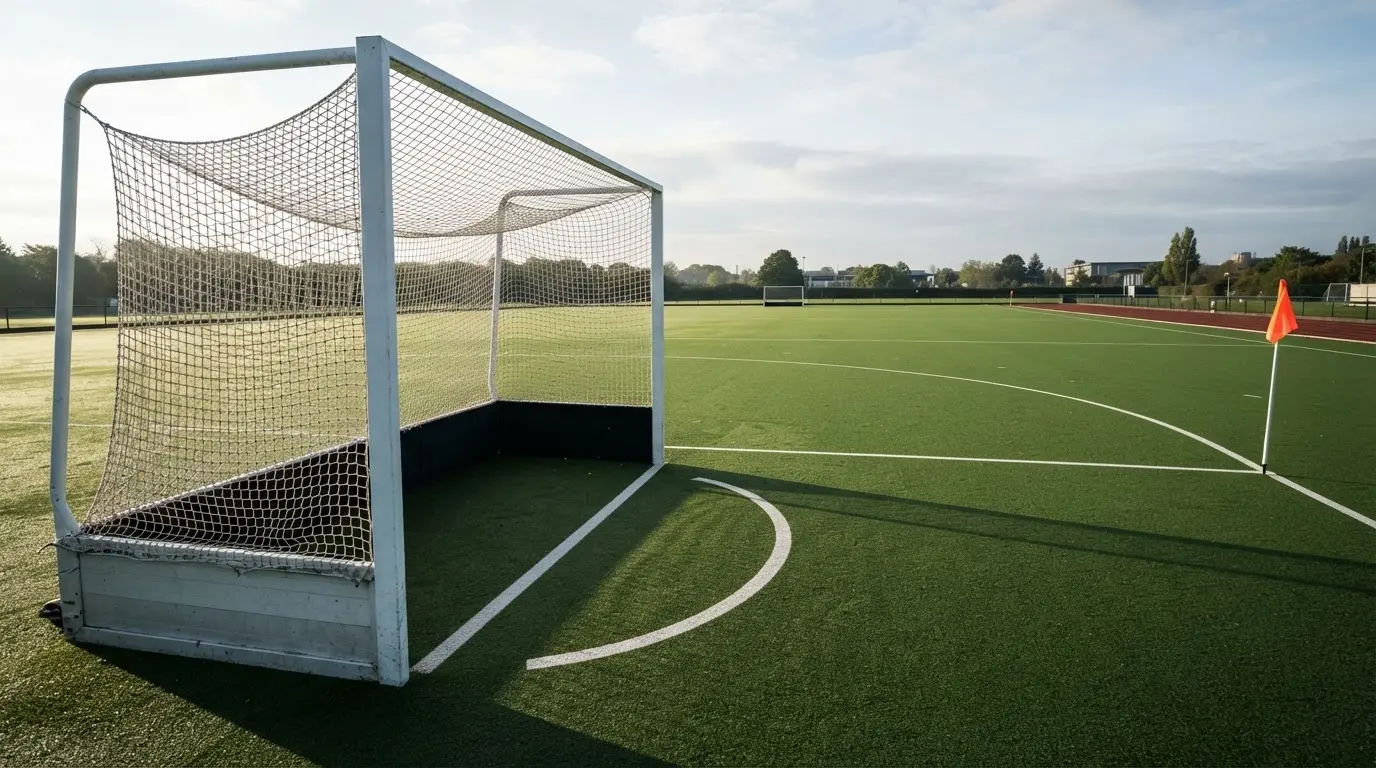
The rules worth carrying into a betting decision are short. Each side fields ten outfielders and a goalkeeper, eleven in total, on a pitch that measures 91.4 m × 55 m, with goals 2.14 m high and 3.66 m wide. Since 2017 matches have been played in four 15-minute quarters with a 2-minute break after each quarter and a 15-minute half-time after the second; the side with more goals at the end of sixty minutes wins. A tied match may stand, go to extra time or be decided by a shoot-out depending on the competition; since March 2013 FIH regulations send tied classification matches directly to a shoot-out without extra time. The structure shapes both the live market and the pre-match market: quarter markets, next-goal markets and handicap lines are all products of a sport that scores in bursts and resets between bursts.
The British betting market does not cover every competition, and the punter who cannot find a price on a fixture should treat that absence as information. A bookmaker that does not price the EuroHockey Club Champions Cup or the lower divisions of the Dutch league is telling the punter that the depth of the price list ends at the Pro League, the Hockey India League and the headline international fixtures. A punter whose edge sits in a less-covered competition is a punter who has to find a less-covered brand or sit on the bench.
The field-hockey bookmakers on the British market in 2026
The ten brands below each hold a Gambling Commission remote general betting standard (real events) licence, the relevant category for sports betting, and each is named in the Commission’s public register against a UK-incorporated licensee. The list is ordered by the marque research licence; the ordering does not order the recommendation, because the right brand depends on the punter’s stake, the market the punter prices and the way the punter wants to manage deposits. Each review carries the licence number, the licence holder, the headline feature that distinguishes the brand from the others on the list and a verdict on who the brand is built for. No offer on this page carries a promo code, a voucher or a click-through; every bonus is described in the form the operator’s own terms state it, and a punter who decides to claim one reads the terms on the operator’s site before the deposit goes in.
| Brand | Gambling Commission remote licence number and licence holder | What the operator’s own terms state on the key’s subject |
|---|---|---|
| BetGoodwin | 002927-R-327985-008; Goodwin Racing Limited | Pays Best Odds Guaranteed on all UK and Irish horse and greyhound racing, up to £1,000 |
| Sky Bet | 067370-R-341330-005; SBG Sports Limited | £30 in free bets (three £10 tokens) on a first £5+ single or each-way bet at 1/1 or greater |
| 10bet | 043173-R-322899-023; Blue Star Planet Limited | Cash out, Bet Builder and Live Streaming across football, tennis and horse racing |
| bet365 | 055148-R-331498-002; Hillside (UK Sports) ENC | In-play betting, live streaming worldwide, plus Bet Track, Match Live and a Live Golf Tracker |
| Copybet | 053774-R-330743-010; Copybet UK Limited | Best Odds Guaranteed all day on UK and Irish racing, with first-past-the-post paid even on later disqualification |
| BoyleSports | 039469-R-319383-025; Boylesports Enterprise | Acca Insurance on opt-in: £5+ stake, 1/2 minimum odds, max £20 free-bet refund, 7-day expiry, same-day settlement |
| Betmaster | 065699-R-339929-002; BM Solutions GB Ltd | UK-licensed under BM Solutions GB Ltd, registered in Malta, offering sports and casino |
| VBet | 044662-R-324273-022; SCGO Limited | Bet Builder, pre-match and in-play, live streaming and a live calendar with results and stats |
| BetVictor | 039576-R-319370-028; BV Gaming Limited | Best Odds Guaranteed on UK and Irish racing, enhanced live race streaming, BetFinder, Smart Stats |
| Spreadex | 008835-R-104580-022; Spreadex Limited | £60 in free bets for a £10 fixed-odds bet, usable across fixed odds and spread betting; 28-day window |
BetGoodwin
Goodwin Racing Limited runs BetGoodwin from a Commission account that has been on the register for years, and the brand’s distinguishing feature is its Best Odds Guaranteed offer on UK and Irish horse and greyhound racing — the price the punter takes is the price paid if it improves, up to £1,000. The product depth outside racing is narrower than the bigger sportsbooks on this list, and a punter looking for field-hockey depth at the level of the Pro League will find the betting menu shorter than bet365’s or BetVictor’s. For the racing-led punter who wants BOG and a clean Commission footprint, BetGoodwin is a sensible place to hold an account.
Sky Bet
SBG Sports Limited’s Sky Bet runs the same Best Odds Guaranteed product on racing and layers on a £30 free-bet welcome broken into three £10 tokens, credited after a £5+ first single or each-way bet at minimum odds of 1/1 (decimal 2.00). The free-bet stake is not returned with a winning free bet, so a £10 token at 2.00 pays £10 in profit only, and the three tokens carry their own expiry windows. Sky Bet’s product depth on field hockey runs through the major fixtures; the in-play coverage is competent; the cash-out button is available on singles. The right account here is the punter who wants a mainstream British sportsbook with a clear welcome and a familiar brand.
10bet
Blue Star Planet Limited’s 10bet carries Cash out, Bet Builder and Live Streaming across football, tennis and horse racing, which is the trio of products that defines a modern British sportsbook. The field-hockey product is not the headline market — the brand’s depth sits in football — and a punter pricing the Pro League week-by-week may find the menu thinner than a specialist’s. For the punter who bets mostly on football with a tennis or racing add-on and wants a single account to hold all three, 10bet is a competent middle-of-the-table choice.
bet365
Hillside (UK Sports) ENC runs bet365 from one of the best-known remote licences in the British market, and the brand’s product on field hockey is the deepest in the comparison. In-play betting, live streaming across events worldwide, Bet Track, Match Live and a Live Golf Tracker cover the infrastructure that lets a punter follow a price while it moves; live streaming of a lower-tier field-hockey fixture is rarer, but the brand’s tracker products compensate where the picture is not available. The right bet365 account is the punter who prices the sport seriously, wants every leg of the in-play toolkit and is willing to navigate a busy product to find the price.
Copybet
Copybet UK Limited is the licensee, and the brand’s distinguishing feature is its all-day Best Odds Guaranteed on UK and Irish racing plus a first-past-the-post rule that pays out even on a winner disqualified after the result. For the punter whose betting book sits in racing, Copybet is one of the more generous BOG products in the British market. Field hockey sits on the menu but is not the brand’s headline sport. The right punter here is the racing-led account-holder who wants the BOG terms and the disqualification protection and treats field hockey as an occasional side bet.
BoyleSports
Boylesports Enterprise runs BoyleSports, and the brand’s headline promotion is its Acca Insurance: opt in, stake £5 or more at minimum odds of 1/2 (decimal 1.50), build a winning multi where one leg lets the punter down, and BoyleSports refunds up to £20 as a free bet that expires in seven days, with the requirement that the bet is placed and settled on the same day. The terms are tighter than the headline suggests — a same-day settlement rule and a 1/2 minimum price both shrink the qualifying universe — and a punter who does not read them treats the insurance as more generous than it pays out to be. Field hockey is priced as a menu sport. The right account is the acca punter who can live inside the same-day and minimum-odds windows.
Betmaster
BM Solutions GB Ltd, registered in Malta, runs Betmaster under remote account 65699, and the brand offers a UK-licensed sportsbook alongside its casino. The product depth on field hockey is thinner than the bigger sportsbooks on this list, and the welcome offer sits in the same band as the rest of the British market. For the punter who wants a Commission-licensed sportsbook and is comfortable with a smaller betting menu, Betmaster is a credible place to hold an account.
VBet
SCGO Limited runs VBet from Commission account 44662, and the brand’s product set is built around Bet Builder, pre-match and in-play betting, live streaming and a live calendar with results and stats. The live calendar is the unusual feature — most sportsbooks keep results behind a tab; VBet puts the calendar on the front of the in-play section. Field hockey is priced as a menu sport with a focus on the bigger international fixtures. The right punter here is the customer who values the in-play surface and uses the calendar as a planning tool.
BetVictor
BV Gaming Limited runs BetVictor from one of the longest-standing licences on the British register, and the brand’s racing product is the headline — Best Odds Guaranteed on UK and Irish racing, enhanced live race streaming, a BetFinder feature for finding racing bets and Smart Stats to back the form work. Field hockey is a menu sport. The right punter is the racing-led account-holder who wants the BOG, the streaming and the form tools, and treats field hockey as a side bet.
Spreadex
Spreadex Limited runs Spreadex from Commission account 8835, and the brand is the only one on this list with a dual regulatory footprint: fixed-odds betting is regulated by the Gambling Commission, and spread betting on financial markets is regulated by the Financial Conduct Authority. The welcome offer is £60 in free bets for a £10 fixed-odds bet, with the free bets usable across fixed-odds and spread betting, and the qualifying bet must be placed within 28 days of opening the account. The spread-betting product is the brand’s distinguishing feature, and the firm’s own terms remind customers that spread-betting losses can exceed the deposit. Field hockey is priced inside the fixed-odds product. The right account is the punter who wants the dual product and is willing to take the spread-betting book on its own terms — which are not the same as a sportsbook’s.
How the bookmaker’s margin turns a price into a cost
Every price on every market carries a margin, and the margin reflects the bookmaker’s share of every pound staked on average. The arithmetic is mechanical and worth running once, by hand, because the result is the single best reason to compare prices across bookmakers before staking. Take an illustrative two-way market at decimal odds of 1.90 on each side: the implied probability on each side is 1 ÷ 1.90 = 0.5263, or 52.63%. Add the two implied probabilities and the sum is 1.0526, which is more than 1.000 — the extra 0.0526 is the bookmaker’s margin, and it means the bookmaker pays out 1 ÷ 1.0526 = 0.95 of every pound staked in aggregate. The remaining 0.05, or 5%, is the slice kept. A punter staking the same unit on the same outcome at 1.90 loses 5% of turnover to the margin on average; a punter who can find the same outcome at 1.95 holds the margin down to about 2.5% and keeps the difference.
Three things follow from the arithmetic. First, the margin varies by event, by market and by bookmaker: a Premier League match-result market sits in a 2-4% margin band on the biggest books, a Pro League match-result market sits wider, and the same fixture’s correct-score market sits much higher. A punter who only ever bets the same market on the same sport at the same bookmaker is paying the same margin again and again; a punter who shops the price across bookmakers is paying a smaller margin on at least some of the bets. Second, the closing price is the test: a bookmaker’s price ten minutes before the off is rarely its sharpest, and a market that has been live for hours has usually tightened as money has come in. A punter who prices early pays a wider margin; a punter who waits pays a narrower one, and the wait is itself a discipline.
Third, the margin is not the same as the bookmaker’s profit. The margin is the average take; the bookmaker’s profit is whatever is left after payouts and operating costs. The two are related — a wider margin usually means a fatter bookmaker margin — but the punter’s only handle on the number is the implied probability, and that handle is enough. A punter who strips the margin out, builds a probability, compares the two and finds the price is worth taking is a punter who has done the job; a punter who cannot strip the margin out is paying whatever margin the bookmaker charges and is gambling rather than pricing.
The mechanics of a field hockey bet, end to end
A bet on a field hockey match runs through the same sequence a bet on any other sport does, and the sequence is short enough to walk through once and then use as a checklist. The punter registers with a Commission-licensed bookmaker, verifies name, address and date of birth, deposits via debit card or bank transfer (credit cards are banned for gambling in Great Britain), opens the field-hockey menu, selects the fixture, selects the market, enters the stake and confirms the bet. The bookmaker records the price at strike and locks the bet at that price; any subsequent move in the price does not affect the bet. At settlement, the result is checked against the official competition result, and the bet pays out at the recorded price or settles as a loser. A free bet settles the same way but pays profit only — the stake is not returned with a winning free bet.
Three points sit underneath the sequence. The first is the price-lock: a bookmaker’s price is a snapshot, and the snapshot is what counts. A price the punter sees, rejects, and then comes back to after the price has shortened is gone. A punter who takes the first price on offer and the price the bookmaker sends back at confirmation is the punter whose record is honest. The second is the verification gate: the Commission has required identity verification before the first deposit since May 2019, so there is no path to anonymous play at a licensed site. The third is the credit-card rule: since 14 April 2020 no gambling transaction at a Commission-licensed site can be funded by a credit card, including a credit-card-funded payment through an e-wallet. A punter who tries to deposit by credit card is bounced at the cashier; a punter who funds an e-wallet by credit card and then uses the e-wallet at a betting site is also bounced, because the rule covers the route as well as the destination.
The withdrawal runs through the same gates in reverse. A punter who requests a withdrawal back to the original deposit method is paid in the same channel as the deposit; a punter who tries to withdraw more than the deposit total triggers a source-of-funds check at the higher spend bands, and the check is the same one the financial vulnerability rules govern. The withdrawal time varies by bookmaker and by method — debit card typically one to three working days, bank transfer one to five, e-wallets faster — and a punter who values speed shops the method as carefully as the price.
What the British betting tax framework means for the punter
British betting winnings are not taxed at the punter’s side: there is no income tax on a sports-betting win, no capital-gains treatment, no declaration to HMRC for a casual punter. The tax sits on the operator, in the form of General Betting Duty, currently 15% on the operator’s gross profits from general betting, with a new remote betting rate of 25% set to apply from 1 April 2027 inside the duty, while remote bets on UK horse racing, self-service betting terminal bets, pool betting and in-person betting stay at 15%. Until 1 April 2027 the remote rate stays at 15%, and whether operators pass the duty on through odds is not established from the public record. The punter pays no duty, and any claim by a bookmaker or a tipster that the punter owes tax on a winning bet is wrong.
The caveat is the professional gambler. HMRC treats some bettors as trading, in which case the income is taxable under trading-income rules, and a reader who treats betting as a business should ask HMRC or a tax adviser. This page is not tax advice; the rule is named because the absence of a tax bill for the casual punter is the headline and the exception for the professional is the footnote. Spread betting has its own duty structure: 3% on financial spread bets, 10% on other spread bets, levied on the operator.
The Commission’s statutory levy, paid by operators to fund research, treatment and harm-prevention work, is a separate charge, not a tax. The punter sees it priced into the margin or the offer rather than levied directly, and the levy is part of the cost of running a licensed bookmaker rather than part of the cost of placing a bet.
The offshore question: what the punter loses by betting outside the British framework
A bookmaker licensed outside Great Britain and serving British customers without a Commission licence is not “the same product, less paperwork”. The product is the same; the paperwork is the protection. A punter who registers with an offshore bookmaker loses GAMSTOP coverage (the multi-operator self-exclusion scheme is a Commission-licence condition, not a market-wide rule), loses the bonus cap (the 10x wagering cap is a Commission rule, not a global one), loses the £150 vulnerability check (a Commission rule) and loses the complaints route (the Commission runs an approved dispute-resolution route that requires a Commission licence). A punter who wins a six-figure sum and the offshore bookmaker refuses to pay has fewer routes than a punter who wins the same and the British bookmaker refuses to pay; an offshore bookmaker can vanish in a way a Commission licensee cannot.
The legal framing is that providing gambling facilities in Great Britain without the required licence is an offence under section 33 of the Gambling Act 2005, with penalties aimed at the operator (up to 51 weeks’ imprisonment, a fine up to level 5, or both; six months in Scotland). No offence aimed at a customer who merely bets on an unlicensed site has been established in the public record, and the framing is best left at the level of loss of protection rather than at the level of criminal risk. The Commission’s enforcement tools are disruption — cease-and-desist notices, search-engine referrals, registrar and host work — and the Commission has been given, or is about to receive, court-order DNS blocking powers; ISP blocking is not in operation as a standing tool. The honest framing for a British punter is that licensed means checks, limits, GAMSTOP and the bonus cap but also verification before the first deposit, and unlicensed means no checks and no protection and the same risk of loss a punter accepts in any unregulated financial transaction.
The field hockey betting landscape in summary
The British punter pricing field hockey in 2026 is buying into a market that runs on three rails — the FIH international calendar, the Pro League, and a handful of national leagues and club competitions — and is being served by a field of Commission-licensed sportsbooks whose products run from racing-led brands with field hockey as a side menu to specialist operators with deep in-play coverage and live data. The decision is not which bookmaker to use; it is which bookmaker’s product matches the punter’s stake and the punter’s market. A racing-led punter is best served by a brand with Best Odds Guaranteed and a clean racing product; a Pro League punter is best served by a brand with in-play depth, a live tracker and a fast data feed; a multi-sport punter is best served by a brand with a wide product and a Bet Builder that lets the punter assemble a same-game multi. The licensing check is uniform across all three — every brand on the comparison above holds a Commission licence, every brand takes part in GAMSTOP, every brand is required to offer deposit limits and the safer-gambling toolkit — and the punter who confirms the licence on the Commission’s public register before the deposit goes in has done the part no bonus can do for them.
Frequently asked questions
What is a value bet and why is no tip ever certain?
A value bet is a price whose implied probability, after the bookmaker’s margin is stripped out, sits below the punter’s own estimate of the true probability. This margin reflects the bookmaker’s share of every pound staked on average, and a price of 2.00 in decimal odds implies a 50% chance before margin is loaded; the punter’s estimate has to beat that implied number for the bet to be worth striking. No tip is ever certain because no probability estimate is ever exact, and a probability of 70% leaves a 30% chance of losing. The discipline is to size the stake as a small unit of the bankroll and to keep a written record of every bet, with the price at strike, the closing price and the result.
What is the bookmaker’s margin and how can it be seen in the odds?
This figure represents the portion of each pound staked retained by the bookmaker on average, and it sits inside every price on every market. The arithmetic runs from the implied probabilities: a two-way market at decimal odds of 1.90 on each side has implied probabilities of 1 ÷ 1.90 ≈ 0.5263 on each side, summing to 1.0526; the extra 0.0526 is the margin, the bookmaker pays out 1 ÷ 1.0526 ≈ 0.95 of every pound staked, and keeps the rest. A market whose summed implied probabilities exceed 1.000 by more is a market whose margin is wider, and a punter who compares the same market across three bookmakers is shopping the margin down.
How is the return on a bet worked out from the stake and the odds?
For a single bet, the return is the stake multiplied by the decimal odds, and the net profit is the stake multiplied by the odds minus one. A £10 stake at decimal odds of 3.75 returns £37.50 and pays a net profit of £27.50. A combination bet multiplies the odds of the legs together into one price, so a treble with legs at 2.00, 3.00 and 4.00 has a combined price of 24.00; a £10 treble returns £240 and pays a net profit of £230. The stake on a free bet is not returned with a winning free bet, so a £10 free bet at 3.75 pays a profit of £27.50 only, with the £10 stake forfeited whether the bet wins or loses.
How can a punter check that a bookmaker holds a Gambling Commission licence?
The Commission’s public register is searchable by business name, trading name, domain or account number, and is the whole test of whether a brand holds a licence. The relevant category for a sportsbook covering field hockey is remote general betting standard (real events); a brand that holds the licence is named on the register against a UK-incorporated licensee, with the licence number, the licence type and the licensed website. A brand that does not appear on the register is not licensed for the British market, and a punter who registers with one loses GAMSTOP coverage, the bonus cap, the vulnerability check and the Commission’s complaints route.
Which safer-gambling tools does a licensed bookmaker have to offer?
A Commission-licensed bookmaker must offer GAMSTOP registration, deposit limits, time-out periods, product restrictions and self-exclusion, and must surface links to GamCare, GambleAware, NHS gambling clinics, Gambling Therapy and the Betting and Gaming Council. The financial vulnerability check has applied since 28 February 2025 and triggers once a customer’s deposits minus withdrawals exceed £150 in any rolling 30-day period; the check is a public-records check, not an income check. The deposit-limit rules have applied in stages from 31 October 2025, with a second phase postponed to 30 September 2026; whether the second phase is live is not confirmed on the public record.
US & other team sports – Footy Tips
Content created by the «Footy Tips» team
