
Football Accumulator Bets: What They Cost and Who Offers Them
 Available in US
A £10 accumulator on three modest football selections can return forty pounds or four hundred. That gap is the point, and it is also the trap. This page is built around the cost side of that gap — what a price actually carries, what an “acca” really pays when one leg loses, and which bookmakers offer the product to British customers under a Gambling Commission licence. The mathematics and the licensing framework are the substance; the marketing words are not.
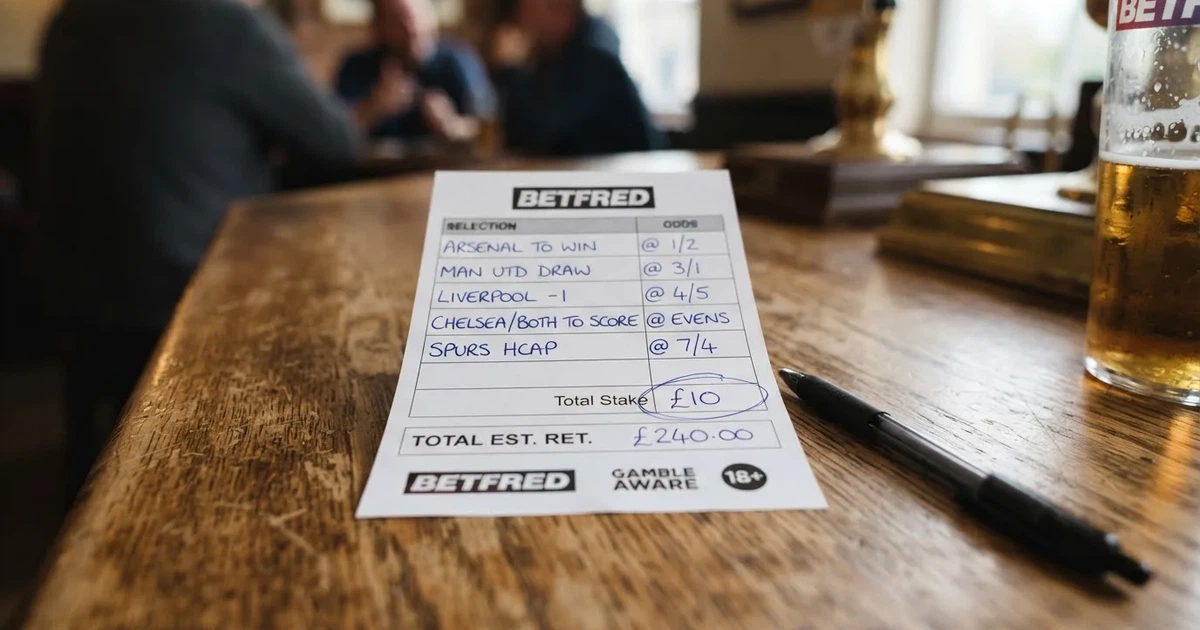
Current as of 27 October 2026. Operator licences checked against the Gambling Commission’s public register.
How Football Accumulators Are Priced — and What the Bookmaker Keeps
An accumulator links two or more single wagers into one bet. The payout odds of the bet are the product of the odds of every selection: a treble at 2.00, 3.00 and 4.00 reads as 24.00, not 9.00, because the winnings of the first two legs roll forward into the third. The stake returns with the winnings only if every selection wins; a single losing leg loses the whole bet, which is the price paid for the long price the accumulator prints at the top of the slip. A leg that ties — a “push” — is removed and the accumulator settles on the remaining legs at their combined odds.

The product of the legs is the headline number. The bookmaker’s margin sits inside every leg, multiplied along with the price. Decimal odds suit accumulators because the multiplication is direct; the British fractional price of 5/1 is the same as 6.00 in decimal, and the conversion is a/b → a ÷ b + 1. A bookmaker quoting 2.50, 2.50, 2.50 on three outcomes of a single match is publishing a margin that compounds three times across the accumulator, which is one reason prices between firms diverge more on accas than on singles. The punter pays the margin on every leg, and the accumulator is no exception.
A worked example on illustrative prices — these are not a quoted offer from any operator:
- three selections at decimal odds of 1.50, 2.00 and 2.50;
- product: 1.50 × 2.00 × 2.50 = 7.50;
- stake of £10 returns £75 if all three win, profit £65.
The same stake, with one price moved to evens (2.00) on every leg, returns £80 — a band, not a single figure, because the price of each leg varies by bookmaker and market. Two accumulators with the same headline number from two firms carry different margins, and the punter who treats the headline as the price is the punter the margin is built for.
A few names deserve to be set down before the comparisons begin:
- Single — one wager, one outcome, settled on that outcome alone.
- Double — two selections, both must win.
- Treble — three selections, all three must win.
- Accumulator (acca) — four or more selections, all must win; the more legs, the longer the price, the thinner the hit rate.
- Each-way — two equal-stake bets: one on the win, one on a place. The stake doubles; place terms vary by race and operator.
- Full-cover bets — multiple bets across the same set of selections. A Trixie is a full-cover bet on 3 selections made up of 4 bets. A Yankee covers 4 selections in 11 bets. A Heinz covers 6 selections in 57 bets and a Super Heinz covers 7 selections in 120 bets. The total stake is the unit stake multiplied by the number of bets, so a £2 Trixie costs £8 to place.
- Bet Builder / same-game multi — a single bet combining several markets on one match (result, both teams to score, total goals, player to score), settled as one accumulator.
- Cash Out — settling the bet before the final selection is decided, at a price the bookmaker sets and may withdraw without notice. Where Cash Out is unavailable, bets stand on their original terms.
- Acca insurance — a promotion that refunds the stake (usually as a free bet, whose stake is not returned on a win) if one leg of a named accumulator lets the punter down.
The accumulator’s attraction is the long price for a small stake; the cost is the compounded margin, the all-or-nothing structure, and the marketing around “free” and “boosted” that turns what is a probability problem into a price tag.
The Selection — Statutory Landscape for Football Accumulators in Britain
The regulator is the Gambling Commission, a non-departmental public body that licenses the whole commercial market for Great Britain under the Gambling Act 2005. Since the Gambling (Licensing and Advertising) Act 2014 an operator needs a Commission licence wherever it is based if its remote facilities are used in Great Britain; a Curaçao, Maltese or Gibraltar licence is not a substitute. Sections 33 and 36 of the 2005 Act, as amended, are the relevant provisions. Northern Ireland is outside the Act and runs on older law, so “GB-licensed” is the correct label, never a UK licence in the all-jurisdictions sense.

The licence categories that cover football accumulators are remote general betting standard (real events) for traditional bookmakers and remote betting intermediary for exchanges such as Betfair and Smarkets. Spread betting on football falls under financial spread betting when it is a financial product (the Financial Conduct Authority regulates that side) and under General Betting Duty when it is not. There is no statutory list of permitted bets or markets: an operator holds a licence for a category and offers markets under its own house rules and the Licence Conditions and Codes of Practice. The Commission’s public register, searchable by business name, trading name, domain or account number, is the whole test of who holds a licence.
There is no statutory cap on stakes in sports betting. Operators set their own maximum stakes and may restrict them by customer, by market, by promotion. The punter who hits a stake limit on a price-boosted acca finds the offer quietly shrinks; that is house rules, not statute.
The Commission has no list of permitted sports. Football is licensed like any other real event under the remote general betting standard category. In-play betting on football is offered by GB bookmakers under their own licence conditions, never because Parliament wrote a rule saying in-play is permitted. Esports, virtual sports, politics and novelty markets are treated similarly; virtual events are a separate licence category.
The Commission’s enforcement tools are operational, not legislative. Cease-and-desist notices, referrals to search engines, work with registrars, hosts and payment providers, and court-order DNS-blocking powers that the Commission has been given or is about to receive. No offence aimed at a customer who merely bets on an unlicensed site was found in the framework: the loss runs the other way — no GAMSTOP coverage, no Commission complaints route, no approved dispute-resolution service, no British consumer redress if funds are withheld, and none of the bonus and vulnerability controls that licensed operators run under. ISP blocking is not in operation. “Legal to use” is not the right frame; “unprotected” is.
Responsible Gambling and the Cost of a Lost Bet
GAMSTOP is the national multi-operator online self-exclusion scheme and a mandatory licence condition for online operators since 31 March 2020. Exclusion periods are six months, one year, five years, or five years with auto-renewal; after the minimum period the exclusion stays in place for a further seven years unless the customer asks GAMSTOP to remove it. GAMSTOP covers online sites and apps; betting shops use a separate service. A licensed operator verifies a customer’s name, address and date of birth before the first deposit or gamble — including with a free bet or bonus — so anonymous play at a licensed site is over. Help: GamCare and the National Gambling Helpline, GambleAware, NHS gambling clinics, Gamblers Anonymous.
A financial vulnerability check (LCCP condition 3.4.4, in force since 30 August 2024) applies to licensed remote betting when a customer’s deposits minus withdrawals exceed £150 in a rolling 30 days (since 28 February 2025). It is a public-record check, looking for bankruptcy or county court judgments, not an income check and not a credit reference check. Financial risk assessments (the “affordability checks” of the press) are announced, staged and have no start date — write “announced, staged, no start date”, never “in force”. A staged deposit-limit framework began on 31 October 2025 with a second phase postponed to 30 September 2026; whether the second phase is live is not established. There is no state-set ceiling: limits are the customer’s choice, the licence’s requirement to offer them, and the operator’s own spend controls.
Credit cards are banned for gambling in Great Britain (LCCP condition 6.1.2, since 14 April 2020), and the ban reaches credit-card-funded payments through an e-wallet. Debit cards and bank-based payments are not. British named-account rules, a state list of permitted payment methods and any rule for or against cryptocurrency deposits at licensed operators are not established; payments are described qualitatively from each operator’s terms.
The cost to the punter of these controls is friction before the first bet and friction at higher spend. The benefit is a market that identifies problem spend before it tips into a problem debt, and a register the punter can search to confirm a brand is licensed.
The Strategy Question — What Forecasts and Tips Are Worth on an Accumulator
Forecasts for football fixtures are produced by tipsters, by statistical models and by bookmaker-promoted pages that double as marketing. None of them changes the margin baked into the price, and none of them turns an accumulator into a positive expected-value bet. The mathematics is unforgiving: a treble of three outcomes each priced at 1.80 carries a fair payout share of 1 ÷ (1/1.80 + 1/1.80 + 1/1.80) on a three-way market — three such outcomes are not the same market, so the illustration stops at one — and an accumulator compounds a margin across legs.
Bankroll discipline matters more than selection. The punter who stakes a fixed unit (say, 1 per cent of a stated bank) on every accumulator survives the runs of losing slips that any long-priced multi produces. The punter who doubles the stake after a loss — a “chase” — meets the bookmaker’s stake limit and the limits on free-bet winnings sooner than they meet the recovery they were chasing. Acca insurance, where offered, refunds a stake (usually as a free bet whose stake is not returned with a win) when one selection loses; it does not refund several, it does not always apply to enhanced prices, and it does not turn a losing slip into a winning one.
Tipsters sell forecasts. Some publish a record; most do not; almost none audits that record at the level an independent bettor would. A tipster’s strike rate of 40 per cent on singles says nothing about how their tips combine into an accumulator, because the correlation between legs is what governs the parlay’s hit rate. Two “safe” picks from the same matchday coupon are not independent if they share match conditions, league form or motivation patterns.
A forecast has no price tag on its face; a tip that reads “Back the home side at 1.95” carries the bookmaker’s 2.5 per cent margin against the punter before the punter’s own forecasting skill is even measured. The strategy that holds up under cost is a small, fixed stake, a limit on the number of legs, and the discipline to walk past the price boost when the price boost carries terms the punter has not read.
Bet Types, Odds and How a Punter Reads the Slip
Decimal odds suit accumulators. A treble at 1.50, 2.00 and 2.50 reads 7.50; a stake of £10 returns £75; profit, £65. The same selections priced at 1.40, 1.90 and 2.40 read 6.38; the same £10 returns £63.80; profit, £53.80. The arithmetic is direct, the comparison between two bookmakers is direct, and the punter who reads decimals sees the margin compounding in front of them.
Fractional odds are the British form. 5/1 reads 6.00 in decimal; 11/4 reads 3.75; evens (1/1) reads 2.00. Odds-on prices — shorter than evens — read as a decimal below 2.00: 4/6 is 1.67, 8/11 is 1.73. The conversion is a/b → a ÷ b + 1, and the article holds both forms because the reader meets both on the same betting slip.
Starting price (SP) is the price fixed at the off, used when the punter has not taken an earlier price. Best Odds Guaranteed (BOG) is the bookmaker’s promise that, if the SP is bigger than the price the punter took, the bigger odds are paid. BOG is offered on horse and greyhound racing as a matter of course; on football it is rarer, and where offered on a sportsbook it covers named leagues and named markets only.
Each-way betting splits a stake into two equal halves: one on the win, one on a place. The place part pays at a fraction of the win price (a quarter or a fifth, depending on the field), so each-way is a partial recovery, not a hedge. Each-way does not exist on football accumulators in the racing sense, because “place” is not a football market — the each-way button on a football slip is a different mechanic.
Cash Out settles the bet before the final selection is decided, at a price the bookmaker sets and may withdraw at any time. Where Cash Out is unavailable, bets stand on their original terms; the punter who relies on Cash Out for in-play risk control finds out, on the day, how much of their risk plan was theirs.
Bet Builder and same-game multi combine several markets on one match into one accumulator. The combined price is the product of the legs, with the bookmaker’s margin compounded across markets of the same fixture — a result the builder’s headline price disguises. Correlation between legs (a goal for the favourite increases the chance of a corner, increases the chance of a card, decreases the chance of a clean sheet) is part of the price the bookmaker builds.
Football Accumulator Bookmakers — Selection Criteria for 2026
The bookmakers reviewed below all hold a remote general betting standard (real events) licence issued by the Gambling Commission and all appear on the Commission’s public register. Each entry names the licence holder, the Commission account number, and what the operator’s own terms state on accumulators — acca insurance, Bet Builder, acca boosts, Cash Out, in-play — because the licence is the floor, not the ceiling, and the difference between two licensed operators sits in the product and the price.
| Bookmaker | Gambling Commission remote licence | What the operator’s own terms state on accumulators |
|---|---|---|
| Betfred | 039544-R-319290-010, account 39544, held by Petfre (Gibraltar) Limited | Bet Builder, Sub Switch, Racing Post data, Extra Places, live casino and bingo are features on the app |
| Lottoland | 038991-R-319408-020, account 38991, held by EU Lotto Limited | Sports betting combined with casino, lottery betting and scratchcards on the UK app; sportsbook offers accumulators within the broader product |
| Sporting Index | 027343-R-308898-011, account 27343, held by Sporting Index Limited | Fixed-odds football betting under the Gambling Commission; sports spread betting (financial) under the FCA — two products, two regulators, one operator |
| Swifty Sports | 058957-R-334734-006, account 58957, held by Swifty Global (UK) Ltd | Cash Out, daily price boosts, live streaming and in-play betting are listed; Bet Builder is listed as coming soon |
| BetMGM | 039198-R-319450-029, account 39198, held by LeoVegas Gaming PLC | Welcome package includes four £10 free bets, two on football accumulators of four or more selections and two on sports multiples of two or more, valid for seven days; the app lists minimum odds and opt-in requirements |
| Fafabet | 057385-R-333191-006, account 57385, held by Taichi Tech Limited | Best Odds Guaranteed is paid on UK and Irish horse racing win and each-way bets from 9am on race days; sportsbook offers football accumulators as standard |
| Ladbrokes | 054743-R-330863-014, account 54743, held by LC International Limited | Acca Boosts, Best Odds Guaranteed on UK and Irish horse racing, odds boosts on horse and greyhound bets, in-play betting, Acca Boost is the named acca feature |
| DAZN Bet | 048756-R-327274-019, account 48756, held by DZBT Limited | Cash Out, Bet Builder, daily bet boosts, in-play betting; Cash Out availability is not guaranteed and bets stand where Cash Out is unavailable |
| Dabble | 065677-R-340363-005, account 65677, held by Dabble Sports UK Ltd | Welcome offer is described as a £10 stake for £10 in free bets on first deposit, with minimum odds, a seven-day free bet expiry, and the free-bet stake not returned |
| Fitzwilliam Sports | 048760-R-335434-009, account 48760, held by SBKI Limited | Prices are based on Oddschecker’s average price for each selection; mobile apps on Apple and Google |
A few notes on how the table was assembled. The licence number is the Commission’s remote licence reference, which combines the account number and a sequential identifier on the public register. The licence holder is the corporate entity the Commission has licensed — often a Gibraltar, Maltese or Isle of Man group that operates under a Commission-issued licence for Great Britain. The third column carries what the operator’s own pages or App Store listing state on accumulators and the related products (Bet Builder, acca insurance, Cash Out, in-play). Where the App Store listing is the source, that is what the App Store shows; where the operator’s own site is the source, that is what the site shows. The two sources are not the same instrument — the App Store listing is a marketing description written by the publisher, the operator’s site is the operator’s own terms — and the column says which is which only by what it reports.
The punter who shops by headline feature (Bet Builder, acca boost, Cash Out) finds that feature on most of these brands. The punter who shops by price discovers the spread that does not show in the feature list. The next ten sections name each brand, what it carries that the others do not, and what its terms cost the punter who claims them.
Betfred — the high-street heavy with the long acca list
Betfred’s licence is held by Petfre (Gibraltar) Limited under Commission account 39544; the remote general betting standard (real events) category covers football accumulators end to end. The Betfred app lists Bet Builder, Sub Switch, Racing Post data and a bingo and live casino product alongside the sportsbook, which is one reason Betfred sits on the high street as well as online. The acca product is the standard full-cover menu — singles, doubles, trebles, accumulators, each-way where applicable, plus full-cover bets on the multi-leg slips — and the bookmaker’s Extra Places concession on horse racing does not extend to football. The punter who wants a Betfred acca, a Betfred Sub Switch on a Premier League fixture and a Betfred bingo ticket in one basket finds the basket here; the punter who wants a football-specific acca insurance product finds the offer better spelled at competitors who name it.
The verdict: Betfred is the licensed bookmaker for the punter who already has a Betfred shop and wants the app and the web product to match it. The licence is the floor every operator in this list clears; the differentiating feature is the cross-product scope and the Sub Switch mechanic that lets the punter change a player selection in a settled bet before the match starts. Punters whose betting stays inside football will find the same Bet Builder and acca product at a competitor with thinner margins on the prices.
Lottoland — the lottery bookmaker with a sportsbook attached
Lottoland’s UK licence is held by EU Lotto Limited under Commission account 38991. The product is a casino, a lottery book, scratchcards and a sportsbook in one app, which makes Lottoland a different kind of bet on this list: the punter who buys a lottery outcome through Lottoland and a football accumulator through Lottoland is using the same wallet and the same identity verification. The sportsbook offers football accumulators as standard; the lottery product is the larger side of the business and the acca is the smaller. The licence covers remote general betting standard (real events), which is the right category for football accumulators.
The verdict: Lottoland provides a single-wallet account for lottery and football betting. The acca is a service line rather than the headline product, and the punter who bets on football heavily will find a bookmaker with a thicker sportsbook product — Ladbrokes, Betfred, BetMGM — gives them more acca-specific mechanics and price boosts. Lottoland’s value sits in the bundle, not in the football book.
Sporting Index — spread betting and fixed odds under one roof
Sporting Index’s licence is held by Sporting Index Limited under Commission account 27343 for the fixed-odds product; the financial-spread-betting product runs under the Financial Conduct Authority, not the Commission. Two regulators, one operator, two product lines. Fixed-odds football betting sits under the Commission licence and offers accumulators in the standard way; spread betting on football (Total Goals, Winning Favourites, Race Index applied to sports) sits under the FCA and is a different bet — a per-unit-stake exposure that can exceed the deposit and can produce a loss larger than the stake.
The verdict: Sporting Index is the bookmaker for the punter who deliberately wants both products under one account and is clear which is which. The Commission licence covers the accumulator; the FCA authorisation covers the spread bet; a punter who treats a spread bet as a fixed-odds acca has misread the product and is exposed to losses a deposit cannot absorb. The licensed acca is sound; the FCA-regulated side is its own product.
Swifty Sports — the new-entrant with the standard toolkit and a Builder coming soon
Swifty Sports’ licence is held by Swifty Global (UK) Ltd under Commission account 58957. The app lists Cash Out on markets including horse racing and football, daily price boosts, live streaming, in-play betting, and Bet Builder as coming soon. That mix is a newer bookmaker’s standard toolkit — the features the customer expects from a Commission-licensed product in 2026 — without a unique football mechanic.
The verdict: Swifty Sports is the licensed bookmaker for the punter who wants a clean sportsbook product with the standard acca feature set and who is willing to wait for the Bet Builder. The price-boosting product is comparable to longer-established operators, and the punter who values the brand’s smaller marketing footprint over the feature breadth of Ladbrokes or Betfred finds a serviceable acca book. The acca insurance and acca-boost product is less developed than the longer-established competitors.
BetMGM — the MGM-backed bookmaker with a multi-shaped welcome
BetMGM’s UK app is published by LeoVegas Gaming PLC under Commission account 39198. The welcome package for new UK customers is four £10 free bets — two on football accumulators of four or more selections and two on sports multiples of two or more — valid for seven days, with minimum odds and an opt-in. The stake of a free bet is not returned on a win, which is the standard free-bet mechanic: a £10 free bet at 5.00 returns £50 in profit, not £60. The customer must deposit £10 or more and place a sports bet within seven days to qualify.
The verdict: BetMGM is the licensed bookmaker for the punter who reads the welcome package as four narrowly-shaped free bets rather than as £40 of bonus value. Two of the four are accas at four-plus legs, which is a specific product and a specific price range; the other two are two-plus-leg multiples. The punter who only bets singles and trebles leaves two of the four free bets on the table; the punter who regularly bets accas at four legs finds the welcome product aligned with their betting. The seven-day expiry is short; the stake-not-returned rule is standard for free bets in this market.
Fafabet — the racing-led bookmaker with the standard football acca
Fafabet’s licence is held by Taichi Tech Limited under Commission account 57385. The headline concession is Best Odds Guaranteed on UK and Irish horse racing from 9am on race days — if the starting price is bigger than the price the punter took, the bigger odds are paid. Football accumulators are a serviceable product on the sportsbook rather than the headline product; the racing concessions are the differentiator.
The verdict: Fafabet is the licensed bookmaker for the punter whose betting spans horse racing and football and who wants BOG on the racing side. The acca product is comparable to other licensed operators in this list; the punter whose betting stays inside football will find the same Bet Builder and acca mechanic at a competitor whose brand is built around the sportsbook. The licence is the floor every operator clears; Fafabet’s edge is the racing side.
Ladbrokes — the legacy bookmaker with the named acca feature
Ladbrokes’ licence is held by LC International Limited under Commission account 54743. Two categories appear on the register: remote general betting standard (real events) and remote betting intermediary — the latter because Ladbrokes runs an exchange alongside the sportsbook. Acca Boosts is the named acca feature, alongside Best Odds Guaranteed on UK and Irish horse racing, odds boosts on horse and greyhound bets, in-play betting. The legacy is the high-street shop, the brand recognition and the acca product’s maturity.
The verdict: Ladbrokes is the licensed bookmaker for the punter who wants the long-established product and the named acca boost mechanic. Acca Boost is a feature the punter can find on the slip — a percentage uplift on the winnings of a winning accumulator of a named size — and is a different offer from acca insurance, which refunds the stake on a one-leg loss. The punter who reads the two as the same offer is being marketed at; the punter who reads them as different products is reading them right. The bookmaker’s other product (the exchange) sits under the same licence.
DAZN Bet — the broadcast brand’s bookmaker with a clear Cash Out caveat
DAZN Bet’s licence is held by DZBT Limited under Commission account 48756. The product lists Cash Out, Bet Builder, daily bet boosts and in-play betting; the operator’s own help page says Cash Out availability is not guaranteed and bets stand where Cash Out is unavailable. The Cash Out caveat is the standard licensed-bookmaker line; the DAZN Bet page states it explicitly, which is the right place to state it.
The verdict: DAZN Bet is the licensed bookmaker for the punter who reads the Cash Out caveat on the same page as the bet. The acca product sits inside the sportsbook; the Bet Builder and acca feature set is comparable to other licensed operators in this list. The punter who relies on Cash Out for in-play risk control finds that the bookmaker’s right to withdraw Cash Out is the operating reality, not a marketing caveat; reading the help page before betting is the only reading that pays.
Dabble — the social bookmaker with a £10-for-£10 welcome
Dabble’s licence is held by Dabble Sports UK Ltd under Commission account 65677. The welcome offer is a £10 stake for £10 in free bets on first deposit for new customers, with minimum odds, a seven-day free bet expiry, and the free-bet stake not returned on a win. The product is a sportsbook with a social feature — a chat-style layer where punters share tips — sitting on top of the standard acca, Bet Builder and Cash Out mechanics.
The verdict: Dabble is the licensed bookmaker for the punter who wants a community layer on top of a sportsbook and a simple £10-for-£10 welcome. The free-bet stake is not returned; the seven-day expiry is short; the minimum odds apply. The acca product is comparable to other licensed operators in this list, and the social layer is the differentiator rather than the price.
Fitzwilliam Sports — the price-disciplined bookmaker with average-priced selections
Fitzwilliam Sports’ licence is held by SBKI Limited under Commission account 48760. The differentiator is the pricing: prices are based on Oddschecker’s average price for each selection, which is a published reference rather than a bookmaker’s own price. The mobile apps on Apple and Google carry the product; the brand is smaller than the legacy names on this list, and the pricing mechanic is its centre of gravity.
The verdict: Fitzwilliam Sports is the licensed bookmaker for the punter who values an averaged market price over the bookmaker’s own line. The Oddschecker-average price carries a slightly lower margin than the bookmaker’s own price in some markets and a slightly higher margin in others; the punter who reads it as a free lunch has misread it. The acca product sits inside the sportsbook; the licence is the floor every operator clears; the differentiator is the price discipline, and the punter who trades price for feature will weigh the two.
Cost — Where the Money Goes on a Football Accumulator
The bookmaker’s margin sits inside every leg of every accumulator. A margin is the share of every pound staked that the bookmaker keeps across all outcomes of one market — a 5 per cent margin on a market means the bookmaker keeps 5p of every £1 staked, on average, across all outcomes. The payout share is 1 minus the margin (a 5 per cent margin = 95 per cent payout share), and the calculation is identical from both sides.
For one market with three outcomes priced at 1.80, 3.40 and 4.50:
- payout share = 1 ÷ (1/1.80 + 1/3.40 + 1/4.50);
- = 1 ÷ (0.5556 + 0.2941 + 0.2222);
- = 1 ÷ 1.0719;
- = 0.9328, or 93.28 per cent;
- margin = 1 − 0.9328 = 0.0672, or about 6.72 per cent.
On a £10 single at 1.80, the punter wins £18 or loses £10; on a treble of 1.80, 3.40 and 4.50, the punter wins £217.62 or loses £10, but the margin of 6.72 per cent has compounded across every leg — not the same way, because the legs are different markets — and the trebles’s effective margin is larger than any single leg’s. The punter who picks the longest-priced treble at three of the highest-margin legs on the coupon has compounded the bookmaker’s edge three times. The bookmaker’s marketing calls that “longer odds”; the maths calls it a higher compounded margin.
A worked payout on illustrative selections:
- three selections at decimal odds of 1.50, 2.00 and 2.50;
- product: 1.50 × 2.00 × 2.50 = 7.50;
- £10 stake returns £75 if all three win; profit, £65.
The same stake, with one price moved to evens (2.00) on every leg, returns £80 — a £5 band on a £10 stake, depending on the bookmaker’s prices. The cost is the margin, and the margin is in the price before the punter selects a single leg. This variance in the band’s width represents the punter’s loss to the bookmaker before the bet is even placed.
Overview — What the Page Found
This page has worked through the legal frame, the responsible-gambling controls, the strategy question, the bet types and odds, and ten operators licensed by the Gambling Commission to take football accumulators from British customers. The substantive findings:
- The Commission is the regulator for accumulators on real events; the Commission’s public register is the whole test of who holds a licence.
- The licence is the floor. Every GB-licensed online operator takes part in GAMSTOP; verification before the first deposit or gamble is universal; the £150 financial vulnerability check is universal above the threshold; credit cards are banned.
- The margin compounds across the accumulator’s legs, and the headline price is the product of the legs. A punter who shops only by the headline product feature (Bet Builder, acca boost, Cash Out) finds it on most licensed operators; a punter who shops by price finds a spread the feature list hides.
- The free-bet stake is not returned on a win; the welcome package is a set of narrowly-shaped free bets rather than a single pool of bonus value; the seven-day expiry is short; minimum odds apply.
- Spread betting is a different product and a different regulator. Where a bookmaker runs both (Sporting Index is the clearest example on this list), the punter must keep the two products apart.
The punter’s real cost is the compounded margin, the verification friction, the time spent on bonus terms, and the loss of the free-bet stake on a winning free-bet acca. The punter’s real return, when the acca wins, is the product of the legs minus the stake, paid at the bookmaker’s price. Both are visible; both are negotiable; both are the page’s point.
Frequently Asked Questions
How do football accumulator bets work?
An accumulator links two or more single wagers into one bet, and the payout odds are the product of the odds of every leg. A £10 stake at a combined price of 7.50 returns £75 if every leg wins, and a single losing leg loses the whole stake. The stake returns only on a winning accumulator; ties reduce the combined odds by removing the tied leg; a void selection is settled according to the bookmaker’s rules. The bookmaker’s margin sits inside every leg, and the headline price is the product of legs at each bookmaker’s margin.
Where can I place football accumulator bets?
A punter in Great Britain places football accumulator bets with operators licensed by the Gambling Commission under the remote general betting standard (real events) category, and the Commission’s public register is the whole test of who holds one. The ten bookmakers reviewed above are all on the register, with Ladbrokes also licensed as a betting intermediary for its exchange product and Sporting Index separately authorised by the FCA for its financial spread-betting product. An unlicensed site offers no GAMSTOP coverage, no Commission complaints route and no British consumer redress if funds are withheld; the punter pays the price of an unlicensed bookmaker in unprotected funds.
How does an accumulator work in football betting?
In football betting, an accumulator is a single bet linking two or more football selections (match result, both teams to score, total goals, first goalscorer) at combined odds that are the product of the individual prices. A Bet Builder or same-game multi is an accumulator on several markets of one match, settled as one bet at the combined price. The stake is lost if any one selection loses, and the stake returns with the winnings only if every selection wins; ties are removed and the price is reduced. Cash Out may be offered before the final selection is decided, at a price the bookmaker sets and may withdraw without notice.
How can it be checked that a bookmaker holds a Gambling Commission licence?
The Commission’s public register, searchable by business name, trading name, domain or account number, is the whole test. The punter enters the bookmaker’s business name or trading name, reads the licence categories and the account number, and confirms the licence holder. The licence categories for football accumulators are remote general betting standard (real events), and the punter who finds the category and the account number has confirmed the licence. A domain proves nothing — licensed operators use .com as well as .co.uk — and a Commission-issued remote licence covers the whole commercial betting market at the point of consumption.
How is the return on a bet worked out from the stake and the odds?
The return is the stake multiplied by the decimal odds, and the profit is the stake multiplied by the odds minus one. On a £10 stake at decimal odds of 3.75, the return is £37.50 and the profit is £27.50. On a treble at 1.50, 2.00 and 2.50, the combined price is 7.50, the return on a £10 stake is £75, and the profit is £65. Fractional odds of 5/1 are the same as decimal 6.00; the conversion is a/b → a ÷ b + 1. The return figure is what the bookmaker pays on a winning bet; the figure assumes the bet wins, and a losing bet returns zero.
What is the bookmaker’s margin and how can it be seen in the odds?
The margin is the share of every pound staked that the bookmaker keeps across all outcomes of one market, and it is the difference between the implied probability of every outcome and 100 per cent. On a market priced at 1.80, 3.40 and 4.50, the implied probabilities are 55.56 per cent, 29.41 per cent and 22.22 per cent — a sum of 107.19 per cent — and the margin is 7.19 per cent (or 6.72 per cent on the more precise calculation). The margin sits inside every leg of every accumulator, and the punter who reads the margin in the prices sees the cost of the bet before the bet is placed. The same payout share seen from the other side is 100 per cent minus the margin.
Bet types & in-play – Footy Tips
Content created by the «Footy Tips» team
