
Chess Betting Odds
 Available in US
Chess is an unusual sport to find on a British betting slip. A single contest can run for hours, three classical results are possible at almost any point, and the bookmaker’s price on each one has to cover the other two. The punter who understands how those prices are built, and what the operator’s margin takes out of them, keeps more of every winning stake than the one who reads the headline figure and moves on.
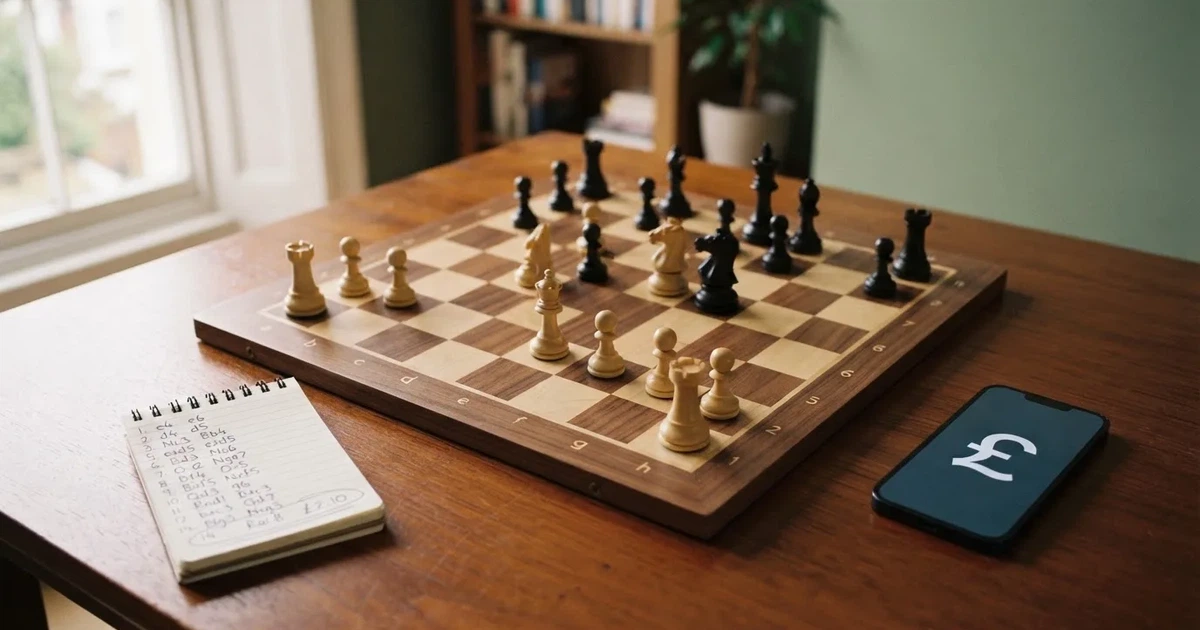
This page is written for the reader who has decided to bet on chess at a British-licensed bookmaker and wants to know what the odds on offer actually cost. It walks through the legal frame a UK punter sits inside, the safer-gambling controls a licence carries with it, the mobile and in-play experience, the markets a chess event actually produces, and a shortlist of ten operators that hold a Gambling Commission remote licence and serve Great Britain. The pricing worked example uses an illustrative two-way line at decimal odds 1.90/1.90 to show the margin at work — the kind of line a bookmaker prices on a Grand Prix game or a rapid match, not a figure copied from any one operator’s site.
Data current as of 27 October 2026 and checked against the Gambling Commission’s public register. Odds and margins age faster than anything else on this page, so a specific price or margin is printed only with the date research carries it. Where research gives a price without a date, the point is made in words, not in numbers.
The legal frame for chess betting in Great Britain
Chess is not on any list of “approved” sports. There is no list at all. What exists is the Gambling Act 2005, a licence regime run by the Gambling Commission, and a duty on every operator whose remote facilities are used in Great Britain to hold one of those licences wherever the operator itself is based. The 2014 amendment closed the “white-listed” jurisdictions loophole that had let Malta- and Gibraltar-licensed firms serve British customers without a British licence, and it brought the whole market onto the same footing. A Curaçao licence, an Anjouan licence, a Maltese licence — none of these stand in for a Commission licence for British customers. The register is the test, and it is searchable by business name, trading name, domain or account number.
Three licence types do most of the lifting on a chess betting site. A *remote general betting standard (real events)* licence covers ordinary fixed-odds and in-play betting on real sporting fixtures, and chess falls under it as it falls under the same licence as football or tennis. A *remote betting intermediary* licence is the exchange licence, used by betting exchanges that match back and lay bets between customers rather than pricing the book themselves. A *remote general betting limited* licence covers smaller-scale operations with restricted product ranges. A separate *pool betting* licence exists for the traditional tote product on horse and dog racing; the lotteries and any betting on virtual chess (a computer-generated event with no human players) sit on yet another category. The category on the licence and the markets the operator offers under it are not the same thing: the licence is permission, and what the operator prices on a given day is its own commercial decision.
Northern Ireland is the exception that proves the rule. The 2005 Act covers England, Scotland and Wales, and the regime there has no statutory list of permitted events or markets. Northern Ireland runs on the Betting, Gaming, Lotteries and Amusements (Northern Ireland) Order 1985, with its own licensing system run by the district courts. A bookmaker serving customers in Great Britain on a Commission licence is not, by that licence alone, serving Northern Ireland. The Chess Olympiad, the World Championship cycle and the Grand Prix series all play out around the world, so a chess punter betting from a UK address is interacting with the GB regime unless they are physically in Belfast or Derry and betting with a Northern Irish-licensed operator.
Two practical consequences follow. First, the bookmaker has to verify the customer’s name, address and date of birth before they can deposit or place a bet, including with a free bet or bonus, and that obligation has been in force since 7 May 2019. Chess betting is not anonymous. Second, the operator carries the safer-gambling controls that come with the licence: GAMSTOP enrolment, the £150 rolling 30-day vulnerability check, the deposit-limit offer, the 10x wagering cap on bonuses, and the requirement to act on the customer’s stake-size and deposit patterns when the figures suggest harm. None of this is the punter’s choice to opt into. It is the licence condition. The trade-off for that protection is the verification step at sign-up, which can take longer than the betting itself when the operator’s system is busy.
What the regulator actually checks
The Commission’s role is the licensing-and-enforcement framework, not a vetting service for individual bets. It does not approve chess events before they are priced, it does not bless specific markets, and it does not rank bookmakers. The Commission’s public register records the licence type, the licence holder (often a parent company rather than the trading name the customer sees), the trading names that fall under that licence, the domains attached to it, and any conditions or penalties currently in force. A punter who wants to confirm a bookmaker holds a licence types the trading name or the domain into the register and checks the result against the address bar of the site they actually opened. Brand names are licensed to different operators at different moments in the market — Ladbrokes and Coral have shared parentage, Paddy Power and Betfair have shared parentage, and the trading name on the betting slip is not the legal entity that holds the licence.
A check is a five-minute task. Search the register by the trading name as it appears on the site, look at the licence number, and look at the licence holder. If the holder is a known operator and the trading name is one of the names on its licence, the brand is in good standing on the day of the check. If the register shows nothing, the brand is unlicensed for Great Britain and the punter who bets on it loses the protection of a licence: no GAMSTOP, no Commission complaints route, no approved alternative dispute resolution service, no British consumer redress if funds are withheld, and no 10x bonus cap. The bookmaker has not committed an offence in the punter’s name — the offence under section 33 of the 2005 Act is aimed at the operator providing unlicensed facilities in Great Britain. The punter’s exposure is unprotected funds, not a criminal record.
Safer gambling at a UK-licensed chess bookmaker
The framework a Commission licence carries is not optional and not a marketing badge. Three pieces of it land directly on a chess betting account.
The first is GAMSTOP, the national multi-operator online self-exclusion scheme. Every GB-licensed online operator is a member, and a customer who registers with GAMSTOP blocks themselves from opening new accounts and from logging into existing ones across the whole licensed online market. The minimum exclusion is six months; the longer periods are one year, five years, and five years with auto-renewal, and at the end of the chosen minimum period the exclusion stays in place for a further seven years unless the customer asks for it to come off. The shop product uses a separate offline scheme, so GAMSTOP is the bet slip and the betting app, not the high-street counter.
The second is the financial vulnerability check, in force since 30 August 2024 under LCCP condition 3.4.4, and tightened against a deposit threshold from 28 February 2025. Once a customer’s deposits minus withdrawals crosses £150 in a rolling 30-day window, the operator must run a public-record check — bankruptcy, county court judgments, similar registers — before letting further deposits through. The check is not an income check and not a credit reference check, and it is not the same as the “affordability” announcements that have been in the press. Those financial risk assessments are at an earlier stage of a staged Commission plan published on 7 July 2026; they are announced, staged, and carry no start date, so writing them down as live gets the reader acting on a rule that does not yet exist. The vulnerability check, by contrast, is live, and an account that crosses the threshold sees it run.
The third is deposit limits. The first changes to operators’ gross deposit limits on a fixed time frame have applied since 31 October 2025, and a second phase was postponed to 30 September 2026. Whether that second phase is live is not settled, and an account on a brand that has not yet implemented it operates under the earlier rules. There is no state-set deposit ceiling. The ceiling is the customer’s, set inside the limits the licence condition requires the operator to offer.
The single cap a punter will see on a chess betting offer itself is the wagering-requirement ceiling on bonuses. Since 19 January 2026 any bonus a GB-licensed operator gives a customer must carry a wagering requirement no higher than 10x: a £10 bonus clears with at most £100 of qualifying bets, regardless of what the small print said a year earlier. The same rule banned mixed-product promotions — the offer that bets on football to unlock free spins, the casino-welcome tied to a sportsbook deposit — so a chess bonus that requires the punter to play a few slots on the way through is no longer permitted. Free bets whose only condition is being used inside the seven-day validity window are not caught by the wagering cap. The status of any money cap on a bonus’s headline value — the “100% up to £X” figure — is not established, so this page does not print one. What is settled is that wagering cannot exceed 10x, and any offer whose small print implies otherwise is one the punter should walk past.
Help, for the punter who needs it, runs through GamCare and the National Gambling Helpline, GambleAware, the NHS gambling clinics and Gamblers Anonymous. The brand pages that list these are not being thorough for the sake of it; the licence requires the links.
Betting on chess from a phone
Chess has a particular shape on a mobile screen. A single classical game can run for four or five hours, the move clock makes in-play pricing workable on rapid and blitz events, and a long tournament means the punter will be reaching for the phone between rounds as often as during them. Three operators on the ten reviewed have built their sportsbook product around the app-first customer, and the rest have apps that run the same product as the desktop site with the navigation rearranged for a smaller screen. The differences the punter actually feels are at the edges: how fast the in-play odds refresh on the live page, whether the bet builder accepts two chess markets from the same event, and whether the bet slip keeps the player’s stake visible when the market moves.
The British market’s two touchstones here are bet365, the most downloaded sports betting app in the UK by the publisher’s own description, and Paddy Power, whose sports betting app lists football, horse racing, boxing, rugby, tennis, golf, darts, snooker and F1 as covered sports. bet365 layers on Bet Builder+ for combining markets from one event into a single bet, Super Boosts, Winnings Boosts on Bet Builders and selected singles, and a daily Bet Boosts feed. Its in-play product pairs live streaming with Bet Track, Match Live and a Live Golf Tracker — the live tracker is the model a chess in-play product would need to copy if a major event landed in the schedule. The Paddy Power app is the more generalist product: long-established sportsbook, the same kind of price boosts and acca insurance other major brands run, and the marketing weight of a household name.
The smaller British-licensed brands compete on focus rather than depth. Fitzwilliam Sports describes itself as a Dublin bookmaker with capped membership and a “High Stakes Welcome” subject to compliance criteria, and the app supports instant deposits, fast withdrawals, timeouts and deposit limits alongside the safer-gambling links. DragonBet publishes an app that features Welsh football and rugby, racing, American football, in-play betting and bet builder markets. Bar One Racing — now BAR 1 Betting — runs an Irish independent product with shop presence and racing sponsorships at Dundalk, Fairyhouse, Navan, The Curragh, Curraheen Park and Cork. None of these smaller brands has the depth of the majors in chess specifically, but all of them are on the Commission’s register under the licences cited later in this guide, and they all handle a chess event if one is on the schedule.
The chess-specific consideration is the live page. Classical chess, with long think time and a clock that runs for hours, does not lend itself to the second-by-second pricing of a tennis or a basketball in-play market. Rapid, blitz and bullet chess do. Most chess events priced by British bookmakers are rapid and blitz, sometimes titled as the “Speed Chess Championship” or the “New In Chess Classic”, and the in-play product the punter actually uses is the rapid-and-blitz one. Where the bookmaker offers live streaming at all on these events, it is usually a YouTube or Twitch embed rather than first-party video, and the live tracker the punter relies on is the third-party broadcast running alongside the app, not a tracker the bookmaker has built.
Live betting and cash out on chess events
Chess’s three classical results — a White win, a Black win, and a draw — give the bookmaker a market that re-prices through the game, and a punter who understands why can take money out before the final move.
The in-play product on a rapid or blitz game works because the clock ticks. The position is changing every few seconds, the engine evaluation is updating in the live broadcast, and the bookmaker’s price on White, on Black, and on the draw is updating with it. A common pattern: White opens at 1.90, Black at 2.20, the draw at 3.40. Black blunders on move 14, the engine flips to +3.5 for White, and within a minute the in-play page is showing White at 1.35, Black at 7.00, the draw at 5.50. The punter who backed White at 1.90 and feels the position slipping toward equality has the option to cash out at a price the bookmaker is willing to lock in right now, not the price at move 40.
Cash out is a price, not a refund. The bookmaker offers to settle the bet early at a figure that reflects the current in-play price minus the bookmaker’s margin and minus the risk the book is laying off by closing the position. On a White win at 1.90 that is now trading at 1.35 in play, the cash-out figure is below 1.90 — how far below depends on the operator, on how much of the position the book has hedged, and on whether the customer is staking a single, a double, or a larger combination. The punter who holds for the full game is exposed to the original price plus the eventual result; the punter who cashes out locks in a smaller but known figure. The decision is the punter’s, and the price is the bookmaker’s.
bet365’s in-play product carries live streaming of fixtures worldwide alongside Bet Track and Match Live; the Bet Track overlay is the kind of live-data product a chess in-play page needs to make its prices legible. Paddy Power, Betfred, BetMGM, Midnite, DragonBet, 10bet and NetBet all run an in-play product on their sportsbook. Betfred publishes the Betfred Sports, Casino & Games app covering 21 sports and over 2,000 casino-style games; 10bet covers football, tennis and horse racing with Cash out, Bet Builder and Live Streaming; Midnite’s home page carries in-play events alongside the bet builder, popular accas and price boosts with the maximum-stake limits noted on each boost.
The cash-out feature is not universal across bookmakers for chess. Operators running in-play on chess generally let the punter take a cash-out figure on a single bet, and may or may not extend it to a combination bet whose legs include chess events. Where it is offered, the figure is the bookmaker’s offer — the punter is not negotiating. Where it is not offered, the bet runs to settlement. The punter who wants cash out on chess specifically checks the brand’s terms page before staking, not the day the position turns.
The deeper point about live chess betting is that the position is information. The engine evaluation, the clock time remaining, the colour of the pieces, the specific opening variation being run — all of it is public. A bookmaker whose in-play product does not refresh fast enough to track the broadcast is one the punter can beat by hand. A bookmaker whose in-play product does refresh is one whose margin the punter pays on every price tick. Either way, the price the punter sees is a price that has the operator’s margin baked in. The next section shows what that margin looks like.
Predictions, analysis and the cost of beating the bookmaker
Chess is unusually well-suited to forecasting on paper and unusually punishing to forecast with money. Every top-level game is played out in public, with the moves published and an engine evaluation available within a minute of each move. The information the bookmaker prices on is the same information the punter has. The edge the punter can find is in the gap between the bookmaker’s line and the punter’s read of the position — and that gap closes quickly, because the price is moving against the punter as soon as the bet is on.
The honest framing of “chess betting tips” and “chess betting strategies” is that no system produces the result they sell. The pin that breaks a game is not knowable in advance, the engine evaluation is not a prediction, and a winning run at one tournament is not predictive of the next. What a punter can do is take a position on a player, a tournament, or a specific match-up and let the price they are offered decide whether the bet is worth taking. Two rules do most of the work.
First, the punter’s stake is the punter’s risk, and the price is the punter’s reward. A £10 bet at 2.50 returns £25 if it wins and loses the £10 if it does not. The punter who prices this in their head before they bet — what fraction of the time does this player need to win for the bet to clear its commission? — is doing the only arithmetic that matters. The second rule is that the bookmaker’s margin is in every price on the market, and the punter who understands it is paying it knowingly rather than losing it unknowingly. The worked example in the next section shows exactly how the margin works on a betting line.
Chess has a market for the World Championship cycle — the Candidates Tournament, the World Championship match itself, the Grand Prix series, the rapid and blitz events. It also has a market on individual games within those events, which is where the in-play product has something to track. The punter who wants to bet on chess for an event the bookmaker does not price is out of luck; the punter who wants to bet on the next World Championship match will find every major bookmaker running a price well before the first move.
Chess bet types and how the odds are built
A chess betting market has three outcomes: White wins, Black wins, or the game is drawn. The bookmaker’s price on each one has to cover the other two, and the gap between the three prices’ prices and a “fair” set of prices is the bookmaker’s margin.
The arithmetic of the margin is worth working through once. Take a simple two-way market — a single game’s “either player wins” market after the draw has been priced out, or a player to win a match format that ends in armageddon — priced by the bookmaker at decimal odds 1.90 and 1.90. The formula for the payout share over both outcomes is:
1 / (1/odds₁ + 1/odds₂) = 1 / (1/1.90 + 1/1.90) = 1 / 1.0526… = 0.95
That is a payout share of 0.95, or 95%. The bookmaker’s margin — the share of every unit bet on this market the bookmaker keeps on average — is 1 − 0.95 = 0.05, or 5%. Stated as a band, the margin on this illustrative market is in the region of 5%, which is a standard pricing margin for a sharp bookmaker on a low-vig two-way line.
A three-way market on a chess game is heavier. A common pre-game line is White 1.90, Black 2.20, the draw 3.40, and the payout share on that set is:
1 / (1/1.90 + 1/2.20 + 1/3.40) = 1 / (0.5263 + 0.4545 + 0.2941) = 1 / 1.2750 = 0.7843
That is a payout share of about 78.4%, and a margin of about 21.6%. The three-way market is the standard chess pricing shape, and the margin on it is wider than the two-way market by design — the bookmaker has to price all three outcomes and the third outcome (the draw) is a meaningful share of games at elite level. The punter who bets on chess pays that margin on every bet, and the operator’s headline “best odds” claims sit on top of it.
What the punter reads on the betting slip is the price on their selection. What they do not see is the price on the other two outcomes or three. A market where White is at 2.00, Black at 2.00, the draw at 4.50 is tighter than one where White is at 1.80, Black at 1.80, the draw at 3.00, because the second bookmaker’s set produces a wider margin. The honest way to compare two operators’ chess lines is to compute the payout share on each one’s three-way prices for the same event, not to compare the headline figure on the punter’s selection.
A combination bet, where two or more legs are multiplied into one price, multiplies the margins with the prices. Two legs each at 95% payout share, multiplied into a combination at 90.25% payout share, give a 9.75% margin on the combination. A treble of three such legs gives an 85.7% payout share and a 14.3% margin. A bet builder or same-game multi, which is a combination bet on markets from a single event, runs the same arithmetic — the bookmaker quotes a single price on the combined selection, and that price reflects the margin across all the legs. The bet builder price looks bigger than any single leg; the underlying margin is also bigger.
What this means for the punter’s stake is that the bigger the price, the more of the stake the punter keeps if the bet wins, but the more the punter is paying the bookmaker for the privilege of the bet. A 2.00 single on a low-margin bookmaker is a different bet from a 2.00 single on a high-margin bookmaker, and the only way the punter can tell which is which is to compare the other prices on the same market or to compute the payout share from the published set. No operator publishes its margin; the punter computes it from the prices.
How the return is worked out from stake and odds
The arithmetic of the return itself is simpler than the margin. A £10 bet at decimal odds 2.50 returns £10 × 2.50 = £25, and the punter’s net profit is £10 × (2.50 − 1) = £15. A £10 each-way bet on a runner at 5.00, with one third of the win odds applied to the place, returns the win portion at full odds and the place portion at one third of the odds — two £10 bets, so a £20 stake, with a return figure on each side. A combination bet’s odds are the product of the legs’ odds: a double at 2.00 and 3.00 is priced at 6.00, and a £10 bet at 6.00 returns £60 if both legs win. These figures are what the bookmaker’s bet slip shows on every bet, and they are the only arithmetic the punter needs to know to settle a winning bet.
The harder arithmetic is the one that decides whether the bet is worth taking in the first place, and that is the payout share of the market the bet is on. The punter who runs that calculation once per market has a read on what the bookmaker is keeping.
Chess events that get priced
The chess calendar the bookmakers price falls into four bands, and they differ in how many games they contain, how long each game runs, and how much in-play product the bookmaker can build around them.
The classical events are the slowest. The World Championship match, played out as twelve or fourteen classical games at long time controls, is a tournament the punter can bet on weeks before the first move — the head-to-head market, the individual game markets, the over/under on the number of games, and the draw-no-bet market on the match itself. The Candidates Tournament, played every one or two years as the eight-player qualifier for the World Championship match, gets the same kind of coverage but a shorter market lead time. The Grand Prix series, which forms part of the World Championship cycle in some years, runs a similar shape with each leg as a classical round-robin of ten or twelve games.
The rapid and blitz events are the in-play product’s home. The World Rapid and Blitz Championships, the Speed Chess Championship, the New In Chess Classic, and the various tour-busting promos played online all run with shorter clocks and shorter games. The bookmaker’s in-play product refreshes fast enough to track the position; the cash-out product has a price to lock in on every move; the live streaming product has an event to broadcast. The punter who wants to use the live product bets on rapid and blitz, not on the classical cycle.
The club and league events — the Pro Chess League, the online league events, the club championships — get thinner coverage. The bookmakers price the headline markets on the bigger events and ignore the rest, and the punter who wants a price on a specific club match will not find one at a major brand. The smaller brands with a chess-specific proposition may price a few extra fixtures, but the published markets on a club game are usually limited to head-to-head and to a tournament winner.
The Olympiad and the team events are priced on the national side rather than the individual side. A punter can bet on Russia or India to win the open section, on the United States or Ukraine to take the women’s section, and on the head-to-head of any individual board within a round. The in-play product on a team event is sparse because the moves within a round do not run on the same clock, and a punter betting on the team is more often betting on the aggregate score than the result of a specific game.
The newer tournaments that bookmakers have added in the last few seasons are the online championship events and the influencer-led speed events. These are smaller in stakes than the World Championship cycle, larger in audience, and a fit for the in-play product that the classical events are not. The punter who wants a market on these events finds them at the bookmakers that price online chess specifically, not at the brands whose chess coverage is limited to the World Championship.
How the reviewed bookmakers compare
| Brand | Gambling Commission licence | What its own terms state on chess and in-play |
|---|---|---|
| Betfred | Remote general betting standard (real events), account 39544; licence held by Petfre (Gibraltar) Limited | Sportsbook covers 21 sports alongside over 2,000 casino-style games on the Betfred Sports, Casino & Games app |
| BetMGM | Remote general betting standard (real events), account 39198; licence held by LeoVegas Gaming PLC | UK sports welcome gives four £10 free bets (two football accumulators of 4+ selections, two sports multiples of 2+) on a £10+ deposit and a sports bet within 7 days; free bets valid 7 days |
| Bet600 | Remote general betting standard (real events), account 44731; licence held by Tyche Tech Limited | Best Odds Guaranteed on horse racing: if the SP exceeds the early or show price taken, the bet is paid at the SP |
| 10bet | Remote general betting standard (real events), account 43173; licence held by Blue Star Planet Limited | Sportsbook covers football, tennis and horse racing with Cash out, Bet Builder and Live Streaming |
| DragonBet | Remote general betting standard (real events), account 64908; licence held by DragonBet Ltd | Welsh football and rugby markets, racing, American football, in-play betting and bet builder markets |
| Fitzwilliam Sports | Remote general betting standard (real events), account 48760; licence held by SBKI Limited | Dublin bookmaker with capped membership; “High Stakes Welcome” subject to compliance criteria; instant deposits, fast withdrawals, timeouts and deposit limits |
| Bar One Racing | Remote general betting standard (real events), account 56516; licence held by Bar-One Racing Limited | Irish independent bookmaker (BAR 1 Betting) with shops across Ireland and racing sponsorships at Dundalk, Fairyhouse, Navan, The Curragh, Curraheen Park and Cork |
| Midnite | Remote general betting standard (real events), account 101839; licence held by Midnite Limited | In-play events, acca builder, popular accas and price boosts with maximum-stake limits noted on each boost; UK sports welcome: £25 in free bets and 50 free spins on a £5+ pre-match bet at EVS (2.0) or greater within 14 days, valid 7 days |
| Paddy Power | Remote general betting standard (real events), account 39439; licence held by PPB Counterparty Services Limited | Sports betting app covers football, horse racing, boxing, rugby, tennis, golf, darts, snooker and F1 |
| NetBet | Remote general betting standard (real events), account 39170; licence held by Netbet Enterprises Limited | Daily Boosts, Profit Boosts and free bet offers; Bet Builder with instant dynamic odds; sports stats for major leagues |
The full set of licence numbers, account numbers and licence holders is taken from the Gambling Commission’s public register, and each entry can be checked against the register’s search by business name, trading name, domain or account number. What the table cannot show is the chess depth of each operator’s schedule. None of the ten brands publishes a chess-first product; all of them price the headline chess events when they run, and the depth beyond that is the operator’s commercial call. The punter who wants to bet on a specific Grand Prix leg checks the betting slip before staking.
Betfred
Betfred’s product is generalist on a large scale. The Sports, Casino & Games app is published by Done Brothers (Cash Betting) Ltd and the sportsbook covers 21 sports, with over 2,000 casino-style games sitting alongside. For a chess punter, the relevant question is whether the brand prices the World Championship cycle and the rapid and blitz events the punter wants to bet on. The brand’s track record on a major event’s pricing is solid, and the in-play product is the standard major-brand product rather than a chess-specific one. The offer attached to the brand is the kind of major-brand offer a punter reads once and then reads again: it carries a deposit condition, a stake-and-minimum-odds condition, a validity window, and an opt-in. The conditions matter more than the headline, and the punter who reads them is the punter who keeps the bonus.
Betfred suits the chess punter who wants a major-brand product with long odds on the headline events and a familiar in-play page, and who is happy to read the small print on the welcome before staking. The verdict for the bettor with a small budget is that the welcome offer’s conditions need weighing against the kind of stake the punter would actually place on a single chess market; the headline figure is the same, the qualifying maths is not.
BetMGM
BetMGM’s UK product runs under LeoVegas Gaming PLC’s licence and is positioned as a major-brand sportsbook with a casino product behind it. The sports welcome for new UK customers who deposit £10 or more and place a sports bet within 7 days is four £10 free bets — two football accumulators of 4+ selections and two sports multiples of 2+, valid for 7 days, with minimum odds and opt-in required. That shape — the bonus split into multiple bets at minimum-odds conditions — is the standard shape of a major-brand sports welcome and the punter’s exposure is the qualifying maths on the first £10 stake. The free-bet stake is not paid back on a win, so the punter’s upside on a winning free bet is the winnings, not the stake plus the winnings.
The verdict for the chess punter is the same kind of trade-off Betfred’s offer carries: a headline figure, a split into multiple qualifying bets, a minimum-odds condition, a 7-day window. The punter who wants the simplest path to a real-money stake reads the conditions and decides whether the qualifying stake is the kind of bet they would place anyway; if it is, the welcome is a reduction in the cost of a bet they were already going to make, and if it is not, the welcome costs the punter a bet they did not want.
Bet600
Bet600’s offer to the punter is the Best Odds Guaranteed on horse racing, which pays the bet at the SP if the starting price exceeds the early or show price taken. That is a racing-specific concession, not a chess-specific one, and it does not affect a chess market directly. The brand’s chess proposition is the brand’s generalist one: a sportsbook with the major events priced and the in-play page on the standard major-brand model. The punter who wants Best Odds Guaranteed on a racing bet and is happy with a generalist sportsbook on the chess side has found a brand that pays at the SP; the punter whose interest is only chess has not.
The verdict for the chess-only punter is that Bet600’s headline concession is in the wrong market, and the chess product is the standard major-brand one. The trade-off is the racing punter’s, not the chess punter’s, and the punter who bets on both has a brand that pays for the racing side at the bigger of two prices.
10bet
10bet’s product covers football, tennis and horse racing with Cash out, Bet Builder and Live Streaming. The chess product is the generalist one — the headline events on the schedule, in-play pricing on the rapid and blitz events when they are on, cash out on the markets the brand has priced. The cash-out, bet builder and live streaming trifecta is the standard major-brand product and is built for the high-volume markets the punter lives on during the football season. The chess punter gets the same product on the chess markets, with the depth of pricing being the brand’s commercial call on the specific event.
The verdict for the chess punter is that 10bet is a generalist brand with a particular generalist product — the kind of punter who wants cash out, bet builder and live streaming on football will find those features, and the chess product is the same product rather than a chess-specific one. The punter who wants a chess-first bookmaker does not have one on this list; the punter who wants a generalist sportsbook with the standard feature set has.
DragonBet
DragonBet’s product is built around Welsh football and rugby, racing, American football, in-play betting and bet builder markets. The brand’s pitch is the Welsh sports product, and the chess product is the generalist one. The licence is held by DragonBet Ltd directly, which is a tighter fit between trading name and licence holder than many of the brands on this list, and the punter’s licence check is the simpler one of the trading name matching the holder.
The verdict for the chess punter is that DragonBet’s chess product is a generalist sportsbook’s chess product, and the brand’s specific value is to the punter who also bets on Welsh football and rugby. The chess punter whose interest is the chess side alone has not found a fit, and the punter whose interest is the Welsh sports has.
Fitzwilliam Sports
Fitzwilliam Sports is a Dublin bookmaker with capped membership and a “High Stakes Welcome” subject to compliance criteria. The capped membership is a deliberate shape — the brand’s pitch is to a smaller, higher-stakes customer base rather than a mass-market one — and the welcome offer is gated by compliance criteria the brand does not publish. Instant deposits, fast withdrawals, timeouts and deposit limits, and the safer-gambling links to GambleAware, GamStop and Gamblers Anonymous, are standard licence conditions rather than the brand’s own choice. The chess product on the brand is the generalist sportsbook product rather than a chess-specific proposition, and the punter’s chess interest is the headline events on the major cycle rather than a deeper schedule.
The verdict for the chess punter is the unusual one of this list: the brand’s value is the higher-stakes customer base and the Dublin bookmaker pitch, not the chess product, and the chess punter whose interest is the higher-stakes welcome has found a different fit than the chess punter whose interest is the headline events on the standard cycle. The trade-off is the operator’s, and the punter who wants the capped-membership shape is the one who finds it.
Bar One Racing
Bar One Racing has rebranded as BAR 1 Betting, an Irish independent bookmaker with shops across Ireland and racing sponsorships at Dundalk, Fairyhouse, Navan, The Curragh, Curraheen Park and Cork. The shape is a racing-led independent with shop presence and a regional pitch. The chess product is the generalist one on the headline events, and the punter’s chess interest is the same generalist interest as on any of the major brands on this list. The racing punter’s interest is the shop presence and the regional sponsorships — neither of which is a chess product.
The verdict for the chess punter is that Bar One Racing’s chess product is the generalist one, and the brand’s specific value is to the racing punter. The chess punter whose interest is only chess has not found a fit, and the racing punter whose interest is regional Irish racing has.
Midnite
Midnite’s UK sports welcome is a £25 in free bets and 50 free spins offer on a £5+ pre-match bet at EVS (2.0) or greater within 14 days of sign-up, valid 7 days. The headline figure is bigger than the £10 deposit and £5 bet a BetMGM and a Midnite smaller-brand welcome would imply, and the qualifying maths is the standard welcome offer’s. The home page shows in-play events, an acca builder, popular accas and price boosts with the maximum-stake limits noted on each boost, and the licence check is the standard register check on account 101839. The free-bet stake is not paid back on a win.
The verdict for the chess punter is the trade-off the welcome carries: the headline figure is the £25 of free bets and 50 free spins, and the qualifying stake is the £5 at the minimum-price threshold. The punter who would have staked that £5 anyway on a chess market at EVS or greater has found a brand that pays for the bet; the punter who would not has found a brand that asks them to place a bet they would not otherwise make.
Paddy Power
Paddy Power is the household-name major brand on this list. The sports betting app is published by Paddy Power PLC and covers football, horse racing, boxing, rugby, tennis, golf, darts, snooker and F1, and the marketing weight of the brand is the kind that makes it the punter’s default choice when the alternative is a smaller-brand bookmaker. The licence is held by PPB Counterparty Services Limited, and the same parentage holds the Betfair exchange licence, which is the betting exchange punters use for back and lay markets on the same events. The chess product on the Paddy Power sportsbook is the generalist one on the headline events; the chess product on the Betfair exchange is the betting exchange’s generalist one.
The verdict for the chess punter is that Paddy Power is the brand whose pitch is the brand itself, and the chess product is the standard major-brand one. The punter who bets on multiple sports and wants the marketing weight of a household name has found it; the punter whose interest is the chess-specific depth has not found it on any of the ten brands on this list, because no brand on the list is chess-first.
NetBet
NetBet’s product is a Daily Boosts, Profit Boosts and free bet offers sportsbook with instant dynamic odds on the Bet Builder and sports stats for major leagues. The licence is held by Netbet Enterprises Limited under account 39170, and the brand’s product is the standard major-brand sportsbook product with the boost-and-free-bet pattern most brands run. The chess product is the generalist one on the headline events, and the punter’s chess interest is the same generalist interest as on any of the other brands on this list.
The verdict for the chess punter is the standard one for a generalist sportsbook with a Daily Boosts and free bet pattern: the headline figure is the Daily Boosts and free bets the punter can claim, and the qualifying maths is the standard qualifying maths. The punter who wants a major-brand sportsbook with the boost-and-free-bet shape has found one; the punter who wants a chess-first bookmaker has not.
Chess betting at a glance
Chess betting odds are the topic of this article, and the worked example of the margin provides the context. What follows is a short wrap that ties the legal frame, the safer-gambling controls, the in-play product and the operator set back together for the reader who wants a single paragraph to take away.
A punter betting on chess at a GB-licensed bookmaker is betting inside the 2005 Act framework, on a market the operator has chosen to price under its own licence conditions, with the operator’s margin baked into every price. The verification step at sign-up, the GAMSTOP enrolment, the £150 vulnerability check on a 30-day rolling basis, the deposit-limit offer and the 10x wagering cap on bonuses are all licence conditions, and none of them is the punter’s choice to opt into. The chess product the punter is betting on is a generalist one — the headline events on the World Championship cycle, the rapid and blitz events on the in-play product, and the team events at a thinner depth. The in-play product on rapid and blitz is where the cash-out product has a price to lock in, and the worked example of the margin on a 1.90/1.90 two-way line is in the region of 5%, against a three-way market’s wider margin. The punter who reads the small print on any welcome offer, who checks the licence register before staking, and who computes the payout share of the market they are betting on is the punter who keeps more of every winning stake. No system wins, no tipster knows the result, and the price the punter sees on the betting slip is the price the operator wants them to take.
Frequently asked questions
Is it legal to bet on chess in the UK?
Yes, at a bookmaker holding a Gambling Commission remote licence. There is no list of permitted sports under the Gambling Act 2005, and a licensed operator may price chess events under its own licence conditions. The operator is licensed for Great Britain (England, Scotland and Wales); Northern Ireland is on its own older regime. Identity verification at sign-up has been a licence condition since 7 May 2019, so a chess betting account is not anonymous. The licence register is searchable by trading name, domain or account number, and a punter can confirm a brand’s standing in five minutes.
Where can I bet on chess in Great Britain?
At any GB-licensed online bookmaker that prices chess events on its schedule. The ten brands reviewed on this page — Betfred, BetMGM, Bet600, 10bet, DragonBet, Fitzwilliam Sports, Bar One Racing, Midnite, Paddy Power and NetBet — all hold a remote general betting standard (real events) licence from the Gambling Commission, and all of them price the headline chess events. No brand on the list is chess-first; all of them run a generalist sportsbook with chess on the schedule when the events are live.
How do I place a bet on chess?
Pick a brand from the Commission’s register, complete sign-up and the identity check, deposit by debit card or bank transfer (credit cards are banned for gambling in Great Britain), and select the chess event from the sportsbook. Pick a market — head-to-head, tournament winner, individual game, draw-no-bet — enter the price stake, and confirm. The bet appears on the bet slip, the stake is taken from the account, and the bet settles on the result the bookmaker records from the official source. The return on a winning bet is the stake multiplied by the decimal odds.
How do I check that a bookmaker holds a Gambling Commission licence?
Open the Commission’s public register and search by trading name, business name, domain or account number. The result shows the licence number, the licence holder, the licence type and the trading names attached to it. Compare the trading name in the result against the one on the site. If they match, the brand is licensed for Great Britain on the day of the check; if not, the punter is looking at an unlicensed site. Brand names can move between operators over time, so a punter who has not bet on a brand for a year should check again.
How is the return on a bet worked out from stake and odds?
The return is the stake multiplied by the decimal odds. A £10 stake at 2.50 returns £25, and the net profit is £15. A combination bet’s odds are the product of the legs’ odds, and an each-way bet is two bets of equal size. These are the figures the bet slip shows, and they are the only arithmetic needed to settle a winning bet. The arithmetic that decides whether the bet is worth taking is the payout share of the market the bet is on, which is the inverse of the sum of the inverse odds on every outcome.
What is the bookmaker’s margin and how do I see it in the odds?
The margin is the share of every unit bet on a market the bookmaker keeps on average. For a two-way market at decimal odds 1.90 and 1.90, the payout share is 1 ÷ (1/1.90 + 1/1.90) = 0.95, and the margin is 5%. For a three-way market on a chess game priced at 1.90, 2.20 and 3.40, the payout share is around 78.4% and the margin is around 21.6%. The punter can compute the payout share on any market from the prices the bookmaker shows; a market where the payout share is higher is a tighter market, and a market where it is lower is a wider one.
Tennis, darts & cue sports – Footy Tips
Content created by the «Footy Tips» team
