
Table tennis betting odds in 2026: the price, the margin and what sits behind it
 Available in US
Snapshot data current as of 27 October 2026, verified against the Gambling Commission’s public register. Odds and margins age faster than anything else on a betting site; specific prices and margins below carry the snapshot date research gives them, and are described in words where the snapshot is missing.
A punter who opens three betting apps, lines up the same table tennis match and sees the same price at all three has not been shown the same market three times. What sits underneath the headline number is a margin, and the margin is what the bookmaker keeps of every pound that crosses that market. Table tennis lives or dies by that margin because the sport’s biggest leagues run several fixtures a day, with no obvious favourites and no obvious underdogs on most nights. This page is about the cost — what a price carries, what a free bet hides, what a bonus extracts, and where the marketing words dissolve once you do the arithmetic.
What the law actually requires to take a table tennis bet from Britain
A bookmaker that serves customers in Great Britain needs a Gambling Commission licence wherever it sits in the world, under sections 33 and 36 of the Gambling Act 2005 as amended by the Gambling (Licensing and Advertising) Act 2014. A Curaçao, Malta or Gibraltar licence on its own is not a substitute; the test is whether the operator’s name, trading name, domain or account number appears on the Commission’s public register. The register can be searched by any of those fields, and what it returns is the whole answer to “is this brand licensed?”.
There is no statutory list of permitted bets or markets. The Commission’s licence categories — remote general betting standard (real events), remote general betting standard (virtual events), remote general betting limited, remote pool betting and remote betting intermediary (for exchanges) — frame what kind of betting an operator may run. The actual menus on each site are the operator’s own, governed by the Licence Conditions and Codes of Practice (LCCP) and its own house rules. Table tennis sits comfortably inside “real events”; no licence carve-out for the sport exists.
The minimum age is 18, and a customer must pass identity checks (name, address, date of birth) before they can deposit or gamble, even with a free bet or a bonus. No licensed site offers anonymous play. For most table tennis punters this means an upload of photo ID at registration, not at first withdrawal, which is the part that catches newcomers off guard.
Northern Ireland sits outside the framework
Great Britain (England, Scotland and Wales) is the territory the Act covers. Northern Ireland has its own older law, and a Commission licence is not a Northern Ireland authorisation. A licence that says “GB” should be read as “Great Britain”, not as a claim over Belfast or Lisburn, and the difference shows up when a Northern Irish customer looks for a complaints route.
Financial spread betting is a different regulator
Spread bets on a financial index — the FTSE 100, a currency pair, a commodity — fall under the Financial Conduct Authority, not the Commission, and the risk is different: losses can exceed the deposit because the position is on a margin rather than a stake. Table tennis is not a financial market, so this applies only where a site markets a financial spread product alongside sports.
The safer-gambling frame the licence forces on every operator
Every remote licence carries safer-gambling conditions, and several of them reach the bettor’s screen rather than living in a back office.
GAMSTOP is the national multi-operator self-exclusion scheme and a mandatory licence condition for online operators. A self-excluded customer is blocked across every participating site, including every app on this page, for six months, one year, five years, or five years with auto-renewal; after the minimum period the exclusion sits in place for a further seven years unless the customer asks GAMSTOP to remove it. Betting shops are not part of GAMSTOP — they run on a separate multi-operator system.
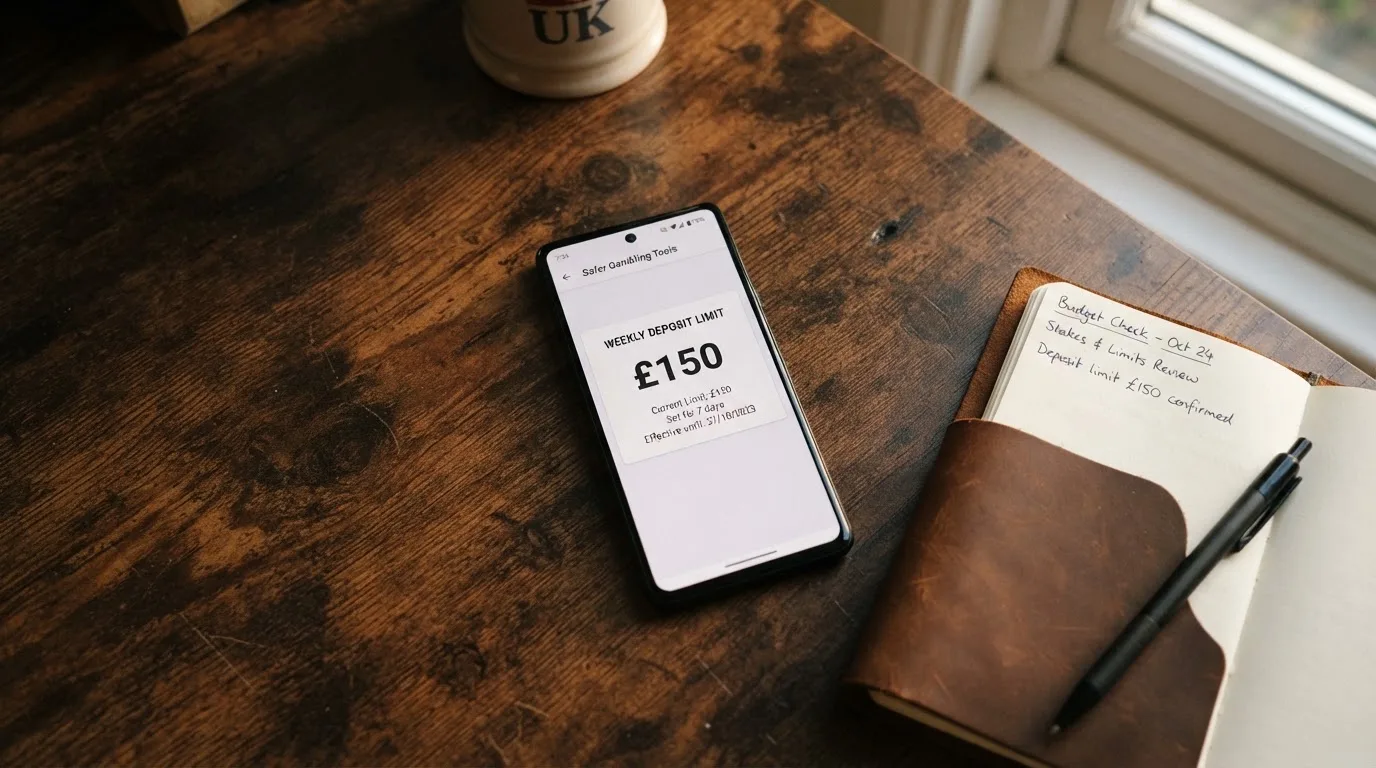
Deposit limits are an operator duty, not a state-set ceiling. The first phase of changes has applied since 31 October 2025; a second phase was postponed to 30 September 2026, and whether it has gone live is not established. Limits are the customer’s choice in pounds sterling and a duty of the operator to honour. No statutory cap exists; a punter can set a daily or weekly limit, raise it, or set none at all, and the operator’s role is to make that choice easy and reversible.
Financial vulnerability checks are a different lever. Under LCCP condition 3.4.4 (in force since 30 August 2024) a licensed remote operator runs a public-record check when a customer’s deposits minus withdrawals exceed £150 in a rolling 30 days — since 28 February 2025. The check looks at county court judgments and bankruptcy notices, not income, and is not a credit reference check. A separate tier of “financial risk assessments” (the affordability checks the press describes) is on a staged plan announced by the Commission, with no start date yet.
Help lines carry the practical load when something has gone wrong: GamCare and the National Gambling Helpline, GambleAware, NHS gambling clinics, and Gamblers Anonymous. They are not part of the licence and they are not the regulator — they are the agencies the regulator points customers at.
What a free bonus actually carries
A licensed operator does not get to label an offer however it likes. Since 19 January 2026 the wagering requirement on a bonus is capped at 10x — a £10 bonus with a 50x requirement needs £500 of qualifying bets and is now unlawful; under the cap no bonus requires more than £100 of qualifying play for every £10 of bonus. A £50 bonus at the maximum 10x wagering would need £500 of qualifying bets before any winnings become withdrawable.
Mixed-product promotions — “bet on football to unlock free spins”, or anything that requires play across two or more product types such as betting, casino, bingo and lottery — are banned outright at licensed sites. An offer that crosses products has to be redesigned or dropped, which is why so many sports welcome packages now stop at sports-only free bets.
The cap applies to bonuses with a wagering condition. Whether it applies to free bets whose winnings are withdrawable from the moment they land, and any cap on the headline money value of a bonus, are not established — describe them only as each operator’s own terms state them.
Where table tennis sits in the crypto and anonymity picture
Table tennis itself has no cryptocurrency rule. The question is what an operator does at the cashier: whether it accepts Bitcoin or another coin, and whether the licence it holds demands a customer pass identity checks first.
Every operator on this page holds a remote licence, and that carries the verification duty: name, address, date of birth, all before the first deposit or first bet. No licensed site takes anonymous deposits, and a Bitcoin deposit is no exception once the operator runs a licence check on the customer. A Bitcoin or Ethereum deposit is fast and pseudonymous between wallets; it is not anonymous at a licensed bookmaker, because the operator still has to verify the account holder under anti-money-laundering rules.
A crypto-only brand with no Commission licence sits outside this picture. It can offer a deposit that the operator does not verify against an ID, but then it also sits outside every protection this page has just described — no GAMSTOP coverage, no Commission complaints route, no approved dispute-resolution service, no British consumer redress if funds are withheld, and no 10x bonus cap to keep its wagering requirements from running away. The trade is real: pseudonymity on the way in, no recourse on the way out.
Tax on winnings
The bettor pays no tax on betting winnings in Great Britain (general information, not tax advice). General Betting Duty is the operator’s tax, currently 15% on gross profits; from 1 April 2027 a new remote betting rate of 25% applies within it, while remote bets on UK horse racing, bets on self-self-service betting terminals in licensed premises, pool betting and in-person betting stay at 15%. Whether operators pass duty through odds is not established, and never write that the player is charged duty. Spread betting has its own rates (3% financial, 10% other).
What a “free bet” really costs the punter
The marketing word is the offer. The arithmetic is the cost. Two examples make the gap visible without naming a single brand’s promotional page.
A £10 free bet at decimal price 3.75. A free bet whose stake is not returned on success returns the winning portion only. At 3.75 the return is £27.50 in profit on a £10 free bet, because the bookmaker does not give back the stake. A £10 cash bet at the same price returns £37.50 — £10 stake plus £27.50 profit — which is why a free bet looks worth less than a paid bet of the same headline value, and why the headline number overstates what lands in the account.
A £10 free bet at 1.50. Short prices exaggerate the gap. At 1.50 a £10 cash bet returns £15 (£5 profit). The same selection as a free bet returns £5, because the stake is forfeit either way and the only thing left is the £5 profit multiplied by the inverse of the price. Below an odds-on price the free bet value collapses sharply, which is why “use your free bet on a short price” is poor advice even when it feels safe.
The wagering layer. A bonus with a 5x wagering requirement on a £50 bonus asks £250 of qualifying bets before any winnings become withdrawable. The qualifying bets are at or above the minimum odds the operator states (typically evens, 2.00 decimal, or 1/1 fractional, but check the terms). At a market margin of 5%, that £250 of qualifying bets carries about €50 to the bookmaker in expected value across all the markets it is wagered through. That £12.50ish number is the headline bonus’s silent price, paid before the customer sees a penny of bonus-related withdrawal.
Free bet, free slot funds, free spins — three different things. A free bet on the sportsbook carries the stake-not-returned rule. Free slot funds for the casino are bonus money on the casino side and are governed by the casino’s wagering rules. Free spins are a casino product, not a sports product, and pay out as bonus money subject to the casino’s own turnover rule. Calling them all “free” hides the asymmetry: the sportsbook free bet has the clearest cost because it sits on a single market; the casino side runs at a higher margin and the wagering often scales with the bonus, not against it.
Live table tennis and cash out — what each one costs
Table tennis is a live sport: a best-of-five match finishes inside thirty minutes, with breaks every two points, and the bookmaker’s live markets pulse through every game. Two products sit on top of that pulse, and each one carries its own cost.
Live betting. A live price is set by the operator’s model with a margin inside it, often a wider margin than the pre-match price because the model has less information to work with and reacts game by game. A pre-match price at a 5% margin can become a 7% or 8% margin in-play on table tennis because the volatility is high and the operator is hedging a fast-moving event with no obvious benchmark.
Cash out. A cash-out offer is a price the operator quotes mid-event, with its own margin, against the position the customer already holds. The cost of cashing out sits in two places: the time gap between the live market and the cash-out figure, and the operator’s margin on the cash-out quote. On a match where the live market says 1.5 and the operator offers a cash-out figure that implies 1.45, the difference is the price of taking the early money. Cashing out is the operator selling the customer their own future at a haircut.
Where live streaming changes the picture
A live stream removes one of the costs of live betting — having to place a bet to see the price move, then place another. The price is still inside the market, but the punter can react to a momentum shift without committing first, which improves the average price the punter gets without changing the margin. A bet builder (combining markets from one event into one bet) compounds the margin instead: each leg carries its own, and the combined price multiplies the margin across legs. A five-leg table tennis builder with a 5% margin per leg carries an effective margin well above 5% — easily 20% across the combined bet — which is why a builder’s headline can look so generous while the value has quietly drained away.
Tips, predictions, and what they cannot promise
No piece of advice can promise a winning table tennis bet. The sport’s results are outcomes, not predictions: a player ranked 50th in the world can take a set off the world number 4 on any given day, and the bookmaker’s margin sits inside every price whether the favourite wins or loses.
What a serious approach can do is narrow where it looks:
- Form over rank. Table tennis rankings lag form because the tour is spread across continents and not every event carries ranking points. A player on a four-event win streak at a smaller event can be mispriced at a major.
- Head-to-head, not just results. Two players with a particular match-up — left-handed against right-handed, a specific serve pattern against a specific return — can produce predictable scorelines even when the overall record looks even.
- Schedule density. The tour runs events back to back, and a player through a deep week in one event rarely wins the next event at the same price. Watch the calendar before the price.
- Surface and ball. The ball changed in 2014 (40mm), and the seam-free polymer ball behaves differently in altitude and humidity. A player strong at home in February is not necessarily strong on tour in July.
A tipster service that claims a hit rate above the margin is selling a margin problem it has not solved. A serious tipster publishes a record over hundreds of bets, with the price at which the bets were placed, and the closing price the bookmaker took at the start of the event. Anything less is marketing.
Bankroll and staking
The cleanest version of bankroll discipline on table tennis is a flat unit per bet (one to two per cent of the bankroll, never more) and a written log of the closing price versus the price taken. The log exposes overround on its own — a market where every bet you place is at a 10% margin will erode the bankroll even at a 55% strike rate, because the price never paid you 55% of fair value to begin with.
What a price is and what sits behind it
A price is the return on a unit stake, including the stake. Decimal odds 2.55 return £2.55 on a £1 stake (£1.55 profit plus the £1 back). Fractional odds 6/4 return £2.50 on a £1 stake (£1.50 profit plus the £1 back). The two notations convert directly: fractional a/b becomes decimal a/b + 1.
The overround. A two-way market at 1.90 / 1.90 (9/10 each) implies a payout share of 1 ÷ (1/1.90 + 1/1.90) = 1 ÷ 1.0526 ≈ 95.0%. The margin — what the bookmaker keeps of every pound wagered on the market — is 1 − 0.9500 = 5.0%. That 5% is the cost of the bet, paid whether the favourite wins or the underdog wins.
A two-way market at 1.85 / 1.85 (17/20 each, “even money minus a touch”) implies a payout share of 1 ÷ 2 × 1.85 ≈ 92.5%, a margin of 7.5%. A two-way market at 2.00 / 2.00 (evens) implies a payout share of exactly 90.0%, a margin of 10.0%. The margin is the silent partner on every bet; two bookmakers with different margins on the same selection are paying the punter two different amounts for the same risk.
On the same event, the margin is not the same across markets. A bookmaker’s 1X2 (match winner) margin is not the same as its margin on total games, on the handicap line, on the first-set winner, on a player to win a specific game, or on a combination bet. Where research gives a margin, it is the margin for that market on that event on that snapshot date, not a house-wide margin.
Where the margin hides. A bet builder compounds margins across legs and shows a higher combined margin than its headline implies. An accumulator (“acca”) compounds margins across legs and a 5% per-leg margin across four legs has an effective margin well above 20%. A market with a clear favourite shows a tighter margin than a market with no favourite, because the bookmaker does not need a wide margin to attract the right side of the betting. A bookmaker’s margin on a Premier League football match on the day of the match is usually tighter than its margin on a table tennis Challenger event the same night, because liquidity flows where the money is.
How the reader can see the margin
Pick a market with two or three outcomes (match winner, over/under total games, first-set winner). Pull the prices. Add 1/decimal for each outcome. The sum is greater than 1; the excess is the overround. Subtract the overround from 1 and you have the payout share; subtract the payout share from 1 and you have the margin. That margin is the cost the market charges on every pound wagered, regardless of which outcome wins.
The shape of table tennis as a betting sport
A table tennis game is won by the first player to reach 11 points. If both players reach 10, the first to lead by two points wins. A match is the best of any odd number of games, and competition matches are typically best of five or seven. Service alternates every two points, and once both players reach 10 each serves one point in turn. Scoring changed from 21 points to 11 in 2001, so anyone reading older form guides is reading about a different game.
A table tennis table is 2.74 m long, 1.525 m wide and 76 cm high, with a net 15.25 cm high; the ball is 40 mm in diameter and weighs 2.7 g. The International Table Tennis Federation was founded in 1926 and table tennis has been an Olympic sport since 1988. Those are the dimensions and the history; none of them changes the margin on a price.
The ITTF tour and where the betting liquidity sits
The ITTF World Tour, the WTT Tour, the Continental Championships, the Olympics, the World Championships, and a constellation of national leagues and club competitions fill the calendar across the year. Most of the betting liquidity sits on the World Tour events, the WTT Tour’s marquee stops, the major Continental Championships, and the Olympic and World Championship cycles, with the smaller Challenger and Future events taking the residual volume.
Table tennis is not a sport with one major league. It is a sport with a tour, and the tour runs more or less continuously, which means a licensed bookmaker running table tennis odds is rarely running an empty menu. The price the punter sees on a Tuesday afternoon Challenger in Ankara and the price on a Friday evening WTT event in Macau are different markets with different margins and different limits.
Spread betting on table tennis
A few operators run financial-style spread products on table tennis (total points in a match, range of games won, and so on) under spread betting rules rather than fixed-odds rules. Losses on a spread bet can exceed the deposit because the position is on a margin, and the product is regulated by the FCA where it is a financial product rather than by the Commission. Outside that narrow lane, table tennis is a fixed-odds sport and a Commission matter.
How the ten licensed sites stack up
| Brand | Gambling Commission Remote Licence Number / Holder | Key Terms |
|---|---|---|
| Fitzwilliam Sports | 048760-R-335434-009 / SBKI Limited | Capped membership; high-stakes welcome |
| BetTom | 064959-R-339314-003 / Bet Tom Limited | 50% back as free bet / 50% casino funds |
| NetBet | 039170-R-319343-032 / Netbet Enterprises Limited | Daily boosts; bet builder |
| Paddy Power | 039439-R-319330-013 / PPB Counterparty Services Limited | Broad sports menu |
| BetUK | 039198-R-319450-029 / LeoVegas Gaming PLC | 4x£10 free bets (accas/multiples only) |
| BetVictor | 039576-R-319370-028 / BV Gaming Limited | BOG on horse racing |
| Geoff Banks | 054095-R-330366-010 / GB Sports Advisors Limited | In-play and ante-post prices |
| Ladbrokes | 054743-R-330863-014 / LC International Limited | High-traffic multi-product app |
| Kalooki Sportsbook | 057730-R-333396-005 / Kalooki Sportsbook Limited | Younger, GAMSTOP-registered operator |
| Dabble | 065677-R-340363-005 / Dabble Sports UK Ltd | Social-style betting app |
Every brand below holds a remote general betting standard (real events) licence on the Gambling Commission’s public register, with categories on the register matched to the operator’s actual product. The licence number, the licence holder and the named operator are taken from the register snapshot this page is dated to. The order is not a ranking, and each card closes on a verdict about what the brand does well enough to be worth the reader’s attention.
A brand not on this list is not “unlicensed” — the register lists many more — but it is also not reviewed here, and the review cannot speak for what it does not name.
Fitzwilliam Sports — the capped-membership Dublin bookmaker
Fitzwilliam Sports describes itself as a Dublin bookmaker with capped membership. It offers instant deposits, fast withdrawals, timeouts and deposit limits, and links to safer-gambling services including GambleAware, GamStop and Gamblers Anonymous. The welcome is a “High Stakes Welcome” subject to compliance criteria, which sets the tone: this is a bookmaker that wants customers with bankrolls, and it filters for them through the membership cap. The trade for the reader is a less crowded sportsbook and a welcome aimed at stakes the average punter would not lay; the cost is a smaller liquidity pool on the table tennis menu and a brand that is not built for the casual £5 bettor.
Fitzwilliam Sports is a specialist venue tailored to the high-stakes player who prioritises a quieter sportsbook over a massive, broad-market user base; it is less well-suited to the recreational punter with a smaller bankroll.
BetTom — the small-stakes welcome
BetTom’s sports welcome is 50% back as a free bet of up to £50, paired with a matching 50% back up to £50 as free slot funds on the casino side. Full terms apply, the stake is not returned on the free bet, and the wagering on the casino leg carries its own rules. For a punter who was going to play both products anyway this is a balanced welcome; for a sports-only punter it is half an offer dressed up to look like a whole one, because the casino free slot funds are not a sports product and cannot be turned into table tennis bets.
The verdict: a fine first offer for the casual punter who plays both sides, but the headline 100% figure is two halves of different products and should be read that way.
NetBet — daily boosts and a bet builder
NetBet Sport offers Daily Boosts, Profit Boosts and free bet offers, a Bet Builder with instant dynamic odds, and sports stats for major leagues. The product set is broad, the builder is a centrepiece, and the boosts run daily rather than as a one-off. The cost of the builder sits in the compounded margin across legs, which the punter who uses it should know about before the headline price carries them away.
NetBet distinguishes itself with a robust daily boost structure and a market-leading builder for multi-sport users; however, it can feel less efficient for those who prefer the simplicity of single-market betting.
Paddy Power — the broad-market sportsbook
Paddy Power covers football, horse racing, boxing, rugby, tennis, golf, darts, snooker and F1 from the Paddy Power Sports Betting app, and its menu outside those sports is wider still. Table tennis is one of several niche markets rather than a focus, and the welcome offers tend to be high-profile rather than table-tennis-specific. The trade is brand familiarity and breadth over depth on a single niche sport.
The verdict: a sensible default for the punter whose betting list runs across sports; not the place for the table tennis specialist who wants the deepest in-play menu.
BetUK — the four-free-bet welcome
BetUK’s sports welcome is deposit £10 or more and place a sports bet within seven days of registering, in return for four £10 free bets (two football accumulators of four or more selections and two multiples of two or more). The free bets are valid for seven days, the stake is not returned, and the selections are constrained to accas and multiples rather than singles. For a punter whose natural bet is the football acca this is a usable welcome; for a table tennis punter who bets singles on the WTT Tour it is half an offer, because the free bets have to be placed on accas or multiples in a sport the welcome does not name.
BetUK is efficiently structured for the football accumulator specialist; it is not the most straightforward landing spot for the dedicated table tennis singles bettor.
BetVictor — best odds guaranteed on the horses
BetVictor offers Best Odds Guaranteed on UK and Irish horse racing, enhanced live race streaming, a BetFinder feature for finding racing bets, and Smart Stats. Horse racing is the centre of gravity; table tennis sits on a menu alongside other sports but is not the marquee product. The welcome offers tend to be horse-racing-shaped, and the in-play tools are race-focused.
The verdict: a strong home for the racing-led punter; not where the table tennis specialist finds the depth they want.
Geoff Banks — the live and ante-post bookmaker
Geoff Banks’ app is published by GB Sports Advisors Ltd and offers live in-play prices and ante-post prices on future events. The shop is built around live markets and ante-post positions, and the menu reflects that: it is a bookmaker for the punter who likes to take a price early or trade in-play rather than place a single pre-match wager on a marquee sport. Table tennis sits in that menu but is not the headline sport.
The verdict: a niche bookmaker with a niche menu, well suited to the punter who wants a different angle on price; not a one-stop shop.
Ladbrokes — the large multi-product brand
Ladbrokes’ Sports Betting app is published by Entain Operations Limited and carries a broad menu across football, horse racing, tennis, golf, and a long tail of niche markets including table tennis. It is a high-traffic sportsbook with a familiar feel, a wide range of welcome offers, and a deep menu. The trade is that table tennis is one of many rather than one of a few, and the depth on niche sports is not the same as the depth on football.
The verdict: a reliable general-purpose sportsbook for the casual table tennis punter; not the specialist’s home.
Kalooki Sportsbook — the GAMSTOP-registered newcomer
Kalooki Sportsbook is operated by Kalooki Sports Book Ltd (company number 12938274), licensed by the Gambling Commission under account 57730, and is a GAMSTOP member. The company is relatively young, the licence is current, and the safer-gambling infrastructure is in place from the start. The menu is built around football with a long tail of other sports including table tennis, and the brand is at the smaller end of the reviewed set.
The verdict: a properly licensed, properly registered option at the smaller end of the market, with the safer-gambling basics in place; the bettor who values a clean licence trail will appreciate the newness of the operation.
Dabble — the £10-for-£10 social-style book
Dabble’s welcome is “Bet £10, Get £10 in Free Bets” on a first deposit for new customers, with minimum odds applying, a 7-day free bet expiry, and the stake not returned on the free bet. The brand leans into a social-style presentation with chat and copy-follow features, and the welcome is a clean straight sports offer rather than a mixed-product package. The trade is the social layer, which some punters want and others do not.
The verdict: a clean sports welcome at a high street-style stake (£10 in, £10 of free bets out), best suited to the casual punter who likes a social layer around the bet.
What a licence does and does not guarantee
Every licence on this page is a remote general betting standard (real events) licence on the Commission’s public register. A licence guarantees: identity checks before the first deposit, GAMSTOP coverage, mandatory deposit limits, the 10x wagering cap on bonuses since 19 January 2026, the £150 vulnerability check trigger, and a route to the Commission’s complaints process if a dispute is not resolved with the operator.
A licence does not guarantee a price. Two licensed bookmakers on the same match can carry different margins, and the punter who only sees the headline price does not see the difference until the margin is calculated. It does not guarantee a welcome bonus aimed at table tennis — most welcomes are football-shaped or racing-shaped, and a table tennis punter is taking a sports welcome designed for another sport. It does not guarantee that an offer is generous in real terms rather than in headline terms — a 100% bonus at 10x wagering is the maximum the law allows, not a bargain.
Frequently asked questions on table tennis betting odds
Can you actually win at table tennis betting over time?
The honest answer is that the bookmaker’s margin sits inside every market, so the average punter loses over time. A punter can come out ahead on a specific streak, on a specific tournament, or on a specific season; what no system can promise is a long-run edge that survives the margin. Discipline (flat staking, a log of the closing price versus the price taken, focus on one or two markets rather than the whole menu) is what reduces the loss to a level the punter can live with.
How does a punter place a table tennis bet from Great Britain?
Pick a licensed operator from the Commission’s public register, register with name, address and date of birth, pass the verification step, deposit by debit card or bank-based method (credit cards are banned for gambling in Great Britain), navigate to the table tennis menu, pick a market, enter a stake, confirm the bet. The price is decimal by default at most operators; a fractional toggle is offered by several. The bet is settled when the match ends and the result is confirmed by the operator’s data feed.
How do you check that a bookmaker really holds a Gambling Commission licence?
Search the Commission’s public register by business name, trading name, domain or account number. The register returns the licence number, the categories on the register, the licence holder, and the trading names associated with the account. Anything less than a direct match against the register is not a confirmation.
How is the return on a bet worked out from the stake and the odds?
Decimal odds: return = stake × odds, net profit = stake × (odds − 1). Fractional odds a/b: return = stake × (a/b + 1), net profit = stake × a/b. For a combination bet the odds of the legs multiply into one price; the £10 stake does not multiply, and the return is stake × (leg odds multiplied). The bookmaker’s margin is the difference between the implied payout share of all outcomes and 100%.
What is the bookmaker’s margin and how is it visible in the price?
The margin is the cut the bookmaker keeps of every pound wagered on a market. A two-way market at 1.90 / 1.90 carries a margin of 5.0%. A two-way market at 2.00 / 2.00 carries a margin of 10.0%. The margin is calculated by adding 1/decimal for each outcome of the market, summing those numbers, and subtracting the sum from 1; that figure is the margin. The narrower the margin, the more of every pound comes back to the punter across the market as a whole.
Tennis, darts & cue sports – Footy Tips
Content created by the «Footy Tips» team
