
Cycling betting tips in 2026, without the tip sheet
 Available in US
A Grand Tour is three weeks of a single rider’s form stretched across a calendar most casual viewers never see. Cycling sits in an odd corner of the British sportsbook: the televised product is two or three races a year, the betting product runs from January to October, and the gap between a price that looks generous and a price that actually is generous is the entire game. This page is not a tip sheet and it carries no picks. It is a guide to how a cycling price is built, what a tip is really worth once the bookmaker has taken its cut, and what the offer that comes with the account costs the punter who takes it.

Current as of 27 October 2026 and checked against the Gambling Commission’s public register.
The legal frame for a cycling bet in Great Britain
Every commercial bookmaker serving customers in Great Britain needs a licence from the Gambling Commission, the regulator set up under the Gambling Act 2005. Since the Gambling (Licensing and Advertising) Act 2014 that requirement applies to every operator whose remote facilities are used in Great Britain, regardless of where the company is based. A Curaçao, Maltese or Gibraltar licence is not a substitute. The Commission’s public register is the only place a punter needs to look: it is searchable by business name, trading name, domain or account number, and it lists the licence type, the holder and the categories the licence covers.
The relevant licence types for a cycling bet are remote general betting standard (real events), which covers fixed-odds sportsbooks, and remote betting intermediary, which covers betting exchanges. A pool-betting licence is a separate thing and covers horse and greyhound pool bets. Financial spread betting is regulated by the Financial Conduct Authority, not the Commission, and the distinction matters when something goes wrong: a spread bet on a cycling index can lose more than the deposit, because the loss is the size of the spread times the stake, not the stake itself. Spreadex, the only book on the list below that runs both products, is the place that line is drawn.
The cost of the legal frame is paid by the reader in friction. Identity checks on name, address and date of birth have been compulsory before the first deposit or bet since 7 May 2019, and a free bet or bonus is not exempt. Credit cards have been banned for gambling in Great Britain since 14 April 2020, including credit-card-funded payments through an e-wallet; debit cards and bank-based payments are not covered. Since 19 January 2026, wagering requirements on bonuses are capped at ten times the bonus amount: a £10 bonus at 50x needed £500 of qualifying bets, and under the cap no more than £100. Mixed-product promotions, an offer that requires gambling on two or more product types such as betting and casino in one bundle, are banned in the same rule. Whether the cap applies to free bets with no wagering condition, and any cap on the money value of a bonus, are not established; describe each offer from its own terms.
The minimum age is 18. There is no statutory cap on stakes, no state list of permitted markets, and no state-set deposit ceiling. Operators set their own maximum stakes, and the limits shown on a slip are the house’s, not the regulator’s. The player pays no tax on betting winnings in Great Britain, and that is general information, not tax advice; a professional gambler should ask HMRC or an adviser. General Betting Duty is the operator’s tax on gross profits, currently 15 per cent, rising to 25 per cent on remote bets (other than on UK horse racing) from 1 April 2027. Whether operators pass duty on through shorter prices is not established; never write that the player is charged duty.
Advertising is not licensed by the Commission. It runs through the CAP Code for non-broadcast and the BCAP Code for broadcast, enforced by the ASA, alongside the Commission’s marketing conditions. Since 1 August 2019 betting advertisements have not been shown on television from five minutes before a live sporting event to five minutes after it, before the 9 pm watershed; horse and greyhound racing are exempt. The Premier League clubs’ withdrawal of gambling sponsorship from the front of matchday shirts from the 2026/27 season is voluntary, not law, and sleeves and perimeter boards remain in use.
A bookmaker whose name does not appear on the public register is operating outside the law. Providing gambling facilities in Great Britain without the licence the Act requires is an offence under section 33 of the 2005 Act. The cost of using such a site falls on the punter: no GAMSTOP coverage, no Commission complaints route, no approved dispute-resolution body, no British consumer redress if funds are withheld, and the offer is not bound by the ten-times cap or the £150 vulnerability check. Enforcement against unlicensed operators is disruption, in the shape of cease-and-desist notices, search-engine referrals, work with registrars, hosts and payment providers, rather than blanket blocking, and the Commission has been given, or is about to receive, court-order DNS blocking powers.
What responsible gambling actually costs the reader
GAMSTOP is the national multi-operator online self-exclusion scheme, and a mandatory licence condition for every online operator since 31 March 2020. A self-exclusion runs for six months, one year, five years, or five years with auto-renewal, and after the minimum period the exclusion stays in place for a further seven years unless the customer asks GAMSTOP to remove it. It covers online sites and apps; high-street bookmakers use a separate service. The cost of GAMSTOP, when it is used, is the loss of access to every licensed account in one stroke, and that is the point.
A financial vulnerability check has applied to licensed remote betting since 30 August 2024 under LCCP condition 3.4.4, and the trigger is in force from 28 February 2025: when a customer’s deposits minus withdrawals exceed £150 in a rolling 30 days, the operator runs a public-record check (bankruptcy, county court judgments, the electoral roll). It is not an income check and it is not a credit reference check, but it is a check, and the punter pays for it in the time it takes. A second tier of financial risk assessments, the affordability checks the press has run for several years, has been announced in a staged plan with no start date; the right phrasing is “announced, staged, no start date”, and the right expectation is patience.
Deposit limits under the Commission’s Remote Technical Standards (RTS 12) require operators to offer a gross deposit limit on a fixed time frame. The first changes have applied since 31 October 2025, a second phase was postponed to 30 September 2026, and whether it is in live operation is not established. There is no state-set deposit or loss ceiling: limits are the customer’s choice, set inside the account. The help available is GamCare (which runs the National Gambling Helpline), GambleAware, the NHS gambling clinics and Gamblers Anonymous, all free at the point of use, none of them a regulator.
The cost the offer hides is the friction of being a verified customer. A punter who wants to bet on the Tour de France has had a name, address and date-of-birth check before the first pound leaves the account. A punter whose deposits cross the £150-in-30-days line is asked to wait while a public-record search runs. A punter who wants to claim a welcome bonus is bound by a wagering cap that did not exist in this form two years ago. None of this is unreasonable, and most of it is what a sharp punter would do by choice; the price is the time and the loss of anonymity, paid in advance, every time.
The cycling calendar — the fixture list the book follows
Cycling’s fixture list is the longest in professional sport and the thinnest in the betting product. The season opens in January with the training camps in southern Spain and the Challenge Mallorca, moves into the Middle East for the UAE Tour and the Tour of Oman in February, and arrives in northern Europe for the opening-weekend classics, Omloop Nieuwsblad and Kuurne–Brussels–Kuurne, at the end of that month. March brings Paris–Nice and Tirreno–Adriatico back to back, the first Monument at Milano–Sanremo, and the cobbled classics through to the Tour of Flanders and Paris–Roubaix in April. The Ardennes, Flèche Wallonne and Liège–Bastogne–Liège, close April. May is the Giro d’Italia, June the Critérium du Dauphiné and the Tour de Suisse, July the Tour de France, August the Vuelta a España and the one-day summer races, and October the Giro di Lombardia and the post-season criteriums.
The bookmaker’s calendar mirrors this with one important gap. The Grand Tours and the Monuments are priced deeply: outright winner, podium, top three, stage winner, head-to-head match bets, points classification, mountains classification, young rider, team classification, and a market on almost every named breakaway on a flat stage. A Challenge Mallorca or a Tour of Turkey gets the winner market and a thin in-play board. The punter pays the depth gap in two ways, by having fewer prices to be selective on and by accepting that the bookmaker’s margin on a thin market is wider than on a deep one.
The five Monuments, Milano–Sanremo, the Tour of Flanders, Paris–Roubaix, Liège–Bastogne–Liège and the Giro di Lombardia, are the one-day races the British punter is most likely to see priced, because each sits on a Sunday in spring or autumn and the field is small enough to be named in full. Each is roughly seven hours of racing, and the in-play board is the day’s market; pre-match outrights close the night before.
The Grand Tours — the statute the season turns on
Three races structure the year. The Giro d’Italia, first held in 1909, runs across three weeks in May. The Tour de France, first held in 1903, runs across three weeks in July. The Vuelta a España, first held in 1935, runs across three weeks in August and September. UCI rules allow a Grand Tour to last between 15 and 23 days; the modern Tour runs 21 stages, the Giro and the Vuelta between 20 and 21. Each race includes two rest days. The leader of the general classification wears a pink jersey in the Giro, yellow in the Tour, red in the Vuelta.
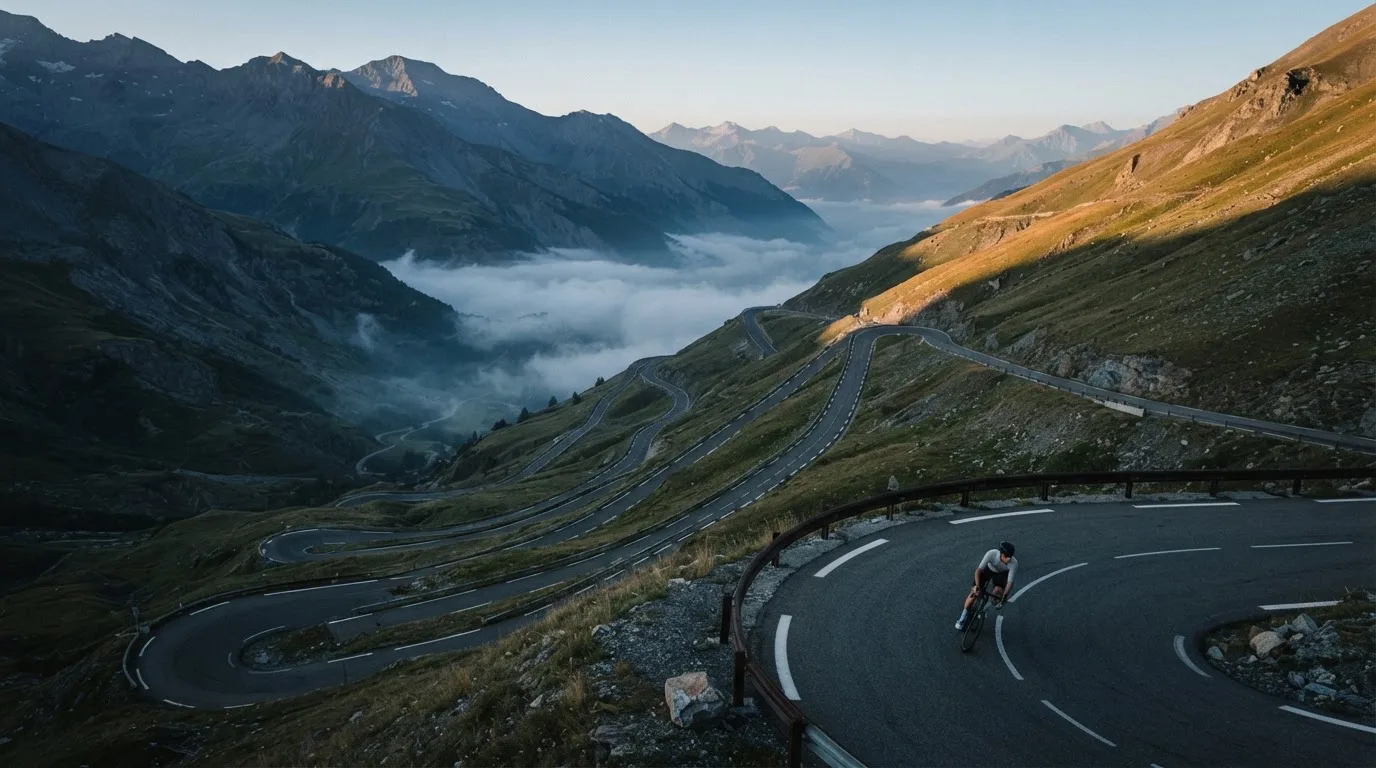
The 2026 Tour de France ran from 4 to 26 July, starting in Barcelona with a team time trial and finishing on the Champs-Élysées in Paris. Twenty-one stages, 3,245 kilometres, 23 teams. Tadej Pogačar, riding for UAE Team Emirates, won the general classification, his fifth Tour victory. The race is a working example of what a deep cycling market looks like: an outright market on the GC winner, on each stage winner, on the points classification, the mountains classification, the young rider, the team classification, and on every named head-to-head between two riders for a single stage. The margin on the stage-winner market is tighter than on the GC; the margin on a stage H2H is tighter still; the margin on the team classification is the widest of the lot because the bookmaker has the least information to work with.
The Giro and the Vuelta are priced to a similar depth, with one structural difference: the Giro’s time trial is usually longer and the Vuelta’s parcours is hillier, and the favourites profile of each race is different from the Tour’s. The bookmaker’s margin does not change by race; the field’s depth does, and that is what the punter is paying for when the price on the outright looks short.
The fundamentals: the WorldTour and the racing pyramid
The Union Cycliste Internationale, based in Switzerland, has governed road cycling since 1900 and runs the men’s and women’s road World Championships each year. The UCI WorldTour is the top tier of the men’s calendar, created in 2005 as the ProTour and renamed the WorldTour in 2011. It includes the three Grand Tours, the five Monuments, and roughly 25 other stage races and one-day events. Below it sit the UCI ProSeries, the Continental circuits, and the national championships.

The structure matters for the punter because the WorldTour is what the British sportsbook prices. A race outside the WorldTour is priced by some books and not by others, and the price on a Continental-team rider in a one-day race is a thin number with a wide margin because the book has watched the rider three times this year and has no prior to model on. WorldTour races are the ones with a full team sheet published in advance, a known parcours and a known form cycle. The bookmaker’s information edge is narrower on a WorldTour race, and the punter’s is wider, which is one reason the margin on a Grand Tour stage is tighter than on a Tour of Guangxi stage.
The relegation system, in force since 2020, makes the team sheet a moving target. The bottom two or three WorldTour teams by three-year points total are relegated to the ProSeries at the end of each cycle, and the top ProSeries teams come up. The punter pays for this in late-season races, when a team fighting to keep its place will ride aggressively in a race it would otherwise use for training.
What a cycling betting market actually looks like
The pre-match menu on a Grand Tour stage typically includes: stage winner, top three, top five, head-to-head match bets between two named riders, an over/under on the time gap to the winner for the day’s breakaway, and a market on the first rider across each of the day’s categorised climbs. The outright menu for the GC includes overall winner, podium, top five, top ten, young rider, points, mountains, team, and a withdrawal market on each named rider, on the stage at which the rider abandons, or whether the rider finishes at all.
The in-play board on a stage is the most active of the day. Prices update on every attack, every time gap change, and every named split. The bookmaker’s margin on the in-play winner market is wider than on the pre-match equivalent by one to two percentage points, because the in-play model has less time to settle and the book is hedging across a market that is moving. The punter pays that gap.
The one-day race menu is shorter. Outright winner, podium, top five, and a handful of head-to-head match bets between two named riders. The in-play board is open for the last hour; the book does not run a board for the first six hours of a Monument because the price on the winner does not change enough to justify the cost of trading it.
Outside the top tier, the market collapses. A .1 race (a race below ProSeries level) usually has a winner market and a small in-play board. A national championship has a winner market. A criterium in October has nothing. The punter pays the depth gap in lost selectivity, and the bookmaker collects the wider margin on the markets that do exist.
The ten bookmakers on this list — and how the list was built
The list is built from one test: every brand here holds a Gambling Commission remote licence for fixed-odds sports betting or for betting intermediation, as listed on the Commission’s public register, and the licence is current as of the snapshot date on the line below the lead. A licence is a floor, not a recommendation: it means the operator has passed the Commission’s checks, holds player funds in a ring-fenced account, participates in GAMSTOP, and is bound by the LCCP and the 10x bonus cap. It does not mean the operator is a good cycling bookmaker, and it does not mean the offer is good value.
The columns that follow set out the licence number and the licence holder as the register records them, so a reader can check the entry against the Commission’s own search. A third column the page would normally carry, setting out what each operator’s own terms state on cycling, has been dropped. The snapshot does not record cycling-specific terms for any of the ten, and a column of dashes tells the reader nothing. Where cycling matters for a particular brand, Smarkets as an exchange for the big races, William Hill and BetVictor for outright depth at the Tours, the rest as broad-sports books, the write-up below says so in prose.
| Bookmaker | Gambling Commission remote licence |
|---|---|
| Spreadex | 008835-R-104580-022 (Spreadex Limited) |
| Bar One Racing | 056516-R-332750-007 (Bar-One Racing Limited) |
| Smarkets | 039173-R-319366-011 (Smarkets (Malta) Limited) |
| William Hill | 039225-R-319373-015 (WHG (International) Limited) |
| BetMGM | 039198-R-319450-029 (LeoVegas Gaming PLC) |
| Midnite | 101839-R-342850-001 (Midnite Limited) |
| Paddy Power | 039439-R-319330-013 (PPB Counterparty Services Limited) |
| Betboro | 044181-R-324363-007 (Webmedia Development N.V.) |
| Octobet | 062545-R-337248-006 (Octopus Game Limited) |
| BetVictor | 039576-R-319370-028 (BV Gaming Limited) |
The order is the order in the register snapshot, not a ranking. Several of the brands sit under larger groups, and the licence holder named on the register is the group entity that holds the licence, not the brand’s parent company. The list is a snapshot. Licences change; the register is the live test, and the punter who bets on a brand whose licence has lapsed is paying the cost the legal section above sets out.
What a value bet is, and what the margin inside the price does to it
A price is a number. A value bet is a price whose number is wrong, in the punter’s favour, by more than the bookmaker’s margin. The arithmetic is the entire game.
Start with the implied probability. A decimal price of 2.00 implies a 50 per cent chance of winning, because 1 divided by 2.00 is 0.50. A decimal price of 4.00 implies a 25 per cent chance. A decimal price of 1.50 implies a 66.7 per cent chance. The conversion is mechanical. The bookmaker’s margin is what happens when the implied probabilities of every outcome of a market are added together and the sum comes to more than 100 per cent: the excess is the overround, also called the bookmaker’s margin, also called the vig.
A value bet is a price whose implied probability is below the punter’s own estimate of the true probability, after the margin has been stripped out. If the punter’s model says a rider has a 30 per cent chance of winning a stage, and the bookmaker is offering 4.00 (implying 25 per cent), the difference is 5 percentage points and the bet has value. If the punter’s model says 22 per cent and the book is offering 4.00, the bet is a loser at the offered price even though the model thinks the rider can win. The margin is not optional; it is the price of admission, and the worked example below sets out what the price looks like in numbers.
No tip is ever certain. The bookmaker’s model and the punter’s model are both estimates. The market price is the book’s estimate, with the margin on top. A tipster who claims a lock is selling confidence, not probability; the lock does not exist, and the punter who acts on a single tip is paying the margin on a market the tipster has not modelled. The punter who acts on a price they have built themselves is paying the margin on a market they have, and the difference is the entire game.
Building a tip from form, not from the noise
Form is the only edge a cycling punter has that a bookmaker’s model does not also have. The bookmaker knows the form; the bookmaker has the data; the bookmaker’s model is faster. What the punter adds is context the model misses: a parcours that does not suit a named favourite, a team that has lost its lead-out man to illness, a rider returning from injury whose watts are down ten per cent on last month, a headwind on a finish that flips the sprint order.
The starting point is the recent results, the last 30 days of racing, weighted by the similarity of the parcours. A climber’s form on a mountain stage is a better guide to a future mountain stage than a sprint result on a flat one. The punter who treats all results as equal is paying for the model’s smoothing, and the model smooths more than the form deserves.
The second input is the parcours. A race that ends in a steep climb suits a puncheur, not a pure climber and not a sprinter; a flat finish with a long straight suits a pure sprinter with a lead-out; a cobbled classic suits a rider with a long history on the stones. The bookmaker’s model has the parcours too, and the price reflects it; the punter’s edge is in the cases where the parcours is misread by the model, which is more often in the one-day races than in the Grand Tours.
The third input is the team. A general classification leader with a strong team can sit at the front and wait; a leader whose team is down to three riders by the third week is exposed. A breakaway that includes two riders from the same team is more dangerous than the sum of its parts. The bookmaker’s model handles this less well on a one-day race than on a stage race, because the team sheet is shorter and the punter can read the jersey order on the road.
The fourth input is the time trial. A race with a long time trial favours the diesel engines, riders who can sustain a high pace for an hour; a race without one favours the puncheurs and the climbers. The 2026 Tour opened with a team time trial in Barcelona, and the bookmaker’s outright price on Pogačar shortened when the route was announced, because a TTT rewards a deep squad.
The punter who builds a tip from these four inputs and prices it against the bookmaker’s market is not promising a win. The punter is pricing a probability, comparing it to the market’s probability, and betting when the difference is positive and large enough to cover the bookmaker’s margin over many bets.
Staking, the bankroll, and the cost of being wrong
The bookmaker’s edge is small on a single bet. Compounded over hundreds of bets, it is the difference between a punter who is up and a punter who is down. The arithmetic is unflattering: at a 5 per cent margin, a flat-stake punter betting on coin-flip markets loses roughly 5 per cent of total turnover per year before any skill adjustment; at a 7 per cent margin, the loss is 7 per cent; at a 10 per cent margin, the loss is 10 per cent. A punter who bets £100 a week at a 5 per cent margin is paying £260 a year for the privilege of having an account.
Staking is what the punter controls. A flat unit, 1 per cent to 3 per cent of the bankroll per bet regardless of confidence, is the discipline that keeps a losing run from ending the bankroll. The Kelly criterion, which sizes the stake to the edge, is the mathematically optimal staking plan but it requires an honest estimate of the edge, and most punters who use it over-stake because they over-estimate the edge. The honest estimate is the harder of the two to build.
The cost of being wrong is not the stake. It is the stake compounded by the number of bets needed to recover, and the punter who chases losses by doubling the stake after a loser is paying the book’s margin on a larger number of bets, not fewer. The bookmaker does not need the punter to be right; the bookmaker needs the punter to keep betting. That is the entire business model, and it is the reason every offer on this page is examined for what it costs, not what it pays.
The bankroll is the punter’s. It is the amount the punter can afford to lose in full without the loss changing the punter’s life. Anything beyond that is borrowed from next month, and the bookmaker’s margin on borrowed money is the most expensive money the punter will ever bet with.
Ten bookmakers reviewed
Spreadex
Spreadex combines fixed-odds betting and financial spread betting in one app, regulated by the Gambling Commission for the fixed-odds side and by the Financial Conduct Authority for the spread-betting side. The two are not the same product. A fixed-odds bet on a cycling stage caps the loss at the stake; a spread bet on a cycling index can lose more than the deposit, because the loss is the size of the spread times the stake, not the stake itself. The Commission’s own note on the Spreadex homepage is that spread-betting losses can exceed deposits. The cycling product on the fixed-odds side is the standard Grand Tour and WorldTour menu; the spread side is the part of the offer that no other brand on this list runs, and it is the part of the offer that costs the punter the most when the trade goes wrong. For the punter who wants spread exposure to a cycling race outcome alongside a fixed-odds account, Spreadex is the only choice on the list; for the punter who does not, the dual-offer structure is overhead, not upside.
Bar One Racing
Bar One Racing rebranded as BAR 1 Betting and runs as an Irish independent bookmaker with shops across Ireland, alongside horse-racing sponsorships at Dundalk, Fairyhouse, Navan, The Curragh, Curraheen Park and Cork. The site holds a Commission remote licence for customers in Great Britain, and the on-course presence is the centre of gravity. The cycling product is light: the Irish racing focus and the shop window are the brand, and the Grand Tour outrights and stage markets are the cycling content. This is a horse-racing book that takes cycling bets, and an account built around the flat and the jumps will use it for the Tours as a side bet, not as a cycling book.
Smarkets
Smarkets is a betting exchange, not a sportsbook, and runs under a remote betting intermediary licence, the licence type the Commission reserves for exchanges. An exchange lets the punter back a selection at one price and lay the same selection at another, and the punter’s counterparty is another punter, not the book. The margin is the difference between the back and the lay prices on either side of the market, and on a liquid race, the Grand Tours and the Monuments, that difference is roughly 1.5 to 3 percentage points, half what a sportsbook charges. On a thin race, the difference is wider and the exchange is no cheaper than the book. Smarkets pays withdrawals within six hours from £10 to £100,000, and bank-transfer deposits are instant from £10 to £10,000; debit-card deposits are instant from £10 to £15,000. The best margin on the list for the Grand Tours and the Monuments, and the wrong product for a one-day race outside the top tier.
William Hill
William Hill is the longest-established brand on the list, and the outright market at the Grand Tours is the deepest, with prices on the GC, each stage, the points, the mountains, the young rider and the team classification. Best Odds Guaranteed applies to UK and Irish horse racing from 8 am on the day of the race, on singles and multiples, and does not apply to ante-post, tote or pari-mutuel bets; it does not apply to cycling, and the gap is the gap. The Grand Tour outright punter gets the widest menu on the list; the Wednesday-night WorldTour stage punter gets the standard board and not much else.
BetMGM
BetMGM’s UK sportsbook runs under a Commission remote licence held at the group level. The welcome offer for new UK customers is four £10 free bets, two football accumulators of four selections or more and two sports multiples of two selections or more, for customers who deposit £10 or more and place a sports bet within seven days. The free bets are valid for seven days, with minimum odds and an opt-in required. The cycling product is the broad-sports book: Grand Tour outrights, stage markets, and in-play on the bigger stages, but no cycling-specific feature. The welcome structure favours the football acca punter, and a cycling backer is paying for a bonus whose qualifying shape does not match the bet they want to place.
Midnite
Midnite’s site shows in-play events, an acca builder, popular accas and price boosts with maximum-stake limits. The welcome offer for new customers is £25 in free bets and 50 free spins on a sports bet of £5 or more at pre-match odds of evens (2.0) or greater within 14 days of sign-up, with the free bets valid for seven days. The acca builder is the cycling-relevant feature on the site, and the price boosts are the cycling-relevant market mechanic; the welcome offer’s minimum odds of evens is the cycling-relevant filter. An acca punter gets a reasonable welcome; the stage-winner single punter gets a thin one, because the structure rewards the acca, not the price.
Paddy Power
Paddy Power’s app covers football, horse racing, boxing, rugby, tennis, golf, darts, snooker and Formula 1; cycling is on the list at the Grand Tours and at the bigger one-day races. The brand’s market is specials and price boosts, and the welcome offer runs in the same shape, a money-back special or a boosted odds token rather than a matched deposit. The Tour is a three-week price-boost festival here, and the stage H2H board is the gap a serious cycling punter will feel.
Betboro
Betboro’s sports welcome offer is a 100 per cent matched free bet of up to £25 on the first qualifying wager, requiring a debit-card deposit of at least £10 and a first bet of £5 to £25 with at least three selections, each at 3/5 (1.60) or higher. The three-selection minimum and the 1.60 minimum price are the filter, and they price the cycling punter out of the qualifying bet unless the punter is willing to add two legs to a stage wager that would otherwise be a single. The acca punter gets a tight welcome; the stage-winner single is structurally excluded by the three-selection rule.
Octobet
Octobet’s sportsbook welcome offer is 50 per cent back as a free bet up to £50, plus a £10 casino bonus for new customers. The structure is a loss-back rather than a matched deposit, and the 50 per cent ceiling is half what a full match would be; the upside is that the punter keeps the stake on a win and gets a free bet on a loss, rather than the other way round. The cycling product is the broad-sports book. A reasonable first-bet safety net for backing a single stage winner, and a thin headline number compared with a full matched offer.
BetVictor
BetVictor offers Best Odds Guaranteed on UK and Irish horse racing, enhanced live race streaming, a BetFinder feature for finding racing bets, and Smart Stats. The cycling product is the broad-sports book with Grand Tour outrights and stage markets; the Smart Stats and BetFinder features are horse-racing tools, not cycling tools. Horse racing is the centre of gravity and cycling is a three-week sidebar in July; the year-round cycling punter should look elsewhere.
What a margin of five per cent actually pays for
Take the illustrative two-way market priced at 1.90 against 1.90, the kind of symmetric price a bookmaker might offer on a two-runner match bet or a head-to-head stage market. The implied probability of each side is 1 divided by 1.90, or roughly 52.63 per cent. The sum of the two implied probabilities is 105.26 per cent, and the bookmaker’s margin, the share of every pound wagered that the book expects to keep on average across many bets, is the excess over 100 per cent, which is 5.26 percentage points, or roughly 5 per cent. The payout share is the reciprocal: 1 divided by 1.0526, or 95 per cent, which is the share of every pound wagered the book returns to customers as winnings. The two figures are the same market seen from two sides, and the choice of label is the choice of which side the page is talking to.
The number is a band rather than a single figure, because the symmetry of the two prices is the assumption. A two-way market priced at 1.85 against 1.95 has a tighter margin on the favourite and a wider one on the outsider, and the average is still close to 5 per cent, but the punter’s exposure on the favourite is different from the punter’s exposure on the outsider. The punter betting on the favourite pays a smaller margin per unit staked; the punter betting on the outsider pays a larger one. The cost is paid in the price, and the price is paid on every selection.
The cost of a 5 per cent margin to a flat-stake punter betting £100 a week is £5 of every £100 wagered, or £260 a year in expected loss. A punter who bets selectively, only when the price is above the model’s probability by enough to cover the margin, pays the margin on fewer pounds; the savings are the entire point of selectivity. A punter who bets on every race the book prices is paying the margin on the full ticket, and the full ticket is what the book wants.
The cost compounds at the same rate as the margin. A punter down 5 per cent in year one is down a further 5 per cent of the smaller bankroll in year two, and a further 5 per cent in year three, and the book does not need the punter to be unlucky: the book needs the punter to keep betting at the offered price, and the offered price already has the margin inside it. The arithmetic is the central point of this guide, and it is the only number the punter can act on, because the punter cannot change the price and cannot change the margin, but can change which pounds are wagered and at which price.
Frequently asked questions
How do you bet on cycling?
Pick a race from the sportsbook’s cycling menu: a Grand Tour stage, a one-day Monument, or a smaller WorldTour event. Pick a market: race winner, general classification, stage winner, head-to-head match bet, or a classification market. Enter the stake on the selection. The book holds the stake and pays the return, stake plus winnings, on settlement. Pre-match or in-play are the two windows; the in-play margin is the wider one.
Is cycling available to bet on with UK bookmakers?
Yes, every major UK-licensed sportsbook prices the three Grand Tours and most WorldTour one-day races. Market depth drops sharply outside the top tier, and a Continental-level race is usually priced with a winner market only. The full menu returns at the next WorldTour event, and the margin widens between events.
What is a value bet?
A price whose implied probability is below the punter’s own estimate of the true probability, after the bookmaker’s margin is stripped out. If the punter’s model says 30 per cent and the price implies 25 per cent, the bet has value. The margin is the cost of admission; the edge is the gap between the model’s number and the price’s number, and the gap has to be wide enough to survive a long run of being wrong.
What is the bookmaker’s margin?
The share of every pound wagered the book expects to keep across many bets. It is built into the prices, not added on top, and it shows up as the excess over 100 per cent when the implied probabilities of every outcome of a market are summed. A two-way market at 1.90 against 1.90 has a margin of roughly 5 per cent; a one-way market on a single rider cannot have a margin expressed the same way, but the overround lives in the price.
How is a return worked out from the stake and the odds?
Decimal odds times the stake is the return, which includes the original stake. A £10 stake at 3.50 returns £35, of which £25 is profit. For a combination bet the odds of the legs multiply into one price before the stake is applied, and the return is stake times the combined price. No tip can change the arithmetic, and the arithmetic is the same on a win and on a loss: the stake is the stake.
Combat & motorsport – Footy Tips
Content created by the «Footy Tips» team
