
Darts betting tips for 2026: how to read form, value and the margin
 Available in US
Darts looks like a fair target for tipsters. Players are individual, the calendar is finite, form swings visibly, head-to-heads are short and recent. The game is a clean two-player contest with a clear win condition. That is part of why tip sheets for darts are everywhere, and why the cost of trusting one is so easy to miss. A tip is a forecast, a price is a probability with a margin taken out, and a stake is what the punter pays for the difference. None of the three is what most tip pages actually explain. This guide covers the rest: how a tip is built, what makes one worth a stake and what the offer wrapped around the bet actually pays. It does not call winners, because nobody can. What it does is walk through the mechanics — odds formats, handicaps, each-way terms, the cash-out button, the wagering multiple on a free bet — so the punter sees where the money goes before the slip is placed.

The data and operator claims below are current as of 27 October 2026 and were checked against the UK Gambling Commission’s public register and the operators’ own terms.
UK regulation: who can take a darts bet from a British customer
Every bookmaker taking remote bets from customers in Great Britain must hold a Gambling Commission licence. The Commission is the non-departmental public body that licenses commercial gambling under the Gambling Act 2005. The framework covers England, Scotland and Wales; Northern Ireland runs a separate regime and is not regulated by the same Act, so the phrase is “GB-licensed”, not “UK-licensed”. A Malta, Gibraltar or Curaçao licence is not a substitute: since the Gambling (Licensing and Advertising) Act 2014 an operator needs a Commission licence wherever it is based if its remote facilities are used in Great Britain. The Commission’s public register is the only test of who holds one. It can be searched by business name, trading name, domain or account number.
The register entry carries a remote general betting standard (real events) licence category, an account number, the licence holder’s company name and the trading site. Several well-known brands share a single licence holder — Paddy Power and Betfair, for example, both sit under one group — and a register entry can name a holding company rather than the brand on the slips. A place in a comparison is not a licence, and being a GB-licensed bookmaker is not the same as being a UK company. Domain endings prove nothing: licensed operators use .com as freely as .co.uk, so the suffix does not signal the regulatory regime.
Minimum age is 18 across the market. Since 7 May 2019 every licensed remote operator has had to verify the customer’s name, address and date of birth before the first deposit — and that check covers free bets and bonuses, not only paid play. Anonymous betting at a licensed site is no longer a thing. For financial spread betting on sport — a different product from fixed-odds darts — the regulator is the Financial Conduct Authority, not the Commission, and the FCA makes plain that spread losses can exceed the deposit.
The short version: if the brand is not on the Commission’s public register, the punter is on an unlicensed site, and the protections that come with a GB licence — GAMSTOP, dispute resolution, the bonus cap, the financial vulnerability check — do not apply. That is the frame the rest of this page sits inside.
Safer gambling: the tools a GB-licensed bookmaker has to give the punter
A GB-licensed bookmaker has more obligations to its customers than an offshore one, and the dart bettor sits inside that frame whether or not they read the safer-gambling page. Three things are worth knowing before the rest of this guide makes sense.
GAMSTOP is the national multi-operator online self-exclusion scheme. It has been a mandatory licence condition for online operators since 31 March 2020, and a GB-licensed remote bookmaker will register a customer who signs up to it across every brand it operates. Self-exclusion periods are six months, one year, five years, or five years with auto-renewal. After the minimum period the exclusion stays in place for a further seven years unless the punter asks GAMSTOP to remove it. GAMSTOP covers online sites and apps only; betting shops use a separate service. It is the single most useful switch on the page, and it works regardless of how the punter opened the account.
Deposit limits are a customer-set control, not a state-set cap. There is no statutory ceiling on what a punter can deposit into a sportsbook — limits are the customer’s own choice, set inside the account and adjustable in some cases only after a cooling-off period. Remote Technical Standard 12 requires operators to offer a gross deposit limit on a fixed time frame, and the first changes have been in force since 31 October 2025; a second phase was postponed to 30 September 2026, and whether it is live at the time of reading is not established. The headline that matters: a daily, weekly or monthly cap is set by the punter, and any change up has to wait the operator’s stated period.
The financial vulnerability check is a public-record check the operator has to run, not a credit check. Under LCCP condition 3.4.4, in force since 30 August 2024, a licensed remote operator has to perform this check when a customer’s deposits minus withdrawals exceed £150 in a rolling 30 days; the threshold has applied since 28 February 2025. It looks at publicly available records such as bankruptcy or county court judgments, and it is not an income check. A separate financial risk assessment — the “affordability check” of the press — is at the centre of a Commission plan announced on 7 July 2026, with a phased rollout and no start date as of writing. State it as “announced, staged, no start date”, not “in force”.
Help exists outside the operator. GamCare runs the National Gambling Helpline; GambleAware funds treatment and research; the NHS runs gambling clinics; Gamblers Anonymous runs meetings. A safer-gambling page is a place to find them. The point of knowing all this before reading the rest of the page is that a guide to betting tips, free bets and accumulator boosts only makes sense inside a frame the punter can leave by.
Bonuses and free bets: what the marketing actually pays
The word on a darts offer is rarely what it pays. A “free bet” is a credit, not cash — the stake is usually not returned with a winning bet, and the credit disappears if the bet loses. A “boosted price” lifts one outcome on one market for one customer, often with a stake cap and a maximum extra winnings figure. A “risk-free” bet is usually refunded as a free bet, not as withdrawable cash, and a refund as a free bet is a different product from a refund in money. A “100% bonus” is a matched deposit that comes with turnover. The job of this section is to read each shape and price what the punter is actually being given.
The headline number is rarely the right one. What a £30 free bet is worth on average is the free-bet amount multiplied by the edge the punter would have had on the same selection, divided by the price they actually take. For a free bet at 2.00 on a market where the punter’s true probability of winning is 45% (so the price should be 2.22), the average value is £30 × 0.45 = £13.50, before any stake-not-returned haircut. The haircut is the bit the marketing never names. A free bet that does not return the stake pays, on average, less than the headline figure, and a free bet with a minimum price of 2.00 locks the punter out of the short prices that most often look good in darts.
The bonus cap the regulator set matters here. Since 19 January 2026 wagering requirements on bonuses are capped at 10x — a £10 bonus at 50x turnover needed £500 of qualifying bets; under the cap no more than £100 — and mixed-product promotions, the kind of “bet on football to get free spins” offer that used to be a staple, are banned. Whether the cap applies to free bets with no wagering condition, and any cap on the money value of a bonus, are not established. The cap is the regulator’s most direct intervention in the offers on this page, and it sits over the welcome packages of every brand reviewed below.
For the punter the practical question is: how much betting does this bonus require? The turnover number is the bonus base multiplied by the wagering factor. Where the base is the bonus only — a £30 free bet with a 1x turnover before withdrawal on any winnings — turnover is £30 and the question is what odds and which markets qualify. Where the base is bonus plus deposit — a 100% match up to £50 with a 6x turnover on bonus plus deposit — the punter has to place £600 of qualifying bets before any winnings are withdrawable. Both shapes are common; both are legal under the 10x cap; the difference between them is what the punter has to do before the money is theirs. The check is always the operator’s own terms, because the shape varies by brand and by season.
One more thing the marketing rarely says. A “dead heat” rule, a “non-runner” rule and a “Rule 4” deduction are all bookmaker rules that can take money off a winning slip after the event. In darts the most common of these is the walkover — when a player is replaced late and the new player is treated as a non-runner for bet settlement. An each-way bet doubles the stake and pays part of the win price if the selection places. The point is not to memorise the rules. It is to read the small print on the operator’s terms page before treating any offer as cash.
Live betting and cash out: the in-play darts market
Darts plays in short bursts, which suits in-play betting. A leg of 501 lasts perhaps five to eight minutes, a set is a best-of-five, and the matches are televised with on-screen graphics showing checkout percentages, 180 counts and average scores per visit. In-play markets exist on most televised PDC events, and the controls around them — minimum price changes between markets, suspension of the market at a set point, what happens if a player withdraws mid-leg — are set by the operator’s licence conditions and its own house rules, not by statute. There is no blanket rule that says what an in-play market must look like; the regulator sets the duty, the bookmaker sets the product.
A cash-out button lets the punter settle a bet before the match ends, at a price the bookmaker sets in real time. The button looks like a profit guarantee, and for short, sharp bets on darts it is tempting: a 3-0 lead in sets in a best-of-five can feel safer at cash-out than at full-time. The price the operator offers is its own, calculated from the live market, the in-built margin, and the operator’s view of how the rest of the match will go. Cash out is not free money. The price quoted is below the “true” payout the same selection would return at full-time, because the operator is paying early and taking the risk back. Used sparingly, on bets that have genuinely changed rather than on bets that have merely drifted, cash out can recover a stake. Used as a habit, it pays the operator.
Bet builders and same-game multis are a different shape: a single slip combining two or more selections from the same match, with the odds multiplied into one price. The leg of a bet builder in darts is typically a player to win, a player to hit the most 180s, a highest checkout, or a handicap on leg or set score. The odds compound, and so does the margin. A bet builder with three legs of around 1.80 each carries the margin of each leg added together, and the bookmaker’s edge on the combined slip is higher than on any one of those legs individually. The product is convenient — one stake, one payout — and the operator is paid for the convenience. A punter who understands what each leg costs in margin will pick a bet builder the way they pick any other bet: by the leg with the worst price, not the leg with the best headline.
A live-streaming feed — where the bookmaker carries the PDC stream inside the app or site — is licensed separately and varies by operator. A feed is not a market; it is the way to see the market settle in real time. The punter who bets in play without watching the feed is pricing blind.
Predictions and strategy: how a tip is built, and why none is certain
A tip on a darts match is a forecast, written by someone who has read form, watched recent matches, and decided which player is more likely to win. Form is recent: how many legs and sets the player has won in the last eight to twelve weeks, against opponents of similar ranking. H2H is short: a small number of recent meetings, and the older ones fade quickly because players change. Stage matters: the PDC World Championship at Alexandra Palace is a different event from a Players Championship floor event, and the floor players who reach the worlds late in the season can be out of form by Christmas. The bookmaker’s price is the final input, because the price is the market’s estimate of the probability of each outcome, with the bookmaker’s margin taken out.
A value bet is a price the punter believes is higher than the true probability warrants. If the punter’s own estimate of a player’s chance of winning is 50% and the bookmaker’s price implies 40%, the bet is value. The arithmetic is the same shape whatever the sport. The punter’s job is not to be right about who wins — most darts matches are close enough that the favourite loses often — but to be right about whether the price is fair. A streak of correct value bets pays over a long run, because the price is on the punter’s side, not because the punter has a hotline. A streak of bets where the price is poor pays no one, even when the selection wins. That is why a tip sheet that names the winner without naming the price is half a guide.
Bankroll discipline is what stops the inevitable losing streak from ending the betting. A stake is a fixed share of the bankroll, usually 1% to 5% per bet, set in advance and not varied to chase losses. The share is small enough that a ten-bet losing run does not wipe the bank, and large enough that a winning run actually pays. A staking plan that grows the stake after a loss is a recovery plan, not a discipline plan, and recovery plans are the standard route to blowing the bank. The point of a fixed share is to keep the punter in the game long enough for the value to come through, if it does.
No tip is ever certain. The favourite in a PDC major at around 1.50 loses more often than a casual reader expects — perhaps a third of those short-priced favourites go down in the first round of the worlds — and a tipster who claims a hit rate of more than about 60% on short-priced darts favourites is selling a record, not a method. The honest framing: a tip is a forecast with a price attached, the price is the only thing that makes a forecast worth a stake, and the stake is a small share of the bank. A punter who treats a tip sheet as a betting system is paying a tipster for the privilege of giving their money back to the bookmaker.
The closing line is the price on the same selection just before the match starts, after all the early money and the in-running shifts have settled. Tracking whether the punter’s own price was better or worse than the closing line is the cleanest single measure of whether their value judgement worked. It is more useful than tracking winners: a punter who beats the closing line on most bets is, by construction, paying less for each unit of true probability than the market. A punter who does not is paying more, regardless of how many bets they have won.
Bet types and odds: what a darts slip actually contains
Darts markets are mostly two-player, set-and-leg structures with a small set of recurring bet types. The 1X2 equivalent is the match winner — two runners, price on each, no draw. The most popular derivatives are the set winner, the leg winner after a handicap, the correct score in sets, the player to hit the most 180s, the highest checkout, and a small set of player specials. A bookmaker will offer 30 to 80 markets on a televised PDC match and far fewer on a non-televised floor event. The range widens through the tournament and narrows by the final, because bookmakers hedge more on the matches they have to.
Odds come in two forms on the British market. Fractional odds (5/1, 11/4, evens) are the native form, and a price of 5/1 returns the stake plus five times the stake in winnings, for a total return of six times the stake. Decimal odds (6.00, 3.75) show the total return to a unit stake — 6.00 means a £1 stake returns £6. The two convert cleanly: a/b in fractions is (a ÷ b) + 1 in decimals, so 5/1 is 6.00 and evens (1/1) is 2.00. Decimal prices compound on a bet builder, which is why a bet builder reads more naturally in decimals. The punter can use either form, and the slip will show the decimal equivalent whatever the default is.
The margin is what the bookmaker keeps of every unit bet on a market. For a two-way market with decimal prices of 1.90 and 1.90, the payout share is 1 ÷ (1 ÷ 1.90 + 1 ÷ 1.90) = 0.95, so the margin is 5% — meaning 95p of every pound staked on the market, in the long run, is paid back as winnings and 5p is kept by the bookmaker. The example is illustrative: real PDC match prices on the two-outcome match-winner market sit in the 1.80 to 1.95 range per side on most televised events, which implies margins in the 2.5% to 10% band depending on the match. A typical Premier League Darts match-winner price might be 1.80 / 2.00 — a margin of around 5.4% — and a heavily bet final might compress to 1.72 / 2.10 with a margin under 5%. The exact figure moves with the money, the field and the time before the off, and the punter who picks the lower-margin bookmaker for the same match is paid the same winners and pays less commission.
A handicap in darts runs on legs or sets, and the line is whole-numbered. A player at -1.5 sets has to win by two clear sets, which on a best-of-five means winning 3-0; a player at +1.5 has to take at least one set, which on the same match means losing 2-3 in sets or winning. The handicap line moves the odds, because the favourite’s price shortens (it has more to do) and the underdog’s price lengthens. The favourite at 1.40 to win the match may be 1.85 to win with a -1.5 set handicap, and the underdog at 3.00 to win may be 1.85 to take a set. Both prices carry the same margin as the match-winner market.
An each-way bet is two bets of equal stake — one on the win, one on the place — and the stake doubles. The place terms are set by the operator and depend on the number of runners: in a four-player field the place terms are typically 1/2 the win odds for first and second, and in a larger field the terms tighten or loosen accordingly. A bettor who backs an each-way outsider pays for two chances of winning and is paid only on one of them, on average. The right shape for an each-way bet is an event with a deep field and a long-priced selection, which is rare in darts. Most darts markets are two-runner or four-runner; an each-way bet is the wrong shape for almost all of them.
The leg of a bet builder is the way the punter puts several of the above into one slip. The leg the punter thinks is the surest tends to be the leg with the worst price, because the market has already priced it in. A bet builder of three legs at 1.80 each compounds to about 5.83, but the implied probability of all three landing is the product of the implied probabilities, and the margin is the gap between the multiplied price and the fair price from the underlying true probabilities. A punter who wants a bet builder to be value has to find legs where each one is at least at the right price — the leg with the worst price caps the whole slip.
The darts calendar: what gets bet on and when
The PDC runs the professional circuit and operates the two tournaments that drive most of the betting turnover. The World Darts Championship is the season’s centrepiece, held at Alexandra Palace in London over the Christmas and New Year period. The 2026 PDC World Championship ran from 11 December 2025 to 3 January 2026 at Alexandra Palace, with 128 players in the field — an expansion from 96 in earlier years — and the final was a first-to-seven-sets match in which Luke Littler beat Gian van Veen 7–1. The prize fund was £5,000,000, with £1,000,000 going to the winner. The format moves up the rounds: rounds 1 and 2 are first to three sets, rounds 3 and 4 are first to four, the quarter-finals are first to five, the semi-finals are first to six and the final is first to seven. The match-winner market is tighter in the early rounds and loosens in the later ones as the field shortens.
The Premier League Darts is the invitational, weekly BBC-televised event that runs across the spring, with eight players meeting in a league format before a play-off night in May. The format suits in-play betting because the matches are short and the legs frequent, and the markets are deep — match winner, set winner, leg winner after a handicap, total 180s, highest checkout. Floor events (Players Championship and European Tour) run year-round and draw the professional field, but the markets on them are thinner and the liquidity lower, because the matches are not televised. The World Matchplay and the World Grand Prix sit in the summer and the autumn, and the Grand Slam of Darts rounds out the late-autumn calendar. The BDO and the WDF run parallel circuits with their own world championships, but the betting turnover sits overwhelmingly on the PDC.
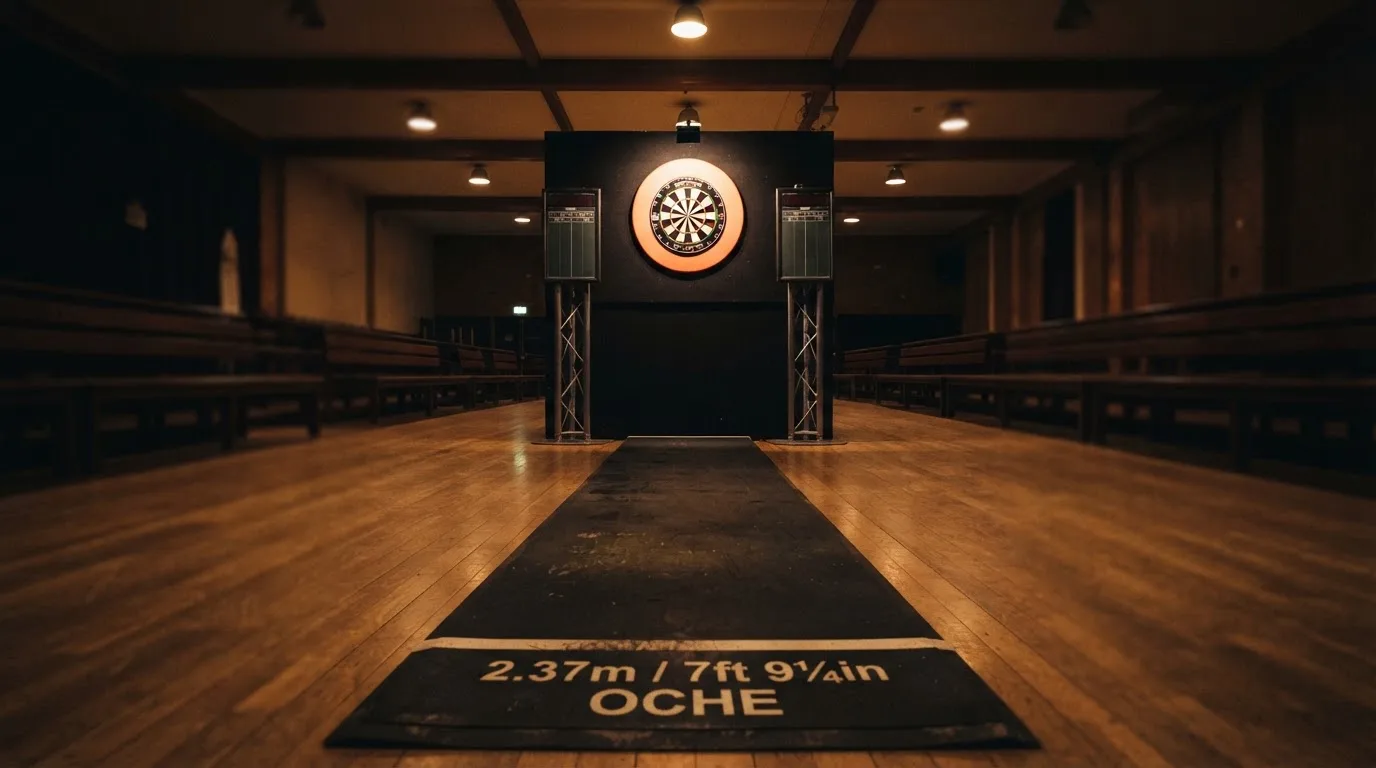
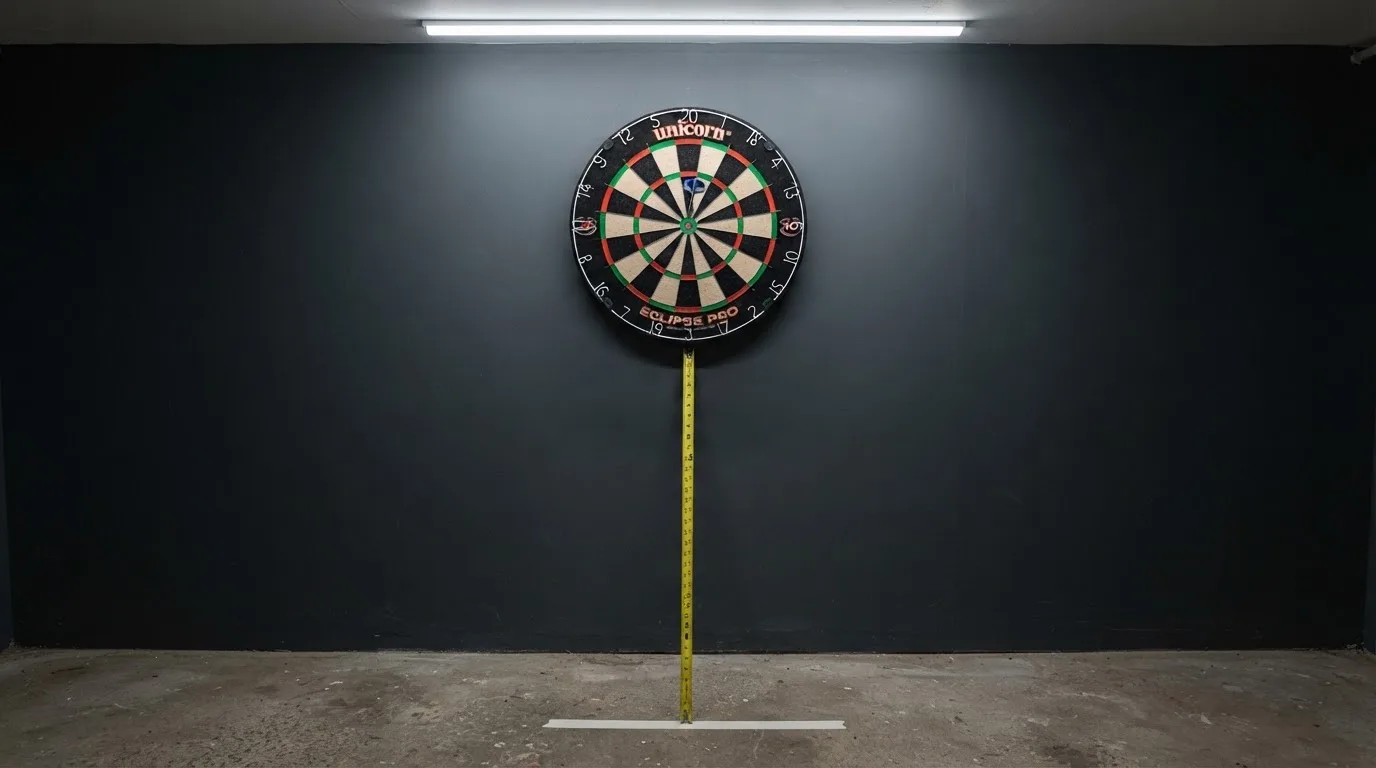
A standard dartboard has 20 numbered segments, each with single, double and treble areas; the bullseye is worth 50 and the outer bull 25. In 501 darts players start at 501 and must finish on a double or the bullseye; the highest possible three-dart finish is 170 (treble 20, treble 20, bullseye) and the minimum possible leg is nine darts. The standard throw distance is 2.37 m (7 ft 9 in) and the bullseye is 1.73 m above the floor. These are the facts a price is built on: a 170 checkout is a long-shot market at 100/1 or longer, a nine-dart leg is in the same ball-park, and a 180 (the maximum score with three darts) is the spine of the in-play markets — every televised match carries a count of 180s and a market on which player hits more.
The 2026 calendar is full from January through the Worlds in late December. The punter’s choice of where to put the bank is shaped by the market’s depth: the televised events carry the deepest markets, the floor events carry the lowest margin in some cases because the bookmakers’ risk teams do less work on them, and the in-between events (the Grand Slam, the Matchplay) are the best combination of televised coverage and a less efficient market. The price the punter gets is partly a function of the tournament they pick.
The top ten darts bookmakers: what each one actually does
The ten bookmakers below are the ones the Gambling Commission’s public register names as remote general betting standard (real events) licence holders, and each is described only on the facts the operator’s own terms state. The licences, the safer-gambling tools and the welcome offer shape are the columns that matter; the rest is the same product under a different brand. The order is the order of the register, not a ranking — being listed is not a recommendation.
| Bookmaker | Licence number and holder | What the operator’s own terms state on the key’s subject |
|---|---|---|
| Paddy Power | UKGC account 39439 (PPB Counterparty Services Limited) | App carries Bet Builder+, Popular Bet Builders, Super Sub (a bet rolls over to the replacement if a selected player is substituted), expanded Win More markets, and player and ACCA stats |
| Betmaster | UKGC account 65699 (BM Solutions GB Ltd) | States it holds UKGC account 65699 on its home page, run by a Malta-registered operator |
| BetGoodwin | UKGC account 2927 (Goodwin Racing Limited) | Pays Best Odds Guaranteed on all UK and Irish horse and greyhound racing, up to £1,000 |
| Sporting Index | UKGC account 27343 (Sporting Index Limited) | New-customer offer: a £10 fixed-odds bet at minimum odds of 1/2 unlocks three £10 free bets, three £5 Total Goals spread bets, three £5 Winning Favourites spread bets and a £1 Race Index spread bet; the qualifying bet cannot be placed in play or cashed out early |
| LiveScore Bet | UKGC account 56859 (LiveScore Betting and Gaming (Gibraltar) Limited) | Accepts debit cards (Visa and Mastercard), Apple Pay, PayPal, Pay by Bank (Open Banking) and Revolut Pay |
| Midnite | UKGC account 101839 (Midnite Limited) | Sports welcome offer: new customers who bet £5 or more on pre-match odds of EVS (2.0) or greater within 14 days of sign-up receive £25 in free bets and 50 free spins, valid for 7 days; the home page cites in-play events, an acca builder, popular accas and price boosts with maximum-stake limits |
| DAZN Bet | UKGC account 48756 (DZBT Limited) | Deposits start at £5 by debit card, Apple Pay, Paysafecard, Trustly and Skrill, and at £20 by PayPal, with no processing fees |
| Lottoland | UKGC account 38991 (EU Lotto Limited) | App combines casino, lottery betting, sports betting and scratchcards, and states it is licensed by the Gambling Commission for customers in Great Britain |
| Fitzwilliam Sports | UKGC account 48760 (SBKI Limited) | Phone and live chat with the office open 09:00 to 21:00, Monday to Sunday, with messenger replies generally within 90 seconds |
| William Hill | UKGC account 39225 (WHG (International) Limited) | Pays Best Odds Guaranteed on UK and Irish horse racing from 8 AM on the day of the race, on single and multiple bets; does not apply to ante-post, tote or pari-mutuel bets |
The table above is the register; the paragraphs below are what each operator is actually like in the darts market. The order is the same as the table.
Paddy Power
Paddy Power runs under PPB Counterparty Services Limited and shares the licence with Betfair. The sports product is broad, the markets on televised darts are deep, and the Bet Builder+ is the shape of the bet the punter is being asked to build. The Super Sub feature is the unusual one: if a selected player is substituted, the bet rolls over to the replacement rather than being voided, which is a small but real edge on a sport with late withdrawals. The price on a typical televised darts match-winner sits in the 1.80 to 2.00 range per side on most events. For the punter who wants a deep market and a familiar interface, Paddy Power is one of the safer picks; for the punter who wants the lowest margin on the same match, a sharper bookmaker like BetGoodwin or Sporting Index on a tight event can pay more for the same selection. The value of Super Sub is real but narrow — a substitution in darts is rare, and the punter pays the platform’s standard margin on the rest of the slip.
Betmaster
Betmaster is the smaller brand in this set, run by a Malta-registered company that holds the UKGC account 65699. The home page carries the licence number, which is the right thing to check on a smaller brand before opening an account. The market depth on televised darts is narrower than on the major brands, and the in-play offering is thinner. For a casual darts bettor who already has an account at a sharper bookmaker, Betmaster is a secondary place to check a price on a non-televised floor event; for a primary account, the depth and the in-play product are not yet on a par with the bigger names. The safer-gambling tools are present in line with the GB-licensed baseline. The punter who values a small operator’s range of promotions over a large operator’s market depth will find a niche; the punter who wants the best in-play price on a televised match will not.
BetGoodwin
BetGoodwin is the horse-racing-led brand in the set, with Best Odds Guaranteed on all UK and Irish horse and greyhound racing up to £1,000. The darts offering is present but not the centrepiece, and the value on a televised darts match sits behind the value on a major horse race on the same day. For the punter who bets on both sports, BetGoodwin is a place to take the morning price on a televised darts event because the BOG promise is a different shape from the headline price; for the punter who bets only on darts, the in-play depth and the price on a Premier League match are not the leading edge of the market. The safer-gambling tools are in place. The honest framing: a solid secondary bookmaker for a darts punter, not the primary one.
Sporting Index
Sporting Index runs fixed-odds and spread betting on sport, with the new-customer offer built around a £10 qualifying bet unlocking a bundle of fixed-odds free bets and spread bets. The qualifying bet cannot be placed in play or cashed out early, which is the standard get-out on a welcome offer. The spread bets (Total Goals, Winning Favourites, Race Index) are the more interesting product: a spread bet’s profit and loss can far exceed the stake, on either side, and Sporting Index publishes the spread and the stop-loss limit on each market. For the punter who understands spread betting, the bundle is a way to try a product without staking the full £1 a point a serious spread bettor would carry; for the punter who does not, the fixed-odds free bets are the part of the offer with a known cost. The cost of the offer is the qualifying bet, and the value is whatever the punter can do with three £10 free bets before they expire. The safer-gambling tools are in place.
LiveScore Bet
LiveScore Bet is the brand attached to the LiveScore scores app, run by LiveScore Betting and Gaming (Gibraltar) Limited. The payments list is the unusual feature: debit cards (Visa and Mastercard), Apple Pay, PayPal, Pay by Bank (Open Banking) and Revolut Pay. Pay by Bank is the open-banking route that links the betting account to the bank account directly, without a card, and Revolut Pay is the closed-loop wallet for Revolut users. The variety matters for the punter who already uses a particular wallet and does not want to fund a betting account through a different route. The markets on televised darts are present at standard depth, and the in-play product is in line with the rest of the set. For the punter who wants to fund the account from a specific wallet, LiveScore Bet is a useful option; for the punter who wants the best in-play price on a televised darts match, the product is not the leading edge of the market.
Midnite
Midnite is the smaller sportsbook-and-casino brand with a clean app and a deep in-play product. The sports welcome offer is the centrepiece: bet £5 or more on pre-match odds of EVS (2.0) or greater within 14 days of sign-up, receive £25 in free bets and 50 free spins, valid for 7 days. The free spins are a casino product, not a sports product, and the offer’s mixed-product element is a reminder that the regulator’s 19 January 2026 ban on mixed-product promotions does not apply to a welcome offer that is already a sports-plus-casino bundle if the casino side is the free spins. The acca builder and the popular accas on the home page are the bet-builder equivalents, and the price boosts have a stated maximum stake. For the punter who wants a small brand with a clean in-play product and a competitive welcome offer, Midnite is a sensible choice; for the punter who wants the widest market depth on a televised darts event, the bigger names carry more lines. The safer-gambling tools are in place.
DAZN Bet
DAZN Bet is the betting brand attached to the DAZN sports streaming service, run by DZBT Limited. The deposits list is the unusual feature: a £5 minimum on debit card, Apple Pay, Paysafecard, Trustly and Skrill, and a £20 minimum on PayPal, with no processing fees. The £5 floor is one of the lowest in the GB-licensed set, and the absence of processing fees is the other unusual feature — most operators do not charge a deposit fee, but some e-wallets carry one at the wallet side. The markets on televised darts are at standard depth, and the in-play product is in line with the rest of the set.
Lottoland
Lottoland is the lottery-led brand that has expanded into sports betting. The app combines casino, lottery betting, sports betting and scratchcards, and the home page states the GB-licensed status for customers in Great Britain. The sports product is the secondary offering behind the lottery product, and the market depth on televised darts is narrower than the rest of the set. For the punter who already plays the lottery and wants a single app for the occasional darts bet, Lottoland is a convenient option; for the punter who wants a serious darts bookmaker, the depth and the price on a televised match are not the leading edge of the market. The safer-gambling tools are in place. The verdict is a secondary bookmaker for a casual punter, not a primary account for a serious one.
Fitzwilliam Sports
Fitzwilliam Sports is the smallest brand in the set by customer base, run by SBKI Limited. The unusual feature is the customer service: phone and live chat with the office open 09:00 to 21:00, Monday to Sunday, and messenger replies generally within 90 seconds. The markets on televised darts are present but the depth is narrower than the major brands, and the in-play offering is thinner. For the punter who values a phone line and a fast live chat over market depth, Fitzwilliam is a useful option; for the punter who wants the best in-play price on a televised darts match, the product is not the leading edge of the market. The safer-gambling tools are in place. The verdict is a niche bookmaker for a punter who values the human contact, not a primary account for a serious darts bettor.
William Hill
William Hill is one of the largest and oldest brands in the GB-licensed set, run by WHG (International) Limited. Best Odds Guaranteed on UK and Irish horse racing from 8 AM on the day of the race is the long-standing promotion, applied to both single and multiple bets, with the carve-outs for ante-post, tote and pari-mutuel bets that the terms name. The darts offering is one of the deepest in the set, with the full market range on televised events and a standard in-play product. The price on a televised darts match-winner sits in the 1.80 to 2.00 range per side on most events. For the punter who wants a major brand with deep markets and a long history, William Hill is one of the safer picks; for the punter who wants the lowest margin on a darts match, a sharper bookmaker on a tight event can pay more for the same selection. The value of BOG is real but it applies to racing, not to darts, and the punter who bets on both sports gets the BOG benefit on the racing side and a standard price on the darts side.
The bookmaker’s margin: where the price takes its cut
The bookmaker’s margin is the slice of every pound bet on a market that the operator keeps in the long run. It is hidden in the prices — for a two-way market, the implied probabilities of the prices add up to more than 100%, and the gap is the overround. For decimal prices of 1.90 and 1.90, the implied probabilities are 52.6% and 52.6%, totalling 105.3%, and the margin is 5.0% — roughly a 5p commission on every pound staked on the market. A price of 1.80 and 2.00 implies 55.6% and 50%, totalling 105.6%, which corresponds to a 5.3% margin. A price of 1.72 and 2.10 implies 58.1% and 47.6%, totalling 105.7%, which corresponds to a 5.4% margin. The margin moves with the match, the market and the time before the off, and the punter’s job is to find the lowest margin on the same selection.
For the example, the two-way market at decimal prices of 1.90 and 1.90 (fractional 9/10) gives a payout share of 1 ÷ (1 ÷ 1.90 + 1 ÷ 1.90) = 0.95, and a margin of 1 − 0.95 = 0.05, or 5%. As a band, the realistic margin on a televised PDC match-winner market runs from about 2.5% on a heavily bet final to about 10% on a non-televised floor event, with most televised Premier League and World Championship matches sitting in the 5% to 7% band. The exact figure moves with the money and the time before the off, and the punter who reads the prices on three or four bookmakers on the same match can pick the lowest margin without much work.
The margin is why a tip with a 60% hit rate at 1.80 (true probability 55.6%) loses money in the long run. The punter is right more often than the price implies, but the price already assumes a 5% margin, and the punter’s edge is on top of the market’s edge, not instead of it. A tip with a 55% hit rate at 2.00 (true probability 50%) is the breakeven point on a market with no margin, and a losing proposition on any market with one. The arithmetic is the same on every market and every sport; the dart-specific part is which markets carry the lowest margin and which carry the highest.
The market with the highest margin on a televised darts match is usually the bet builder, because the legs compound and the margin of each leg is added together. The market with the lowest margin is usually the match-winner on a heavily bet final, because the bookmakers’ risk teams have the field sized and the money is concentrated. The 180s and the highest-checkout markets sit in the middle, and the margin on a player-special (player to hit the most 180s, for example) is usually higher than on the match-winner because the bookmakers price them less frequently. The punter who picks the market with the lowest margin on the same selection pays less commission for the same bet, and that is the simplest edge available without a model.
Payments, tax and the small print
A GB-licensed bookmaker takes debit cards, bank-based payments (open banking, direct bank transfer), and e-wallets. Credit cards have been banned for gambling in Great Britain since 14 April 2020, including credit-card-funded payments through an e-wallet; a punter who tries to fund a betting account with a credit card will be declined at the wallet or at the bookmaker. The verification before the first deposit means a punter cannot move money in until the name, address and date of birth have been checked, and the source-of-funds question is a normal part of the on-boarding at higher spend. There is no state list of permitted payment methods, and the absence of a state-set deposit ceiling means the punter sets the cap, not the regulator.
The punter pays no tax on betting winnings in Great Britain. General Betting Duty is the operator’s tax on gross profits, currently 15%, and from 1 April 2027 a new remote betting rate of 25% applies within it; remote bets on UK horse racing, bets on self-service betting terminals in licensed premises, pool betting and in-person betting stay at 15%. The change in April 2027 is a change to the operator’s tax, not the punter’s, and whether the operator passes the duty on through lower odds is not established. State the rule: punters do not pay tax on winnings, and any obligation to declare professional gambling income to HMRC is a different matter for a professional gambler, who should ask an adviser. A casual punter does not.
Spread betting on a non-financial product is inside General Betting Duty at a different rate, and financial spread betting is regulated by the Financial Conduct Authority with its own rates (3% financial, 10% other). A spread bet’s profit and loss can far exceed the deposit on either side, and the FCA makes plain that spread losses can exceed the deposit. Sporting Index is the spread-betting brand in the reviewed set, and the offer’s spread-bet legs carry the same warning. The punter who backs a spread bet at a stop-loss limit has set a floor; the punter who does not has set nothing.
The small print on the bookmaker’s terms page is where the offer is settled. Walkover rules, non-runner rules, dead heat rules, Rule 4 deductions, the stake-not-returned clause on a free bet, the minimum price for a qualifying bet, the wagering multiple on a bonus, the deadline for using a free bet, the cap on free-bet winnings, the cap on enhanced-odds extra winnings — all of these are bookmaker rules, set inside the framework the regulator has set, and all of them are negotiable only at the moment the punter signs up. After the slip is placed, the rules are the rules.
What “offshore” actually costs the punter
A bookmaker licensed in Curaçao, Malta or Gibraltar, and not on the Gambling Commission’s public register, can take bets from a British customer at the point of consumption — the GB-licensed framework makes the operator’s licence the requirement, not the punter’s nationality — but the punter is on an unlicensed site. No statute makes it an offence for a customer to bet on an unlicensed site; the offence is the operator’s, under section 33 of the Gambling Act 2005. The punter’s loss is the loss of the GB-licensed protections.
No GAMSTOP coverage: the punter who self-excludes is not excluded from an offshore site. No Commission complaints route: a dispute with an offshore operator is governed by the operator’s own terms, in the operator’s own jurisdiction, and the British consumer has no automatic right of redress. No approved dispute-resolution body: the ADR that the Commission approves is for licensed operators only. No British consumer protection if funds are withheld: the punter’s recourse is the offshore operator’s regulator, in the offshore operator’s country. None of the 10x bonus cap, the £150 financial vulnerability check, the credit-card ban or the safer-gambling code apply. The verification before the first bet is the offshore operator’s choice, and the same is true of the source-of-funds checks.
The honest framing: a GB-licensed site is not “the safe choice” by default — verification before the first bet is a real intrusion, the safer-gambling tools can be ignored, and the bonus terms can be tight — but it is the only site that gives the punter the British consumer framework. An offshore site is not “the unsafe choice” by default, and the same operator may have a long history of paying out, but the punter has none of the British protections if it does not. Neither side is risk-free; the difference is which regulator the punter can call if the operator stops paying out.
The Commission’s enforcement against unlicensed operators is disruption, not blocking: cease-and-desist notices, search-engine referrals, work with registrars, hosts and payment providers, and court-order DNS blocking powers that have been granted or are about to be. The Commission has not, as of writing, brought ISP blocking into operation in the way some other jurisdictions have. State the rule: a punter on an unlicensed site is on a site that the regulator is trying to push out of the British market, and the punter’s protection is whatever the operator chooses to give.
The cost of a tip: bringing the calculation forward
The example used in the section on margins is a two-way market at decimal prices of 1.90 and 1.90, fractional 9/10. The arithmetic belongs to the punter’s pocket. The payout share on that market — the share of every pound staked that is paid back as winnings in the long run — is 1 ÷ (1 ÷ 1.90 + 1 ÷ 1.90) = 0.95, or 95p on the pound. The margin — the share the bookmaker keeps — is 1 − 0.95 = 0.05, or 5p on the pound. As a band, the realistic margin on a televised PDC match-winner market runs from about 2.5% on a heavily bet final to about 10% on a non-televised floor event, with most televised Premier League and World Championship matches sitting in the 5% to 7% band.
The implication is straightforward: a tipster with a 55% hit rate at 2.00 is breakeven on a market with no margin and a loser on any market with one. A tipster with a 60% hit rate at 1.80 is paying 5% to 7% of the stake to the bookmaker and keeping the 5% to 7% edge that the price implies. A tipster with a 70% hit rate at 1.40 is paying 5% to 7% to the bookmaker and keeping the larger edge. The arithmetic is the same on every market; the dart-specific part is the realistic margin on the market the punter picks.
The conclusion the arithmetic supports: a tip sheet is a forecast, the price is the market’s view of the forecast, and the margin is the cost of betting on the market. The punter’s edge is the gap between the forecast and the price, and the punter’s cost is the margin. A tip without a price is half a guide. A tip with a price but no margin read is a guide that hides the cost. A tip with a forecast, a price and a margin is the shape the punter actually needs.
Frequently asked questions
How is a darts bet placed?
The punter picks a market (match winner, set winner, handicap, 180s, highest checkout) and a selection, sets a stake, and the slip shows the decimal price and the potential return. The bet settles when the market settles — at the end of the match for the match winner, at the end of the set for the set winner, at the moment of the leg for the in-play markets. A slip can be a single, a combination of two or more selections (a “double”, a “treble” or a longer “accumulator” or “acca”) or a same-game multi (a “bet builder”) that combines legs from the same match.
What is darts betting, in practice?
Darts betting is fixed-odds betting on professional darts matches, with the 1X2 replaced by a two-runner match winner (no draw), and the rest of the markets built around legs, sets, 180s and checkouts. The PDC World Championship at Alexandra Palace is the season’s centrepiece, the Premier League is the weekly invitational, and the floor events run year-round. The market depth is widest on televised events and narrowest on non-televised floor events, and the price is tightest on the heavily bet finals.
How does darts handicap betting work?
A handicap runs on legs or sets and the line is whole-numbered. A player at -1.5 sets has to win by two clear sets (3-0 on a best-of-five); a player at +1.5 has to take at least one set (a 2-3 loss is enough). The handicap shortens the favourite’s price and lengthens the underdog’s, and the market carries the bookmaker’s standard margin. The right shape for a handicap bet is a match with a clear favourite and a tight match-winner price, where the handicap gives the punter a better price on the same view.
What is a value bet, and why is no tip ever certain?
A value bet is a price the punter believes is higher than the true probability warrants — if the punter’s own estimate of a player’s chance of winning is 50% and the bookmaker’s price implies 40%, the bet is value. No tip is ever certain because no forecast of a future event is certain: the favourite in a PDC major loses more often than the headline price suggests, and a tipster who claims a hit rate of more than about 60% on short-priced favourites is selling a record, not a method. A streak of value bets pays over a long run; a streak of bets where the price is poor pays no one.
What is the bookmaker’s margin, and how can it be seen in the odds?
The margin is the slice of every pound bet on a market that the bookmaker keeps in the long run. For a two-way market at decimal prices of 1.90 and 1.90, the implied probabilities of the prices add to 105.3%, which corresponds to a 5.0% margin. The margin is hidden in the prices, and the punter who reads the prices on three or four bookmakers on the same match can pick the lowest margin without much work. A bet builder carries the margin of each leg added together, which is why the same bet at a higher compounded price is not necessarily better value.
Tennis, darts & cue sports – Footy Tips
Content created by the «Footy Tips» team
