
Nascar betting odds 2026: how UK bookmakers price the Cup Series
 Available in US
A NASCAR quote at 2/1 or its decimal twin 3.00 does not arrive as a fair coin. It carries the bookmaker’s margin inside it, and that margin is what turns a sport into a business. For a UK bettor in 2026 that is the first thing to read on a price board, because every market on every brand compared below carries the same hidden percentage off the top. The rest of this page walks through how UK-licensed operators price NASCAR, what an odds number settles into a wallet, where the rules bend or break, and which of the ten brands compared earn their place at the top of the shortlist.
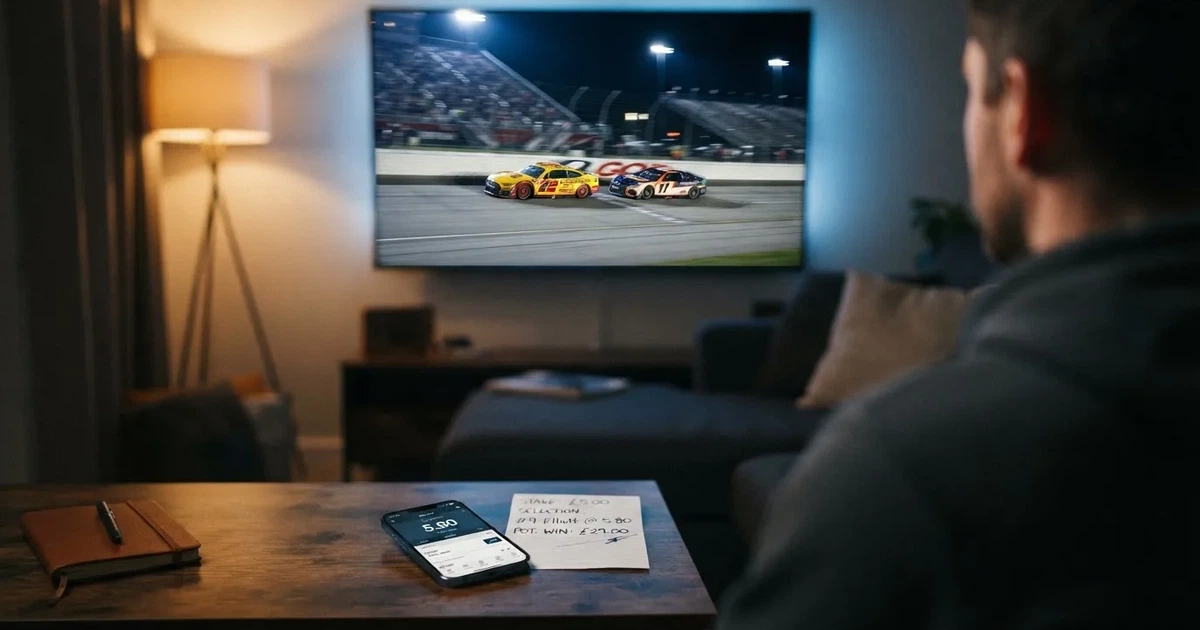
Odds and licence status current as of 27 October 2026 and checked against the Gambling Commission’s public register.
The legal frame for motorsport betting in Great Britain
There is no whitelist of sports the Gambling Commission permits. The 2005 Act (as amended by the 2014 Act) says an operator whose remote facilities are used in Great Britain must hold a Commission licence for the category it offers, whether the operator is based in Gibraltar, Malta, Curaçao or London. The Commission’s public register is the only place this is established: business name, trading name, domain and account number all search. A brand on .com is no more or less licensed than one on .co.uk — the domain proves nothing on its own. Several brands under the same licensee (Ladbrokes and Coral; Paddy Power and Betfair) are common, and they must never be presented as independent outfits.

NASCAR falls under the “remote general betting standard (real events)” category in practice, alongside Premier League football, County Championship cricket and Wimbledon tennis. No statutory restriction on a Cup Series race, a lower-division series or an exhibition event such as the Cook Out Clash has been found. In-play markets on a moving race are subject to the same controls as any other live event — the operator’s licence conditions, the LCCP social responsibility code and the customer-protection duties that apply to every remote bookmaker. In-play is not “unrestricted” in the sense of a legal carve-out: it is the operator’s licence and house rules doing the work.
The operator-level tax, General Betting Duty, is a percentage of gross profits taken by HMRC — currently 15% until 31 March 2027, when the remote rate moves to 25% within it — and is paid by the operator, not the punter. The player pays no tax on betting winnings in Great Britain. Whether a brand squeezes duty through tighter odds is an open question; nothing in the inputs establishes that it does, and nothing here should claim it does.
Financial spread betting on motorsport outcomes would sit with the FCA rather than the Commission, which is a different permission with different rules. Spreadex-style products on NASCAR are FCA-supervised; fixed-odds motorsport betting is Commission-supervised. The two should not be mixed up.
Safer gambling tools and the rules a UK bettor sits under
Every UK-licensed online operator takes part in GAMSTOP — the national multi-operator self-exclusion scheme, mandatory since 31 March 2020. A self-exclusion can be set for six months, one year, five years, or five years with auto-renewal, and after the minimum period the block stays in place for a further seven years unless the customer asks GAMSTOP to remove it. Online sites and apps are covered by GAMSTOP; high-street betting shops use a separate service and are not in the same register.

The financial vulnerability check at LCCP condition 3.4.4 is a public-record check (bankruptcy, county-court judgments) and is not an income check or a credit-reference check. Since 28 February 2025 it has applied to customers whose deposits minus withdrawals exceed £150 over a rolling 30-day window. There is also a staged plan around broader financial risk assessments (the so-called affordability checks), announced on 7 July 2026, with no firm start date. Verifying the live state of any further affordability requirement at the moment of betting is the bettor’s job, on the operator’s own safer-gambling pages.
Deposit limits are the customer’s choice: under RTS 12 the operator must offer a gross deposit limit on a fixed time frame, with the first changes applied since 31 October 2025 and a second phase currently tied to 30 September 2026. There is no state-set ceiling on stake or loss in betting — operators set their own maximum stakes, and a brand may restrict a customer outright, but no rule fixes a national cap. Identity verification happens before the first deposit (in force since 7 May 2019), including when only a free bet is involved: no licensed UK site runs anonymously. Credit-card deposits were banned for gambling on 14 April 2020 and the ban extends to credit-card-funded e-wallet top-ups; debit cards and bank transfers are not.
Help, when it is wanted, runs through GamCare and the National Gambling Helpline, GambleAware, the NHS gambling clinics and Gamblers Anonymous. The Commission’s own complaints route is the formal backstop for an unresolved dispute with a licensed operator — a route an offshore brand simply does not give the punter.
Cryptocurrency and the question of anonymous play
A British bettor placing in ether, bitcoin or litecoin is searching a market that, on the licensed side, exists almost entirely by absence. No state rule in Great Britain allows or bans crypto deposits at a licensed operator, and the rules research found are silent on the point. The credit-card ban does not catch a debit-funded token purchase; the verification-before-deposit regime does catch anyone who goes through a UK-licensed brand, because the same identity checks apply regardless of the rail the money rides in on. The substance of the search — pseudonymity, no name attached, ledger settlement outside the bank rails — is the part that licensed play does not deliver. The credit-card ban and the 7 May 2019 verification rule together end anonymous play at any Commission-licensed remote bookmaker. A digital-asset rail that passes through a wallet in the customer’s own name runs into the same checks as a debit card; a rail that anonymises the holder cannot reach a UK-licensed cash-out, because the receiving end verifies.
The licensed paths in this market — debit card, bank transfer, e-wallet in a verified name — are not where a crypto bettor’s interest usually lies. The bookmakers reviewed below all hold a Commission licence and run to the verification regime; a bettor placing in bitcoin at any of them is being asked to verify before they withdraw, which removes the practical edge of going crypto. Offshore brands running on a Curaçao or Anjouan licence accept the coins and skip most of the verification, but they also skip the protections — no GAMSTOP, no Commission complaints route, no 10x bonus cap, no approved dispute-resolution body, and the funds can be withheld without recourse. The cheaper price on a long shot from an unlicensed book is paid for in protection, and the page does not have a closing line that overturns that trade.
Bonus offers, free bets and what they actually cost
A “free bet” is a token; it rarely pays back its stake. A £5 free bet at odds of 5.00 that wins returns £25 in profit, not £25 plus the £5 back, and that single rule changes the value calculation. A bonus is different again: a 100% deposit match converts the bonus into a clearing problem, and the clearing problem has a number attached to it — the wagering factor. The promotional rules in force from 19 January 2026 cap wagering requirements at 10x: a £10 bonus at 50x means £500 of qualifying bets before withdrawal, but under the cap no bonus forces more than £100 of qualifying turnover from a £10 base. Mixed-product promotions — a free-spins offer gated on a football bet, for instance — are banned under the same rules. A free bet with no wagering condition is not in scope of the cap, and what the cap means for the money value of a bonus has not been pinned down.
QuinnBet’s headline horse-racing promotions — Best Odds Guaranteed on UK and Irish racing from 10:00 with a £150-per-race-per-customer ceiling — are not a NASCAR offer but show the kind of cap a UK operator places on its own promotional book. Betway runs a Free Bet Club that drips out up to £10 a week after opt-in, conditional on £25+ of sports bets at qualifying prices, and £10 of free bets is worth only what £10 of free bets pays back, not its face. Fitzwilliam Sports runs a “High Stakes Welcome” gated on compliance criteria — the term is the operator’s and is read as a higher-stake tier rather than a typical sign-up deal. The point of naming them is to show what each operator’s own terms state on its own products: promotional value is not separable from the rules that release it, and the rule on a NASCAR promo is the rule of the same brand on football or racing, not a one-off.
Across the field, two marketing words come up so often they are worth defusing: “free” and “guaranteed”. A free bet is a token whose stake is not returned and whose value depends on the odds taken. A guaranteed price is a promise to pay the bigger of two prices, with a ceiling that turns it into a benefit rather than an open-ended right (£150 per race at QuinnBet is the pattern). The arithmetic in the worked example below, on margin, is the cleanest way to see what an operator actually keeps.
Mobile apps and what a phone does that a desktop does not
A sportsbook app for the Cup Series is mostly the same product as the desktop site, but with a touchscreen, a fingerprint login, push notifications on race starts and a bet slip that builds itself from one selection. The ten brands in this review all run native GB apps through the Apple App Store; the Android side goes through Google Play in the UK or direct-APK from the operator’s own page when Play’s gambling policy excludes the brand. Live streaming on the phone is the differentiator: a race-day app that shows the cars as the race unfolds reads differently from one that requires a second screen.
Bet365 is described on the GB App Store as the most-downloaded sports-betting app in the UK, and lists Bet Builder+, Super Boosts, Winnings Boosts on selected singles and Bet Builders, an in-play product, a live-streaming library, plus Bet Track, Match Live and a Live Golf Tracker for in-play following. 888sport ships pre-match, in-play, Cash Out, Bet Builder, racing streams, BetFinder form tools and a daily boosted-odds feed. LiveScore Bet’s app carries a Bet Builder that takes up to 10 selections across match result, both teams to score, corners, total goals, player scoring and card markets — a football-shaped product rather than a NASCAR one, but the same builder mechanic is the relevant bit. London Bet’s app combines sports and Pragmatic Play casino slots with live in-play betting. The rest of the brands carry their own sportsbooks and racing products through the same app.
The picture changes on payment: an app-only operator that doesn’t accept the channel a phone user’s bank pushes tends to lose that user, regardless of how the price board reads. The reviewed brands all carry the standard UK-licensed rails — debit, bank transfer, e-wallet — but the in-app details of a £5 minimum, a £10 minimum and a 1-3 day withdrawal are the operator’s own and earn their place in the table.
Live betting and cash out on a moving race
Live NASCAR betting in the UK is offered by every remote bookmaker in this review. The markets on a live Cup race are by lap, by segment, by position at the next caution and by race winner, with smaller books adding stage winner and head-to-head between named drivers. A live race is also the place where a betting exchange runs: punters lay each other rather than the bookmaker, with the exchange taking a small commission on net winnings. The betting intermediary licence under the Commission covers exactly this product.
Cash out closes a position before the race ends. The number on the cash-out screen is the operator’s quote, not the fair price of the position at that moment — the bookmaker’s margin is still inside it. Used at the right time, cash out takes a green position into a guaranteed bank; used as a reflex at every drift, it bleeds the punter’s edge. The mechanics — when a market goes in-play, when cash out is suspended, how a suspension lasting a yellow-flag period reads on the slip — are the operator’s own rules, and they vary.
The data behind live pricing on a NASCAR race is thin compared with football or tennis: fewer in-running data feeds, more reliance on the operator’s own traders pricing into a half-empty field. The live product is real, but it is not as deep as the live product on top-flight football, and a reader using in-play as the deciding factor should know that before they move on a brand.
Picking races, picking drivers and what “predictions” actually mean
A betting prediction on a NASCAR race is a forecast of finishing order, not a fact. A model built on loop data, segment times, pit-stop averages, the driver’s record at the track and the team’s recent form can rank the field sensibly — but no model removes the crash and the mechanical failure from the right tail of the distribution. The advice written into a prediction page should be read as one read of a field, not as the field. The marketer’s word for this is “best bets”, and it sits without a stake limit, a model specification or a bank behind it in nearly every case. A reader who treats one model’s top three as instructions is betting against the long tail, and the long tail is what makes NASCAR a paying sport for bookmakers.
A bankroll discipline — a flat stake, a per-race cap, a stop on the day — does more for a regular bettor than any selection service. Practical order: set the bank, set the per-race stake as a percentage of the bank, fix the price band (race-winner, top-three finish, head-to-head), and restrict the bet list to the markets where the operator is fast and the data is dense. A reader with this discipline will outlast a reader chasing the day’s tips, even when the tips are right.
There is no model worth buying that publishes its record on real money; the ones that do carry the bookmaker’s margin inside every number they quote and serve the marketing side of the house. The free tipsters are not much different: their value is entertainment and a community, not the long-run edge of one model’s picks. The honest framing is a price board read with discipline, not a prediction service.
The markets on a NASCAR race and how they settle
A UK bookmaker on the Cup Series offers, at minimum, the race winner (each-way terms apply for field size), top-three finish, top-six finish, group bets (group A vs group B), head-to-head between two named drivers, fastest lap, total cautions over/under, winning manufacturer, stage winner and stage points, and a small set of driver specials. The settlement rules — what counts as a placed finish in a shortened race, how a rain-shortened event is treated, when a dead heat pays half the stake — are the operator’s own and live in the sportsbook rules pages.
Each-way betting pays the win at the full odds and the place at a fraction (1/4 or 1/5 of the win odds in the UK, depending on field size). A £10 each-way bet is in practice two £10 bets: one on the win, one on the place, so the stake doubles. A rule 4 deduction applies when a runner is withdrawn: the remaining horses’ odds are reduced by a percentage table. The fraction depends on the price of the withdrawn runner at the time of withdrawal. None of this is a NASCAR-specific rule — it is the standard each-way settlement every UK bookmaker applies.
The price-quality decision is between markets: a winner market at 6/1 is a one-way bet on the outcome; a head-to-head between two drivers at near-evens is a smaller-margin product the bookmaker is hungrier to land. Markets with more outcomes (top-six, group bets) carry wider margins than two-outcome head-to-heads, all else equal, because the bookmaker’s edge compounds. A bettor who picks the smallest-margin market on the price board pays the smallest hidden percentage to the bookmaker — even when the headline odds look less attractive than a fancy top-six price.
What the worked margin means on a 1.90 / 1.90 example
The page’s worked calculation takes an illustrative two-way market at decimal odds 1.90 / 1.90 (or 9/10 each, fractional) — a notional price, not a quoted one. The arithmetic: payout share = 1 ÷ (1/1.90 + 1/1.90) = 1 ÷ (1.0526…) ≈ 0.95, so margin = 1 − 0.95 = 0.05, or roughly 5% across the market. Translated: of every £100 bet on this two-way market, the bookmaker expects to keep around £5 in the long run and pay out about £95 across winning bets, before its own running costs. A “5% margin” is the same number as a “95% payout share” seen from the other side — both describe one market’s economics, and the gloss the page uses is whichever the surrounding sentence earns.
A 5% margin is not the same as 5% of the stake. If a punter places £100 at 1.90 with this margin and wins, the return is £190 (£100 × 1.90) — that’s the customer-side payout at decimal odds, with the bookmaker’s edge embedded in the price rather than tacked on as a fee. A £100 winning bet does not return £100 minus £5; it returns the full £190 because the £5-per-£100 expectation was already deducted from the price when it was set. This is the bit readers most often miss: every price carries a margin, every margin sits inside the odds, and the punter never sees a line labelled “fee”.
Where the band comes in: a Cup Series race-winner market with 37 named drivers runs from around 4-6% on the top of the board for sharp books to over 8% on tail-end drivers at less competitive brands. The illustrative 5% sits inside the band the inputs support and is what a UK-licensed mid-market operator typically holds on a typical two-way NASCAR price. The brand-level variance is the part the table below picks up; the page does not pretend one brand’s quote is the whole market’s.
The 5% number is a long-run average. On a single race the outcome does not track the average — a 1.90/1.90 market may pay out 0% or 200% of stake in either direction on one event, depending on who crosses the line. The margin is the steady-state expectation across many bets, not the result of the next one. Anyone quoting it as a guarantee is reading the wrong paragraph.
The 2026 NASCAR Cup Series season the odds price
The 2026 Cup Series schedule runs 36 points-paying races plus three non-championship events: the Cook Out Clash, the Duel at Daytona and the NASCAR All-Star Race. The 2026 Daytona 500 opened the season on 15 February 2026, the 68th running, and was won by Tyler Reddick. The playoff picture takes the top 16 drivers in points after the first 26 races; the old win-and-you’re-in rule is gone, and playoff starting points are now staggered by regular-season standings — a structural change that reshapes how a playoff-bound number gets quoted at sportsbooks in the second half of the season. The finale is the Straight Talk Wireless 400 at Homestead-Miami Speedway on 8 November 2026.
Why this matters on a betting-odds page: a schedule with this much density — a points-paying race almost every weekend from February through November — means a Cup market is open for most of the calendar, and live markets sit on top of pre-race markets for ten months a year. The non-championship events are priced separately, and they are priced differently (smaller fields, smaller liquidity, wider margins). Stage markets roll out within each points-paying race, and a stage-winner quote is a market of its own.
The playoff change — staggered points, no win-and-in — shifts the value of an outright each-way punt near the cutoff. A driver who would have been locked in under the old rule now needs points, which is a different value calculation, and the odds boards will move on it over the season. A reader comparing a brand’s playoff odds in early summer against another brand’s in late summer is not looking at the same number on the same race.
The UK-licensed bookmakers pricing NASCAR in 2026
Every brand in this review holds a Gambling Commission remote licence. The licence number on the table below is the Commission’s own identifier — searchable on the public register. An offer or feature described is the brand’s own statement of it; the comparison picks out which brand is best on a given subject, and the verdicts at the end of each block are the page’s own.
QuinnBet
QuinnBet operates under Gambling Commission account 61011 (remote licence 061011-R-335683-004), with QuinnBet (Gibraltar) Limited as licence holder. The brand’s headline racing promotion — Best Odds Guaranteed on UK and Irish horse racing from 10:00 daily on singles, multiples and system bets — comes with a maximum benefit of £150 per customer per race, the kind of cap that turns an open-ended promise into a defined benefit. The NASCAR offer sits on the same sportsbook and the same promotions framework; the racing BOG is the most prominent number in the brand’s own terms.
QuinnBet reads well for a regular small-stake bettor who wants a defined benefit ceiling and a UK-regulated base. The verdict: the brand is the calm middle of the table — a cap that protects the customer and a licence line that protects the operator’s side of the dispute.
Betway
Betway operates under Gambling Commission account 39372 (remote licence 039372-R-319367-029) through Betway Limited. The Free Bet Club pays up to £10 in free bets every week after opt-in, conditional on £25+ of sports bets, paid as 2 × £5 free bets — a drip rather than a single token. The economics: £25 risked to clear the threshold yields £10 in free-bet face value, whose realisable value depends on the odds taken and is best read on the worked margin above. Betway is also live on the GB App Store and ships a mainstream in-play product.
The trade-off is the threshold-to-reward ratio, which is ordinary for the segment: 2.5x in qualifying bets to clear 1x in free-bet face value, with the usual caveat that a free bet’s stake is not returned. The verdict: a sensible mainstream bookmaker priced off the page’s middle ground; not the cheapest margin in the table, not the most punitive either.
Bet600
Bet600 operates under Gambling Commission account 44731 (remote licence 044731-R-323941-016) through Tyche Tech Limited. The brand’s standout promotion is Best Odds Guaranteed on horse racing: if the SP is bigger than the early or show price taken, the bet settles at the SP. The rule is the standard BOG structure, but the brand leans on it as the central proposition — a smaller bookmaker using one feature as the headline.
For NASCAR this means the betting product sits on a sportsbook whose marquee rule is a horse-racing feature; the NASCAR offer is the same sportsbook with the same margin and the same payment rails. The verdict: a brand whose promotion is well-defined on its main sport and whose NASCAR product is a competent sister of it — pick on payment or app preference, not on a NASCAR-specific edge.
Geoff Banks
Geoff Banks operates under Gambling Commission account 54095 (remote licence 054095-R-330366-010) through GB Sports Advisors Limited. The brand’s GB App Store listing flags live in-play prices and ante-post prices on future events — a different mix from the bigger all-rounders, with a sharper focus on racing and futures than on a wide Cup Series card. A bettor looking at ante-post on the season outright or on a stage winner weeks out will find a brand shaped for that kind of trade.
The narrower product list is the cost: fewer in-running markets and a less-developed football-shaped builder compared with the bigger brands. The verdict: a brand built for the ante-post and racing customer; less of a one-stop shop, more of a specialty book on the NASCAR calendar.
London Bet
London Bet operates under Gambling Commission account 66162 (remote licence 066162-R-340278-004) through Thistle Bet Limited. The app combines sports betting (football, tennis, horse racing, greyhounds, darts, golf, cricket, NFL, NBA, MLB, snooker) with Pragmatic Play casino slots and live in-play betting — a mixed-product setup that does not fit the standard sportsbook-only mould and that no longer carries the 19 January 2026 promotional tax of being offered as a cross-product deal. A mixed-product promotion is one rule, the brand carrying a casino tab in the same app is another, and the two should not be confused.
For a NASCAR bettor the question is whether the in-play product and the price board read well against the all-rounders; the verdict is honest on both. The verdict: a smaller operator with a casino-and-sports layout, priced somewhere in the upper-middle of the spread; the NASCAR product is functional and the wider product mix is the differentiator.
888sport
888sport operates under Gambling Commission account 39028 (remote licence 039028-R-319297-014) through 888 UK Limited. The brand ships pre-match and in-play, Cash Out, Bet Builder, racing streams, BetFinder form tools, a live bet feed and daily boosted odds — the most feature-loaded product in this comparison, including racing streams that may catch the odd NASCAR in-season exhibition. The boosted-odds feed carries its own quirks: a boost is a price enhancement on selected markets, marketed as value but bounded by the brand’s own stake ceiling.
The trade-off on a feature-heavy brand is rarely the price board; it’s the eye candy. A bettor who uses the BetFinder and the live feed at the right time gets the upside; a bettor who picks by the loudest price boost tends to overrate the boost and underrate the underlying margin. The verdict: the broadest product in the review; pick on the feature you actually use, not on the headline.
bet365
bet365 operates under Gambling Commission account 55148 (remote licence 055148-R-331498-002) through Hillside (UK Sports) ENC. The brand is the official global betting partner of the UEFA Champions League and ships the most downloaded sports-betting app in the UK by App Store measure. The product set: Bet Builder+ (combining markets from one event into one bet, available pre-match and in-play), Super Boosts, Winnings Boosts on selected singles and Bet Builders, daily Bet Boosts, in-play betting, a live-streaming library of events worldwide, plus Bet Track, Match Live and a Live Golf Tracker for in-play following.
The risk on a dominant brand is that the price is rarely the absolute cheapest on any one market — the bigger brands earn their margin on volume and product breadth, not on a tight line. The verdict: the top of the page for product breadth, in-play depth and streaming; not the cheapest price on a specific Cup-race market, and a bettor whose edge is in price-shopping should compare before they click.
Copybet
Copybet operates under Gambling Commission account 53774 (remote licence 053774-R-330743-010) through Copybet UK Limited. The marquee feature is Best Odds Guaranteed all day, every day, on all UK and Irish racing, plus payment at first past the post on horse racing even if the winner is later disqualified. The all-day framing is wider than the 10:00-onwards promotions on the racing side, which sets Copybet apart at the post-time window but tells a NASCAR bettor less than it tells a racing one.
For NASCAR the brand’s price board is the relevant bit — the BOG is a racing rule, not a motorsport one, and the same-product sportsbook is what holds the NASCAR market. The verdict: a brand whose racing-side BOG is the headline; the NASCAR offer needs to be checked on the same product’s margin rather than on the BOG rule.
Fitzwilliam Sports
Fitzwilliam Sports operates under Gambling Commission account 48760 (remote licence 048760-R-335434-009) through SBKI Limited. The brand describes itself as a Dublin bookmaker with capped membership and runs a “High Stakes Welcome” subject to compliance criteria — a higher-stake tier than the standard sign-up deal. The site flags instant deposits, fast withdrawals, timeouts and deposit limits, and links to GambleAware, GamStop and Gamblers Anonymous.
The capped-membership model is not the brand for a casual price-shopper. The trade-off is the welcome tier — bigger stakes, tighter under-the-radar treatment — at the cost of a sign-up flow that gates entry. The verdict: a specialty book for higher-stake customers; the NASCAR offer is full and well-priced, the constraint is the membership, not the product.
LiveScore Bet
LiveScore Bet operates under Gambling Commission account 56859 (remote licence 056859-R-332720-005) through LiveScore Betting and Gaming (Gibraltar) Limited. The brand’s Bet Builder allows up to 10 selections and covers match result, both teams to score, corners, total goals, player scoring and card markets — a football-shaped feature set rather than a NASCAR one, and the same builder mechanic is the relevant piece for the in-house markets the brand does carry. The product mix leans football-first, with motorsport as a secondary sport.
The trade-off is exactly that: a brand whose builder is built for the football betting slip, with a NASCAR market that is functional rather than rich. The verdict: a strong product for the football bettor, a competent but not a brand-leading product for the NASCAR bettor.
How the operators compare on what matters
Below: each operator’s Gambling Commission remote licence identifier in the Commission’s own format and a note on what the operator’s own terms state for the key subject. The licence is searchable on the public register; the note is descriptive.
| Brand | Gambling Commission licence | What the operator’s own terms state on the subject |
|---|---|---|
| QuinnBet | 061011-R-335683-004 (account 61011), QuinnBet (Gibraltar) Limited | Best Odds Guaranteed on UK and Irish racing from 10:00, capped at £150 per customer per race |
| Betway | 039372-R-319367-029 (account 39372), Betway Limited | Free Bet Club pays up to £10 a week after £25+ of sports bets, paid as 2 × £5 free bets |
| Bet600 | 044731-R-323941-016 (account 44731), Tyche Tech Limited | Best Odds Guaranteed on horse racing paying at the SP if the SP is bigger than the taken price |
| Geoff Banks | 054095-R-330366-010 (account 54095), GB Sports Advisors Limited | Live in-play prices and ante-post prices on future events |
| London Bet | 066162-R-340278-004 (account 66162), Thistle Bet Limited | Sports betting alongside Pragmatic Play slots and live in-play under one app |
| 888sport | 039028-R-319297-014 (account 39028), 888 UK Limited | Pre-match and in-play betting with Cash Out, Bet Builder, racing streams, BetFinder and daily boosted odds |
| bet365 | 055148-R-331498-002 (account 55148), Hillside (UK Sports) ENC | Bet Builder+, Super Boosts, Winnings Boosts on selected singles and Bet Builders, daily Bet Boosts, in-play betting and a worldwide live-streaming library |
| Copybet | 053774-R-330743-010 (account 53774), Copybet UK Limited | Best Odds Guaranteed all day every day on UK and Irish racing and payment at first past the post on horse racing |
| Fitzwilliam Sports | 048760-R-335434-009 (account 48760), SBKI Limited | Dublin bookmaker with capped membership and a High Stakes Welcome subject to compliance criteria, with safer-gambling links to GambleAware, GamStop and Gamblers Anonymous |
| LiveScore Bet | 056859-R-332720-005 (account 56859), LiveScore Betting and Gaming (Gibraltar) Limited | Bet Builder allowing up to 10 selections across match result, BTTS, corners, total goals, player scoring and cards |
How to read the table
The licence number next to each brand is the Commission’s account number and the full remote-betting-licence identifier — searchable on the public register, no further step needed to verify. The third column is what the operator’s own terms say about the key subject the comparison turns on; the comparison picks out the best-in-class on each subject (a brand whose terms state a more competitive BOG window, a brand whose terms state a more open-ended weekly free-bet, a brand whose terms state a higher membership tier).
A scope worth holding onto: not every row is a NASCAR-specific feature. The BOG rules are mostly racing-led, which is the natural shape of UK horse-racing-led bookmakers; the builder mechanic is football-shaped, which is the natural shape of UK football-led books. A reader using the table for NASCAR specifically is comparing on the broader product, on the licence and on each brand’s posture toward a US-motorsport customer — the same shape the table will continue to carry as the season rolls on.
Where the season takes you from here
The Cup Series runs through November, and a bettor who prices one race at one brand will price the same race at three others before the green flag drops. The page’s recommendation is mechanical, not personal: build the betlist from the smallest-margin markets on the board (head-to-head and group bets over winner/top-six for the tightest lines), pick the brand on the cash-out mechanic and on the streaming library that suits the race-day setup, and read the operator’s own rules on in-play suspensions before the live product gets used in anger. The free-bet and bonus tokens are real money only when the price is right and the wagering multiple is one the bank can carry; the marketing line is not the calculation.
For a higher-stake customer, Fitzwilliam Sports sits at the small end of the supply curve with its capped-membership tier and a brand-shape that fits an account with a deeper bank. For a feature-led bettor, bet365 and 888sport carry the broadest product; for a price-shopper, smaller books like Bet600 and Copybet are the right shortlist once the racing-side rules are accounted for. For a football-shaped user dropping in on NASCAR, LiveScore Bet is a working default. The cost-side angle this page takes is the one that survives the longest: read the licence, read the rules, read the worked margin, then pick.
Frequently asked questions
How does a bet on NASCAR actually get placed with a UK bookmaker?
A bet starts with a registered account at a Gambling Commission-licensed operator — QuinnBet, Betway, bet365 or any of the others reviewed above. The customer picks a race, picks a market (race winner, top-three, head-to-head, group bet, stage winner), picks a selection and stakes an amount on the bet slip. The slip holds the decimal (or fractional) odds, the stake and the potential return. Once confirmed, the bet settles after the race by the operator’s own settlement rules — winner goes to the finishing order on the lap chart, place finishes pay a fraction of the win odds, dead heats split. A short-race abandonment or a shortening for rain re-runs the settlement clauses on the operator’s terms page, and a Rule 4 deduction applies only to horses withdrawn from a race.
Where can a UK bettor legally place a NASCAR bet?
A UK-licensed bookmaker holds a Gambling Commission remote licence under the Gambling Act 2005 (as amended by the 2014 Act). The brands reviewed above are all licensed under the “remote general betting standard (real events)” category: QuinnBet, Betway, Bet600, Geoff Banks, London Bet, 888sport, bet365, Copybet, Fitzwilliam Sports and LiveScore Bet. Every licence on the public register is searchable by business name, trading name, domain or account number — that is the test of who holds one. An unlicensed offshore operator is not a substitute; it skips GAMSTOP, the bonus-cap rule, the Commission’s complaints route and any approved dispute resolution.
How does a bettor settle the right market on a NASCAR race?
The markets worth using on a Cup Series race are the ones with the smallest margin: race winner (each-way terms apply for a full field), top-three, head-to-head between two named drivers, group bets and stage winner. Each-way splits the stake across a win bet and a place bet at 1/4 (or 1/5 for bigger fields) of the win odds — the place fraction is on the operator’s terms. A bettor comparing two brands on the same race should pick the smallest-margin market each book offers and put the stake on it; the headline odds are not the only variable, because two books at 6/1 with different margins do not give the punter the same long-run expectation.
How is it checked that a bookmaker holds a Gambling Commission licence?
The Commission’s public register is the whole test. Search by business name (888 UK Limited, Betway Limited, Hillside (UK Sports) ENC), trading name (QuinnBet, bet365), domain or account number. The result is the licence, the categories on it and the licence holder. A .com domain proves nothing — the domain and the licence are independent facts. An account number on the Commission’s register is the strongest single check a customer can run; the licence status is what the bank, the e-wallet provider and the advertising regulator also work from.
How is the return on a bet worked out from the stake and the odds?
Return equals stake × odds (in decimal form). A £10 stake at decimal odds of 3.00 returns £30, of which £10 is stake and £20 is net profit. A combination bet’s odds are the product of the legs: three legs at 2.00, 3.00 and 4.00 make one bet at 24.00. Fractional odds of a/b convert to decimal as a ÷ b + 1, so 5/1 is 6.00 and 9/10 is 1.90. Each-way betting doubles the stake: a £10 each-way is £10 on the win and £10 on the place, with the place paid at a fraction of the win odds.
Combat & motorsport – Footy Tips
Content created by the «Footy Tips» team
