
Online Badminton Betting in Great Britain
 Available in US
Data current as of 27 October 2026, verified against the Gambling Commission’s public register and each operator’s own published terms.

The shuttle lands twice, the rally ends, and a bookmaker has already taken its cut. That cut is in every price on every badminton market a punter in Great Britain can bet on: it never appears as a separate line on the betting slip, and the bettor who can’t see it is the one who pays it. Online badminton betting looks like a small corner of the sportsbook — a handful of tournaments, two or three markets per match — and it is. What costs the reader isn’t the size of the corner. It’s the margin inside it, the bonus conditions that follow first deposit, the verification check before the first £10 leaves the account, and the difference between a bookmaker that is licensed by the Gambling Commission and one that isn’t. Read those four before the markets, and the rest of the page is a more honest read.
The legal frame a GB-licensed bookmaker sits inside
A commercial bookmaker that takes bets from customers in Great Britain needs an operating licence from the Gambling Commission (UKGC), regardless of where the company itself is seated. Since the Gambling (Licensing and Advertising) Act 2014 an operator whose remote facilities are used in Great Britain — meaning its site or app is opened here and a deposit is made from a British payment card or bank — has to hold one, with the rules drawn from sections 33 and 36 of the Gambling Act 2005 as amended. A Curaçao licence, a Maltese licence, a Gibraltar licence: none of these counts. The Commission’s public register is the only place a licence can be checked, and it’s searchable by business name, trading name, domain or account number.

The licence a brand carries for online fixed-odds betting is a remote general betting standard (real events) licence. Pool betting, betting exchanges, and financial spread betting are separate categories with separate licences — the FCA regulates financial spread betting, not the Commission — and a brand that holds one category does not automatically hold the others. The register’s entry also names the licence holder, the legal entity behind the brand: Tote’s online fixed-odds activity sits with TDCO Limited; BetMGM’s sits with LeoVegas Gaming PLC; Betfred’s with Petfre (Gibraltar) Limited. A reader comparing brands is comparing two things at once: the betting product on the front page and the corporate structure that has to answer to the Commission if anything goes wrong.
There is no statutory list of permitted sports. The 2005 Act doesn’t name badminton, football, politics or novelty markets — it hands the question to each operator’s licence conditions and to the Licence Conditions and Codes of Practice (LCCP). What this means in practice: a GB-licensed bookmaker can decide which sports to offer and which markets to attach to them, and the Commission’s role is the conditions of the licence, not the content of the betting slip. In-play betting on badminton is offered by several of the brands reviewed below and the controls sit in the licence conditions and the social responsibility code, not in any “permission” on the page.
Northern Ireland is outside the 2005 Act. A “GB-licensed” or “Great Britain licence” covers England, Scotland and Wales; Northern Ireland runs its own older law, and a brand licensed only by the Commission is not licensed to take bets from a customer in Belfast. Anyone reading the page from Northern Ireland needs to check the position separately.
No account is anonymous at a GB-licensed bookmaker. Since 7 May 2019 the operator has to verify name, address and date of birth before the first deposit, including on accounts that intend to claim a free bet or bonus — the check is a condition of opening the account, not of withdrawing. A punter who would rather stay anonymous cannot do so at any of the ten brands reviewed below. That trade-off sits at the front of the picture, not at the back: the licence buys a complaints route, GAMSTOP coverage and access to the Commission’s enforcement powers; it costs the bettor the privacy that an unlicensed site still offers.
Self-exclusion, financial checks, and the help that exists
Every brand in this comparison is part of GAMSTOP, the national multi-operator online self-exclusion scheme. A customer who registers with GAMSTOP is excluded from every GB-licensed online operator for the chosen period — six months, one year, five years, or five years with auto-renewal — and after the minimum period the exclusion stays in place for a further seven years unless the customer asks GAMSTOP to remove it. The scheme covers online sites and apps only; a high-street bookmaker’s betting shop runs under a separate service.
Two newer checks sit on top of GAMSTOP. The financial vulnerability check has been in force since 30 August 2024: when a remote betting customer’s deposits minus withdrawals exceed £150 in any rolling 30 days, the operator must run a public-record check (bankruptcy, county court judgments), not an income or credit-reference check. Deposit limits under the Remote Technical Standards (RTS 12) require operators to offer a gross deposit limit on a fixed time frame — the first changes have applied since 31 October 2025, a second phase was postponed to 30 September 2026. Whether that second phase has started is not established; what is established is that there is no state-set cap on deposits or losses. Limits remain the customer’s choice, structured by the operator.
The financial risk assessments — the affordability checks that the press calls them — were announced in a Commission article of 7 July 2026 on a staged plan, with no start date set. State them as “announced, staged, no start date”, never as in force.
The line that runs underneath all of this: credit cards have been banned for gambling in Great Britain since 14 April 2020 (LCCP condition 6.1.2), including credit-card-funded payments through an e-wallet. A debit card, a bank transfer, an e-wallet funded from a debit card — those are fine. There is no British named-account rule, no state list of permitted payment methods, and no settled rule on cryptocurrency deposits at licensed operators: describe any brand’s payment policy only from its own terms.
Help, separately from the rules: GamCare runs the National Gambling Helpline; GambleAware publishes information and funds treatment; the NHS runs gambling clinics; Gamblers Anonymous runs peer-support meetings. Fitzwilliam Sports — included for context, not in the licensed-online-badminton ranking below — links to these on its own site. None of them is the regulator and none is the operator. They are the route for a punter who has decided the bet is the wrong place to spend the next £10.
What a welcome bonus and a free bet actually cost
A welcome bonus at a UK-licensed bookmaker is usually one of three shapes: a matched deposit that releases a bonus balance, free bets credited after a qualifying bet, or stake-back / “risk-free” bets that refund as a free bet if the first wager loses. Each shape carries a cost the marketing page does not name.
Matched deposit. A 100% bonus on £25 is a £25 bonus, and the operator requires turnover — sometimes called a “wagering requirement” — before the bonus or anything won from it can be withdrawn. From 19 January 2026, the cap on bonus wagering requirements is 10x; a £10 bonus at 50x needed £500 of bets, and that offer is no longer legal in front of a British customer. A £25 bonus at the new cap is £250 of qualifying bets before the bonus is “cleared”.
Free bets. The marketing word “free” is the one to puncture. A free bet is a stake the operator credits to the account. The stake is rarely paid back with a win — Sky Bet free bets are non-withdrawable and the stake does not return with winnings, valid for 30 days after crediting and used only on single or each-way markets, never on multiples or virtuals. The bet is real money at risk on a price the bettor selects; it is not a refund, not a guarantee and not a gift. The value of a free bet is the expected value of the position it creates, which is lower than the headline number.
Stake-back / “risk-free” bets. A £10 free bet if the first £10 bet loses looks like insurance. It is a contingent free bet: credited only when the first wager loses, on the operator’s terms, with the same non-returning-stake rule and the same expiry. VBet’s sports welcome offer follows this shape: a £10 free bet when a new, verified customer stakes £10 or more on a first-ever bet that loses. BetMGM’s sports welcome offer is four £10 free bets — two football accumulators of 4+ selections and two sports multiples of 2+ — credited after a £10 deposit and a sports bet within 7 days, valid 7 days from crediting, with minimum odds and an opt-in required.
Other rules in force since 19 January 2026. Mixed-product promotions are banned — an offer that requires gambling on two or more product types such as betting, casino, bingo and lottery (the “bet on football to get free spins” pattern) cannot be marketed to a British customer. The bonus itself still has to be described; what cannot be offered is the cross-product bundle.
The cost structure, then, is three numbers that the page will keep sight of: the deposit (the minimum the operator requires to qualify), the wagering factor (capped at 10x from 19 January 2026), and the expiry (free bets expire on a date that is always shorter than the reader expects). Read those three before the headline, and the welcome offer becomes legible.
One rule that applies to every offer on this page: bonus abuse — opening multiple accounts, betting both sides of a market, using a payment method the operator excludes — voids the bonus and any winnings from it. The terms are the operator’s, and the interpretation of “abuse” is theirs too.
Live betting and cash out on badminton
Live, or in-play, badminton betting means placing a bet after the match has started — between games, mid-game at a change of ends, on the next game winner after a momentum shift. Several of the brands reviewed below carry in-play menus on badminton; the depth of the menu (winner, handicap, total games, next game winner, race to N points) depends on the operator and on whether the tournament is a top-tier BWF event or a Challenger-grade fixture.
Two features matter here, and both carry costs as well as conveniences.
Cash out settles a bet before the match is over. The price offered reflects live prices minus the operator’s margin and its cash-out fee structure; a £10 bet at decimal odds 1.90 that could have paid £19.00 at full-time will cash out for less, often considerably less, and the price moves against the customer on every leg of a multi. Sporting Index’s app lists auto cash-out — a feature that closes a position when a threshold the customer sets is hit — alongside fixed odds, in-play betting and Multi-Markets. Auto cash-out is convenience at the cost of control: the threshold is the operator’s mid-price plus a margin the slip does not show.
Bet builders stack several selections from one match into a single price — match winner, total games over/under, handicap, player to win a specific game. Midnite’s app lists an acca builder and price boosts with maximum-stake limits. Betbuilders are bookmaker margins on each leg multiplied together; an acca of three legs at a 5% margin each is not 5% overall — the margins compound, and the punter pays for the convenience of the one-click slip.
Live betting on badminton has a hard limit the marketing rarely names: the data feed. In-play prices only update as fast as the data provider feeds the score; for BWF World Tour and Premier events the feed is tight; for ITF and lower-tier BWF events there can be a delay of seconds that is visible in the price. A bettor who has watched a fast leg knows the price is behind the play. The cost is on every in-play slip, and only the operator’s terms say so explicitly.
Badminton betting predictions, tipsters and bankroll discipline
A reader searching for “badminton betting tips today” is looking for one of three things: a tipster who claims to know the result in advance, a stats package that quantifies form, or a way to manage the money already on the platform. The honest answer to all three starts with the same sentence: no one knows the result of a sporting event in advance, and a tipster who claims to is selling a story.
What a punter can do is build a process that survives not knowing:
- Form, head-to-head and surface. Badminton is an indoor sport with a single “surface” (the court), so weather is irrelevant. What matters is recent form, head-to-head, and ranking — and the BWF rankings are the most-read piece of public data on the sport.
- Schedule and fatigue. Badminton’s calendar is dense, particularly the BWF World Tour with its Super 1000, 750, 500, 300 and 100 tiers, and the All England Open and the Thomas & Uber Cups are concentrated in a few weeks of the year. A player who won a Super 750 the week before a Super 500 is not the same player as the one at the start of the season.
- Discipline. Five disciplines (men’s singles, women’s singles, men’s doubles, women’s doubles, mixed doubles) means doubles markets move on a different signal to singles — pairings change more often than individual form does. Doubles markets are also where the bookmaker’s data is thinnest, and where the price is more likely to be wrong on either side.
- Bankroll. Betting 5% of a bank on a single match is one rule of thumb; betting 1% is another; betting flat stakes is a third. The rule is the one the punter can keep when the form says otherwise.
- Closing-line value. The price just before the match starts is, across a large sample, the most efficient price the market produced. Betting at or above the closing price over a season is the single best proxy for being on the right side of the bookmaker in the long run. On badminton that proxy is harder to use than on football — fewer betting markets, thinner liquidity — but the principle is the same.
The corollary of “no one knows” is “no system wins”. A reader who acts on a “sure” bet sold on a tipster site or social channel loses real money on that prediction. A stats package can help a process; it does not change the outcome distribution. Badminton betting strategy is bankroll discipline, and bankroll discipline is the only edge the punter actually has.
Bet types, odds and the bookmaker’s margin inside the price
The betting slip on a badminton match is shorter than on football but denser than on most racket sports. The usual menu:
- Match winner (1X2-style). Two-way: Player A or Player B. Match result (best of three games).
- Handicap. Game handicap: e.g. Player A −1.5 games (to win 2-0 outright, not in a third game). Set handicap: e.g. Player A +2.5 games (to win at least one game in a match that’s expected to be close).
- Total games. Over/under 2.5 games: a straight two-game match pays over, a three-game match pays under; a closer match makes the line 2.5; a one-sided match makes it 1.5.
- Game winner. First game winner, second game winner, third game winner if the match goes the distance.
- Race to N points. The player to reach 11 (the mid-game interval) first; mirrors the change-of-end structure of a 21-point game.
- Set betting. Correct score in games: 2-0, 2-1 — six possible combinations in men’s and women’s singles.
- Each-way on tournament outrights. A golfer-style each-way on the tournament winner: the winner market pays the win price, the place market pays a fraction (often 1/2 or 1/4) on a finish in the specified places. The each-way stake doubles the outlay.
- Outrights. Tournament winner, stage winner, country of the next BWF World Championships winner.
- Accumulators and bet builders. Several legs of one match or several matches into one price. Bet builders compound margins: three legs at 5% each is roughly a 15% margin, and the headline return is the full decimal odds multiplied together.
The cost of every bet on this list — and the cost of every bet on this page — sits inside the odds as a margin, sometimes called the overround. The margin is what the bookmaker keeps of every unit bet on a market after all winners are paid. This arithmetic is central to understanding the true price of a bet.
The illustrative example is a two-way market — Player A at decimal odds 1.90, Player B at decimal odds 1.90. The payout share is 1 ÷ (1/1.90 + 1/1.90), and the margin is 1 minus that share. A bookmaker offering even-money on both sides, with a 5.13% margin, is keeping about five pence out of every pound staked across the whole market, before any individual winning bet is paid. That is what the marketing word “best odds” sits on top of: a smaller margin is more of the stake returned to the punter, and the punter on the worse side of the price is paying for it.
State the result as a band, with the condition: at decimal odds 1.90 / 1.90 on a two-way market the margin sits roughly around 5%, in line with the standard margin on a top-tier match-winner market at a GB-licensed bookmaker; tighten or loosen the band as the prices diverge from even-money. State the assumption — a representative two-way market, prices stable across a snapshot — not a guaranteed number for every fixture.
A further note on odds formats. British bookmakers quote in fractional odds by default and in decimal odds on the betting slip. Fractional 5/1 is a return of 6.00 for every 1.00 staked, including the stake; the decimal conversion is fractional ÷ fractional + 1, so 5/1 = 6.00 and 11/4 = 3.75. Odds-on means the fractional top is shorter than the bottom (1/2, 4/6) and the decimal is between 1.00 and 2.00. Evens is 1/1 = 2.00 decimal. The conversion is arithmetic, not a market view: a price listed at 6/4 is the same position as decimal 2.50, regardless of which side of the column the bookmaker writes it on.
The return on a winning bet is the stake multiplied by the decimal odds. A £10 bet at 6/5 (decimal 2.20) returns £22.00; the net profit is £22.00 − £10.00 = £12.00. For an accumulator the odds multiply, with the same margin compound: three legs at 1.90, 2.10 and 1.80 multiply to a decimal price of about 7.18, and a £10 stake returns £71.80 if all three legs win. That is what the bet pays when it wins; it does not say how likely it is to win.
The sport, the courts and the BWF calendar
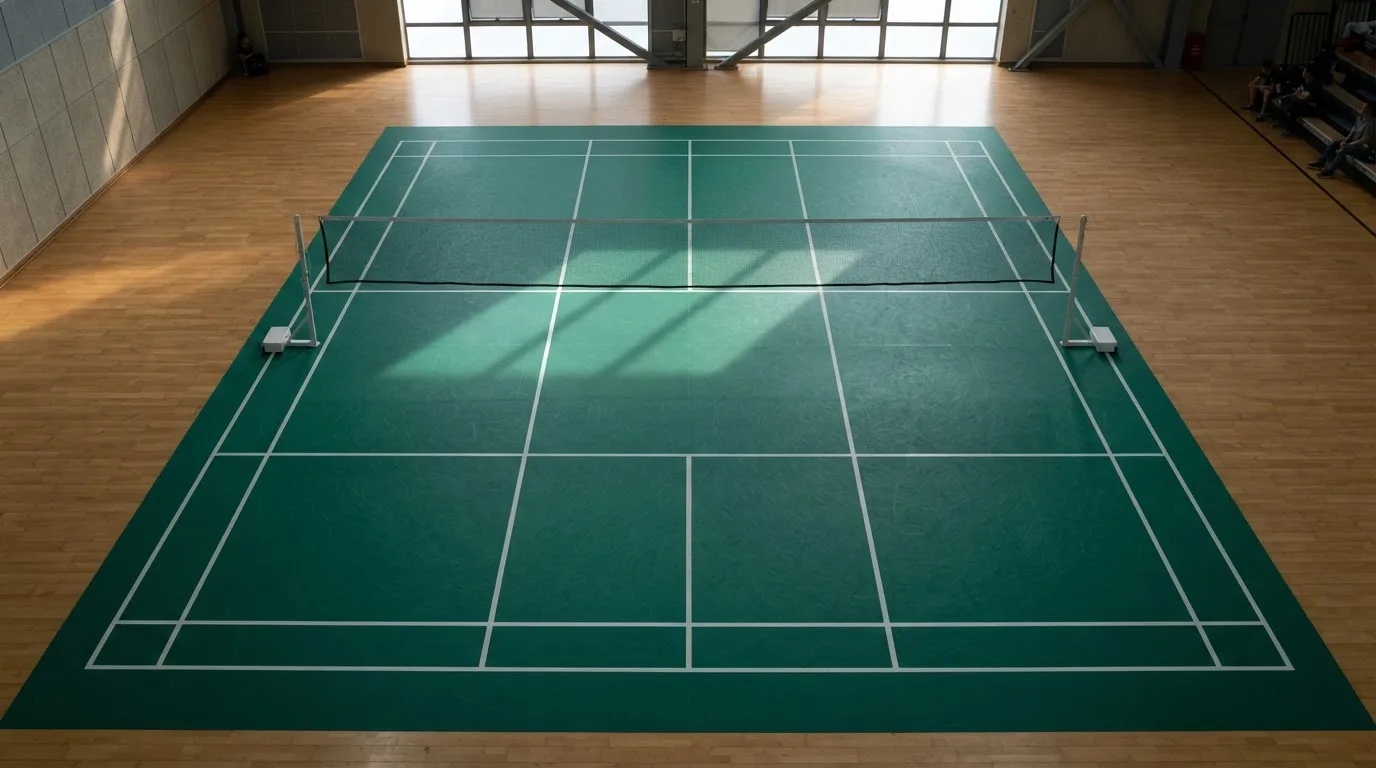
Each badminton game is played to 21 points, with rally-point scoring: every rally produces a point, regardless of who served. At 20–20 play continues until one side leads by two; at 29–29 the next point wins. A match is the best of three games. The court is 13.4 m long, 6.1 m wide for doubles and 5.18 m wide for singles, with the net 1.55 m high at the edges and 1.524 m at the centre — dimensions that are standard across BWF events and matter at the trade level more than the spectator level. There are five disciplines: men’s singles, women’s singles, men’s doubles, women’s doubles and mixed doubles.
The governing body is the Badminton World Federation (BWF), founded in 1934 as the International Badminton Federation. The BWF runs the World Tour (Super 1000, 750, 500, 300 and 100 tiers), the BWF World Championships, the Thomas Cup (men’s team), the Uber Cup (women’s team) and the Sudirman Cup (mixed team, since 1989). The Thomas, Uber and Sudirman Cups are held every two years. The All England Open Championships have been held since 1900, the BWF World Championships since 1977. Badminton has been an official Summer Olympic sport since 1992; mixed doubles was added four years later.
That calendar sets the rhythm of the betting market. Outrights appear weeks before the All England Open and the BWF World Championships; match-winner markets appear on the day; in-play markets run from the first service to the match point. Punters who want a price on a longshot in a Super 1000 final have it for weeks; punters who want to bet on an ITF-level semi-final often have it for hours.
Ten UK-licensed bookmakers for badminton — what each one says, and what the gap looks like
The ten operators below each hold a remote general betting standard (real events) licence from the Gambling Commission; each is part of GAMSTOP; each is reachable in Great Britain. The table that follows names the licence holder and account number, and the column on what each operator’s own terms state is what was found on the operator’s own site or app on the date of the data snapshot. Where the terms say nothing on a particular point the cell is left empty.
| Brand | Licence number (account) and holder | What the operator’s own terms state |
|---|---|---|
| BetVictor | 039576-R-319370-028 — BV Gaming Limited | Best Odds Guaranteed on UK and Irish horse racing, enhanced live race streaming, a BetFinder feature for finding racing bets, alongside Smart Stats. |
| Sporting Index | 027343-R-308898-011 — Sporting Index Limited | The customer can switch between fixed odds and spread betting, with in-play betting, Bet Builder for football, auto cash-out and Multi-Markets. |
| Tote | 054779-R-331321-008 — TDCO Limited | Pool betting is a separate licence category from the remote general betting standard licence listed here, and the brand’s pool product sits alongside fixed odds in its offering. |
| BetMGM | 039198-R-319450-029 — LeoVegas Gaming PLC | Sports welcome offer for new UK customers: deposit £10 or more and place a sports bet within 7 days; four £10 free bets are credited — two football accumulators of 4+ selections and two sports multiples of 2+ — valid for 7 days with minimum odds and an opt-in required. |
| Betboro | 044181-R-324363-007 — Webmedia Development N.V. | Sports welcome offer: a 100% matched free bet of up to £25 on the first qualifying wager; a debit card deposit of at least £10 and a first bet of £5 to £25 with at least three selections each at 3/5 (1.60) or higher. |
| Betmaster | 065699-R-339929-002 — BM Solutions GB Ltd | The app covers football, cricket, horse racing, NFL and eSports, including League of Legends and Dota 2. |
| Betfred | 039544-R-319290-010 — Petfre (Gibraltar) Limited | The app covers 21 sports plus over 2,000 casino-style games; in-play markets for badminton depend on the tournament. |
| William Hill | 039225-R-319373-015 — WHG (International) Limited | Best Odds Guaranteed on UK and Irish horse racing from 8 AM on the day of the race, on single and multiple bets; the offer does not apply to ante-post, tote or pari-mutuel bets. |
| VBet | 044662-R-324273-022 — SCGO Limited | Sports welcome offer: a £10 free bet when a new, verified customer stakes £10 or more on a first-ever bet that loses. |
| Sky Bet | 067370-R-341330-005 — SBG Sports Limited | Free bets expire 30 days after crediting, can be used only on single or each-way markets, not multiples, excluding virtuals; non-withdrawable; the stake does not return with winnings. |
BetVictor
BetVictor’s badminton menu appears inside a wider racing-and-football product built on a single remote general betting standard (real events) licence from the Gambling Commission, account 39576, held by BV Gaming Limited. The headline features — Best Odds Guaranteed on UK and Irish horse racing, a BetFinder tool and Smart Stats — are racing features, not badminton features, and the brand’s depth on badminton depends on which tournament the BWF calendar brings into the slip. The conditions on welcome offers, free bet expiry and minimum odds match the operator’s standard terms; the Smart Stats layer covers enough sports to give an at-a-glance form read.
Verdict. A racing-led brand that carries badminton on top of its main product, with enough BWF events on the in-play menu to make the corner usable; the depth of the badminton menu on a mid-week Challenger is the kind of thing a punter should check on the slip before staking.
Sporting Index
Sporting Index is unusual in this set because the customer can switch between fixed odds and spread betting on the same account. Fixed-odds betting at Sporting Index is licensed under the Commission’s remote general betting licence (account 27343), held by Sporting Index Limited; financial spread betting is regulated by the FCA and is a different product, governed by FCA rules — including the rule that spread betting losses can exceed deposits. The app lists in-play betting, auto cash-out and Multi-Markets, but the headline differentiator is the spread-betting side, where a stake buys a position on a number (a player’s total points, the margin of victory in games, the number of deuces in a set) and the loss can be larger than the deposit.
Verdict. A fit for a punter who already understands spread betting and wants one account with both products; an expensive first pick for a punter who only wants fixed-odds badminton and is new to spread betting, since the FCA-regulated product has a loss profile the Commission-regulated one does not.
Tote
Tote sits on a remote general betting standard (real events) licence, account 54779, held by TDCO Limited. The brand’s history is in pool betting on British and Irish horse racing — a product that pools the stakes of all customers and pays a dividend out of the pool, less the operator’s take — and its site pairs the pool product with a fixed-odds sportsbook. Pool betting on horse racing sits under a different licence category from the one in the table above; the licence number in the table is the remote general betting standard (real events) licence for the fixed-odds sportsbook, not for the pool product.
Verdict. A natural pick for a punt on a major horse race, with a fixed-odds sportsbook alongside that carries badminton when the BWF calendar is live; a thinner first pick for a badminton specialist whose interest is in play on a mid-week ITF event.
BetMGM
BetMGM’s GB sportsbook runs under a remote general betting standard (real events) licence (account 39198) held by LeoVegas Gaming PLC, the listed company behind several UK-facing brands. The headline welcome offer is four £10 free bets (two football accumulators of 4+ selections and two sports multiples of 2+), credited after a £10 deposit and a sports bet within 7 days, valid for 7 days, with minimum odds and an opt-in required. The offer is structurally clear: a £10 deposit plus a single qualifying bet unlocks four free bets, none of which return the stake, all of which expire within a week.
Verdict. A clean welcome offer with the bonus structure written on the tin and the £10 floor low; the 7-day free-bet expiry is short enough that a punt who delays a Saturday’s bet to a Tuesday’s match loses the offer, and that’s worth knowing before the qualifying bet is placed.
Betboro
Betboro is one of the smaller names in the licensed set, and the licence (account 44181) is held by Webmedia Development N.V., a Curaçao-registered operator that nonetheless holds a Gambling Commission remote licence for the GB market. The sports welcome offer is a 100% matched free bet of up to £25 on the first qualifying wager, requiring a debit card deposit of at least £10 and a first bet of £5 to £25 with at least three selections each at 3/5 (1.60) or higher. Three selections at 1.60 means an accumulator of three legs at minimum odds — the welcome offer is structured around a multi, not a single.
Verdict. A higher headline bonus than most in this set, attached to a structure (the acca of three legs at minimum odds) that takes the bonus through a multi whose margin compounds; the licensor and the GB-licensed status are on the public register, but a punter should read the welcome offer carefully before the qualifying bet is placed.
Betmaster
Betmaster’s app is published by BM Solutions GB Ltd and sits on a remote general betting standard (real events) licence, account 65699. The app covers football, cricket, horse racing, NFL and eSports, including League of Legends and Dota 2 — a slate that places badminton under “other sports” alongside any racket sport the operator decides to add. Betmaster is a fit for a punter who wants an under-roof account for several sports; it is not a fit for a specialist badminton bettor.
Verdict. A generalist account with a wider sportsbook than a badminton specialist needs; the badminton menu on any given week depends on which tournament is on the BWF calendar, and the in-play depth at a mid-tier ITF event is the kind of thing to check on the slip.
Betfred
Betfred runs a long-established GB sportsbook on a remote general betting licence (account 39544), held by Petfre (Gibraltar) Limited. The app covers 21 sports plus over 2,000 casino-style games, with in-play markets that include badminton on the top of the BWF calendar and thin out as the tier drops. The trade-off is depth: a Betfred account offers a wider set of side products (lotteries, scratchcards in some sister apps, casino) than a specialist operator does, and the breadth of the casino product sits on a separate licence category from the betting one.
Verdict. A high-street heritage and a deep sportsbook make Betfred a sensible default for the punter who wants a single account; a badminton specialist may find a thinner live menu on a mid-week BWF event than at a brand that has invested in fewer sports.
William Hill
William Hill’s GB sportsbook runs on a remote general betting licence (account 39225), held by WHG (International) Limited. The headline feature — Best Odds Guaranteed on UK and Irish horse racing from 8 AM on the day of the race — is, again, a racing feature, not a badminton feature, and it does not apply to ante-post, tote or pari-mutuel bets. The brand’s depth on badminton is consistent with a major GB sportsbook: top-tier BWF events are well covered, mid-tier events thinly.
Verdict. A major GB sportsbook with a long history and a depth of product that translates to badminton in bursts around the All England, the Thomas Cup and the Olympics, and that thins during the rest of the year.
VBet
VBet’s GB sportsbook runs on a remote general betting licence (account 44662), held by SCGO Limited. The sports welcome offer is the simplest in the set: a £10 free bet when a new, verified customer stakes £10 or more on a first-ever bet that loses. One free bet, no wagering requirement, one condition — the first bet must lose. The offer is contingent: the free bet is credited only when the qualifying bet loses, and the punter who wins the first bet walks away with the winnings and no free bet.
Verdict. A simple, contingent offer that costs the operator almost nothing on a punter who wins, and rewards the punter who loses with a £10 stake on the next bet; one of the easier welcome offers in the set to read end-to-end.
Sky Bet
Sky Bet runs a remote general betting licence (account 67370), held by SBG Sports Limited. The free bet terms are written in unusually clear English: free bets expire 30 days after crediting, can be used only on single or each-way markets (not multiples), excluding virtuals, are non-withdrawable and do not return the stake with winnings. The terms say exactly what the bet is — a stake that expires, on single or each-way markets, with no stake return — and they say what the free bet is not: not a refund, not a multiple, not a virtuals stake.
Verdict. A GB-licensed major sportsbook with free-bet terms the punter can read in one pass; the choice to exclude multiples and virtuals from free-bet use is a real constraint, and the 30-day expiry is short enough that a free bet should be planned the day it is credited.
What the rules around offers, advertising and tax look like
Bonus marketing is not the only place the rules bite. Three further rules touch the badminton page in particular.
Advertising. The Commission does not license advertising; the CAP Code (non-broadcast) and the BCAP Code (broadcast) cover it, enforced by the Advertising Standards Authority (ASA) alongside the LCCP marketing conditions. CAP Code section 16: marketing must be socially responsible, must not be of strong appeal to under-18s, and no one who is or seems to be under 25 may be featured gambling or play a significant role (with a narrow exception for marketing placed where a bet can be made directly). That rule concerns who may appear in the advertisement; it does not change the betting age, which is 18. “Whistle-to-whistle” is an industry code, not law: since 1 August 2019 betting advertisements have not been shown on TV from five minutes before a live sporting event to five minutes after it, before the 9 pm watershed, with horse and greyhound racing excluded.
Premier League shirt sponsorships. From the 2026/27 season gambling sponsorship is gone from the front of Premier League matchday shirts; sleeves and perimeter hoardings remain. Voluntary, not law. Worth knowing for context, not a rule the punter acts on.
Tax. The player pays no tax on betting winnings in Great Britain — that is general information, not tax advice, and a professional gambler should ask HMRC or an adviser. General Betting Duty is the operator’s tax on gross profits, currently 15%; from 1 April 2027 a new remote betting rate of 25% applies within it, while remote bets on UK horse racing, self-service betting terminal bets, pool betting and in-person betting stay at 15% (HM Government policy paper of 26 November 2025). Until 1 April 2027 the remote rate stays at 15%; whether operators pass the duty on through odds is not established. Never write that the player is charged duty.
Offshore brands and what protection is lost
A brand running without a Gambling Commission licence is offshore for GB customers, regardless of where the company is incorporated. The licence the 2005 Act requires is a licence held at the point of consumption — by the operator whose remote facilities are used in Great Britain. A Curaçao licence or a Malta Gaming Authority licence does not satisfy that test.
Providing gambling facilities in Great Britain without the licence the Act requires is an offence under section 33 of the Gambling Act 2005 (on summary conviction up to 51 weeks’ imprisonment, a fine up to level 5, or both; six months in Scotland). The offence is aimed at the operator, not at the customer: a reader who bets on an offshore site is not prosecuted for doing so. The cost is the protection that is missing. No GAMSTOP coverage means the self-exclusion register does not apply. No Commission complaints route, no approved ADR body, no British consumer redress if funds are withheld. No bonus cap, so a 50x or 100x wagering factor can be offered. No £150 financial vulnerability check, so spend-monitoring is the operator’s choice. No credit-card ban — credit cards are a normal funding method at offshore books. No licence-condition advertising rules.
Enforcement against offshore operators is disruption, not blocking: cease-and-desist notices, search-engine delistings, work with registrars and payment providers. The Commission has been given, or is about to receive, court-order DNS blocking powers; never write that ISP-level blocking is in operation now, because that has not been confirmed at the time of writing.
The honest framing: a GB-licensed brand costs the customer verification before the first deposit, a £150 financial vulnerability check at moderate spend and a 10x bonus cap — and buys GAMSTOP coverage, a Commission complaints route, ADR cover and British consumer redress. An offshore brand costs none of those at signup and offers none of those afterwards. Neither is “the safe choice” by default; both carry different costs.
Putting it together — what a £25 badminton bet actually costs
The arithmetic on this page is one number: the bookmaker’s margin inside the price. Take a representative two-way market at decimal odds 1.90 / 1.90. The payout share across both outcomes is 1 ÷ (1/1.90 + 1/1.90), which works out to 1 ÷ 1.0526… ≈ 0.95 — meaning roughly 95% of every unit staked across the market comes back to customers on the winning side. The margin is the rest: about 5%.
State the result as a band, not as a single figure. At decimal odds 1.90 / 1.90 on a representative two-way market, the margin sits in the band of roughly 4.5% to 5.5%, in line with the standard margin on a top-tier match-winner market at a GB-licensed bookmaker; tighten or loosen the band as the prices diverge from even-money (a 1.65 / 2.40 market widens it; a 1.95 / 1.95 market narrows it). State the assumption: a representative two-way market on a BWF World Tour event, prices stable across a snapshot, with no commission or in-play surcharge. The figure is what the bookmaker keeps across the whole market, not the outcome of a single bet.
That 5% is what every badminton bet on this page sits on top of. A winning £25 bet at decimal odds 2.20 (a 6/5 shot) returns £55.00, with a £30.00 net profit; the 5% is the implicit cost of the loser on the other side of the same market, not a charge on the winner’s slip. Read on top of that: the verification check before the first deposit, the £150 financial-vulnerability threshold from 30 August 2024, the 10x bonus cap from 19 January 2026, the 30-day free-bet expiry most operators run, and the loss-of-payout if the betting slip is on an unlicensed site. The combined read: regulated, traceable, with a margin inside the price that the punter can name; unregulated, anonymous, with a margin the operator does not have to disclose.
FAQ
How does a bet on badminton actually work?
Pick a market — match winner, handicap, total games, game winner, set betting — select a stake and confirm the bet. The bookmaker holds the stake until the match settles; a winning bet returns the stake multiplied by the decimal odds (so a £10 bet at 2.20 returns £22.00 with a £12.00 profit). Badminton settles on the official BWF result; retirements mid-game settle under the operator’s house rules, which the bettor should read before staking. BWF World Tour events and the BWF World Championships are the deepest markets; lower-tier BWF events and ITF events often have thinner coverage.
How can a Gambling Commission licence be checked?
Go to the Commission’s public register and search by business name, trading name, domain or account number. Every brand above is searchable by name and by licence number; the licence number is the account number in the table. The register also names the licence holder — the legal entity the licence sits with — and the licence category, which for online fixed-odds badminton is remote general betting standard (real events). A brand whose domain is on the register against this category is licensed for GB customers; a brand whose name does not appear is not. The register is the whole test.
How is the return on a bet worked out?
Return = stake × decimal odds. Net profit = stake × (decimal odds − 1). For a £10 bet at decimal odds 2.20 (a 6/5 shot) the return is £22.00 and the profit is £12.00. For an accumulator the decimal odds of the legs multiply into one price, and a £5 stake at decimal odds 7.18 (three legs of 1.90, 2.10 and 1.80) returns £35.90 with a £30.90 profit if all three legs win. The marginal cost of each leg is the bookmaker’s margin on that market, which compounds across legs.
What is the bookmaker’s margin and how can it be seen in the odds?
The margin is what the bookmaker keeps of every unit staked across a market once all winners are paid. The formula: payout share = 1 ÷ (sum of the reciprocals of all outcomes’ decimal odds); margin = 1 − payout share. On a two-way market at 1.90 / 1.90 the payout share is roughly 0.95 and the margin roughly 5% — about five pence out of every pound staked across the market. Margins compound on accumulators (three legs at 5% give a margin closer to 15%) and shrink on each-way and outright markets where the field is longer.
How do fractional odds convert to decimal odds?
Fractional a/b converts to decimal (a ÷ b) + 1. So 5/1 = (5 ÷ 1) + 1 = 6.00, 11/4 = (11 ÷ 4) + 1 = 3.75, 6/4 = (6 ÷ 4) + 1 = 2.50. Evens (1/1) is decimal 2.00; odds-on (e.g. 4/6) is decimal (4 ÷ 6) + 1 = 1.67. Both formats quote the return including the stake; the conversion is arithmetic, not a market view — a 6/4 shot is the same position as a 2.50 shot, whichever side of the column the price sits on.
Which safer-gambling tools does a licensed bookmaker have to offer?
A GB-licensed online operator must be part of GAMSTOP, with self-exclusion periods of six months, one year, five years, or five years with auto-renewal. The operator must offer deposit limits under RTS 12 (the first changes have applied since 31 October 2025; a second phase, postponed to 30 September 2026, may or may not be live). From 30 August 2024 a financial vulnerability check runs when a remote customer’s deposits minus withdrawals exceed £150 in a rolling 30 days. The operator must provide information on GamCare, the National Gambling Helpline, GambleAware, NHS gambling clinics and Gamblers Anonymous. Timeouts, reality checks and product-blockers are operator-side controls that GB-licensed operators also commonly provide.
Tennis, darts & cue sports – Footy Tips
Content created by the «Footy Tips» team
