
Online handball betting in Great Britain, ranked on what it actually costs the punter
 Available in US
Handball is a niche in the British sportsbook. Most matchday coverage on the high-street apps is football, horse racing and tennis, with handball slotted into the secondary “More Sports” menu alongside volleyball, futsal and floorball. That has not stopped it from becoming a steady market for bettors who follow the European leagues, the IHF World Championship and the EHF Champions League — fixtures run most weeks of the season, the margin on outright and handicap prices is competitive, and a contest that averages 55 to 65 goals across two halves gives live-betting a tempo that football does not. The question for a British punter is not whether handball can be bet on. It is which bookmaker to trust with it, what the price is hiding, and what the offer around the price actually costs.

This page is built around that question. The angle is cost — what handball betting asks of the bettor, in money, in turnover and in conditions, before the bookmaker’s margin is even considered. The first sections explain the legal frame and the player-protection rules a Great Britain licence carries, then move through bonuses, live betting, bet types and the tournament calendar. The ten brands that close the page are all on the Gambling Commission’s public register for remote general betting standard (real events); the table shows their licence number and licence holder, and the review blocks run from a heavy-hitter such as bet365 to a specialist exchange such as Matchbook. The arithmetic at the centre of the page works the bookmaker’s margin from the prices a market posts, because margin is the cost that never appears in the headline odds.
Data current as of 27 October 2026 against the Gambling Commission’s public register of remote operating licences and each operator’s own published terms on 16 October 2026.
The legal frame: what a Great Britain licence means and what it costs
Handball is not a specially regulated sport in British law. There is no statutory list of permitted bets, no minimum margin and no rule that any particular market be available. A bookmaker serving customers in Great Britain needs an operating licence from the Gambling Commission wherever the company is based, and the categories on the licence decide what it may offer. Two categories matter for handball: remote general betting standard (real events), which covers the sport as played, and remote betting intermediary, which is the licence a betting exchange such as Matchbook runs under. Most of the brands reviewed below hold the first; Matchbook and Ladbrokes, which runs a sportsbook alongside the exchange, hold both.
The framework is the Gambling Act 2005 for Great Britain (England, Scotland and Wales), with the Gambling (Licensing and Advertising) Act 2014 closing the route by which an operator based abroad could serve British customers without a British licence. Northern Ireland sits outside the 2005 Act and runs its own older regime — that detail matters because a “GB-licensed” brand is licensed for England, Scotland and Wales and not, in the same form, for Northern Ireland. The Commission’s public register can be searched by business name, trading name, account number or domain, and is the whole test of whether a brand holds a licence; nothing else — not a footer line, not a press release, not a “.co.uk” suffix — proves it. Domains prove nothing because licensed operators use both .com and .co.uk, and an offshore brand can register either.
The cost of that licence shows up in the bettor’s experience in three places. The first is verification: since 7 May 2019 every licensed remote operator has had to verify name, address and date of birth before a customer can deposit or gamble, and that includes a free bet or a bonus. Anonymous betting at a GB-licensed site is gone. The second is the bonus cap: since 19 January 2026 wagering requirements on bonuses are capped at 10x, so a £10 bonus can require at most £100 of qualifying bets, and an offer that mixes product types — football betting tied to free casino spins, for example — is banned outright. The third is GAMSTOP, the multi-operator self-exclusion scheme, which is a mandatory licence condition for online operators since 31 March 2020; every brand below is a GAMSTOP member.
None of that is a free good. Verification means a few days between sign-up and the first settled bet on some brands. The bonus cap means welcome packages are smaller than the offers punters see on unlicensed sites. GAMSTOP means a self-excluded customer cannot simply move to the next brand on the list. Those are the prices a British licence buys, and they sit beside the protections — limits, the £150 vulnerability check that applies once rolling 30-day deposits net of withdrawals clear £150, the Commission’s complaints route, and approved alternative dispute resolution — that the licence funds.
Off-brand play: what an offshore bookmaker does and does not give the bettor
A Curaçao, Malta or Gibraltar licence is not a substitute for a Commission licence when the customer is in Great Britain. The test is the point of consumption: providing gambling facilities in Great Britain without the licence the Act requires is an offence under section 33 of the Gambling Act 2005, aimed at the operator and carrying up to 51 weeks’ imprisonment, a level-5 fine, or both on summary conviction in England and Wales (six months in Scotland). No offence aimed at a customer who merely bets on an unlicensed site was found. A punt on an offshore brand is not a criminal matter for the bettor; the loss is the loss of protection.

What that protection is worth shows up at the moment it is needed. An offshore book is not on GAMSTOP and so the self-exclusion scheme does not cover it. It is not subject to the Commission’s social responsibility code and so the financial vulnerability check, the deposit-limit framework and the bonus cap do not run through it. It is not bound by an approved ADR body’s award, and so an unpaid winning bet or a withheld withdrawal has no British route to complain through. Some offshore operators quote UK-friendly payment methods and a “.co.uk” domain; both are marketing, neither is a licence.
The honest framing is that licensed and offshore are two different products, not a safe-versus-unsafe pair. A GB licence buys checks, limits, GAMSTOP and the bonus cap, and the bettor pays for those in verification time and a smaller welcome offer. An offshore book buys faster sign-up and a bigger headline bonus, and the bettor pays for that in loss of British consumer redress if anything goes wrong. Neither is “the safe choice” by default — safe play is deposit limits, timeouts and the willingness to use GamCare — and the decision is a bettor’s own.
Player protection: limits, vulnerability checks and the help that exists
The serious gambling controls in Great Britain run through the Licence Conditions and Codes of Practice and the Remote Technical Standards, and they sit on top of the bettor’s own choice. Three layers matter for handball betting.
The first is identity and age. Eighteen is the minimum, and the licensed operator verifies name, address and date of birth before the first deposit. That is faster on some brands than others, and a few brands such as Kalooki Sportsbook state explicitly that they run GAMSTOP alongside the verification step.
The second is financial. Since 30 August 2024 a financial vulnerability check (LCCP condition 3.4.4) applies to remote betting when deposits minus withdrawals exceed £150 in a rolling 30 days; since 28 February 2025 it is enforced. The check is a public-record search — bankruptcy, county court judgments, IVA — not an income check, not a credit reference check. Financial risk assessments (the “affordability checks” of the press) have been announced by the Commission on a staged timetable — a Commission article of 7 July 2026 sets the trajectory, with no start date — and that distinction matters: a check that is announced and staged is not the same as a check that is in force, and any operator page that conflates the two is reading the rules backwards.
Deposit limits are the operator’s responsibility under RTS 12, and the bettor can always set their own. The first phase has applied since 31 October 2025, a second phase was postponed to 30 September 2026, and whether the second phase is live is not established. There is no state-set ceiling: a bettor who wants a £10 daily limit sets one, and an operator that defaults to something higher is allowed.
The third is help. GamCare runs the National Gambling Helpline; GambleAware funds treatment and the public-facing information; the NHS runs gambling clinics across Great Britain; Gamblers Anonymous runs meetings in person and online. Fitzwilliam Sports, a niche sportsbook outside the top-ten below, lists all three on its footer — a useful reminder that smaller brands link out as well as the big names. A punt on a Champions League handball match is not the right moment to be working any of this out; a bettor who finds themselves chasing or hiding their activity from family is in the wrong market at the wrong price.
Crypto and handball: what “bitcoin handball betting” actually refers to
The cluster of search terms around crypto and handball — bitcoin handball betting, ethereum handball betting sites, best bitcoin handball betting sites — describes a category of operator that does not sit on the Commission’s register. None of the brands below accepts a cryptocurrency deposit and stays GB-licensed: the money-laundering rules and the verification-before-deposit requirement make that combination awkward, and the operators that pitch it run on Curaçao or similar licences.
Two things follow. The first is that an offer described as a “crypto handball betting site” is an offshore site, and the offshore paragraph above applies in full. The second is that the marketing claim is about payment, not about market depth: a brand that pitches itself on bitcoin deposits but lists twenty-five handball matches a week is a thin book, and the margin on those twenty-five matches is the cost the bitcoin headline hides.
There is one British-side detail worth keeping. The Commission’s registered payment services for retail (the list of permitted methods at a GB-licensed operator) are not established, and the operators reviewed below publish their own accepted-methods pages; a debit card, a bank transfer and an e-wallet such as PayPal or Skrill are the usual set, and credit cards have been banned for gambling in Great Britain since 14 April 2020, including credit-card-funded e-wallet top-ups. That ban does not touch debit cards, does not touch crypto on an offshore site, and does not touch a GB-licensed operator’s decision to refuse a method for its own commercial reasons.
Bonuses and free bets: how to read a handball welcome offer
The marketing word in this market is “free”. A free bet is not a free stake: the stake is rarely returned with the winnings, the offer is gated by an opt-in or a qualifying bet, and the time to use it is short. A welcome bonus is not free credit: it carries a wagering requirement, the requirement is capped at 10x since 19 January 2026, and the offer is constrained by minimum odds and a deadline that varies by brand.
Reading the offer starts with the trigger. BetMGM’s sports welcome offer triggers on a deposit of £10 or more and a sports bet within 7 days, and pays out four £10 free bets (two football accumulators of 4+ selections and two sports multiples of 2+), each valid for 7 days with minimum odds and opt-in required. VBet’s sports welcome offer is a £10 free bet when a new, verified customer stakes £10 or more on a first-ever bet that loses. Hollywoodbets refunds the stake of a first qualifying losing accumulator as a free bet of up to £30 — the qualifying bet is £10 or more, three legs or more, odds of 4/1 or greater, settled within 7 days, one free bet per customer. Betway’s Free Bet Club pays up to £10 in free bets every week to opted-in customers who have spent £25 or more on sports during the week, paid as 2 × £5 free bets.
Reading the offer continues with the cost. The wagering cap is the single most important number on the page. At 10x, a £10 bonus takes £100 of qualifying bets; under the old 50x rule it would have taken £500, and that is the cap’s bite. The minimum odds on a qualifying bet are the second most important number: a market at 1.20 is a virtual certainty by the bookmaker’s own reckoning, and it is not, in most cases, the price the wagering term demands. A bettor who wants to know the cost of clearing a bonus looks at the wagering factor, the minimum odds, the time limit and any cap on the free-bet winnings, in that order.
Reading the offer finishes with what the free bet is worth. A free bet whose stake is not paid back is worth less than the headline number suggests, because the bettor risks the free bet but only collects the profit. At decimal odds of 3.00 on a market with a 95% payout share, the average value of a £10 free bet is £10 × (3.00 − 1) ÷ 3.00 × 0.95 = £6.33. A free bet paid back with the winnings — the rarer structure — is worth the headline number minus the bookmaker’s margin in the same way. The free-bet calculation runs in its own paragraph later in the page.
A punt on a free bet at odds-on (shorter than evens) is a punt on a near-certainty at a margin-clipped price. The bookmaker’s margin lives there, and the free bet is the wrong venue to test it: the offer is a chance to take the bookmaker’s money on a market the bettor follows, and the worst use of it is on a market the bettor does not.
Live betting and cash out: how the in-play handball market works
Handball is a tempo sport: two 30-minute halves, a stoppage every few minutes for a free throw or a two-minute suspension, and a contest that regularly hits 60 total goals. That structure is why in-play handball has become a market in its own right. A bettor can lay a pre-match handicap and watch the first-half lead, hold a total-goals line through the second-half run, or trade a half-time result into a full-time position with the cash-out button the slip carries.
A cash-out is the bookmaker’s offer to settle the bet before the event finishes, at a price the bookmaker’s own screen sets. It is useful in a sport where the lead changes hands eight times in a half. The risk is that the cash-out price embeds the bookmaker’s margin twice — once in the original price and again in the settlement — and that the bookmaker can suspend cash-out at the moment the bettor wants it most. Most of the brands below carry cash-out in one form: Spreadex runs one-click, auto and partial cash out across both fixed-odds and spread bets; bet365 runs in-play betting and live streaming of events worldwide plus Match Live and a Live Golf Tracker for following positions; Ladbrokes and Paddy Power run cash-out across the sportsbook and the exchange where applicable. Matchbook, as a betting exchange, runs in-play with prices set by other users rather than by a trader, which is a different settlement model.
Live streaming is a separate product from live betting, and the two often travel together. Spreadex streams UK and Irish horse racing, greyhounds, tennis, NFL and selected football; Matchbook streams horse racing and greyhounds. Handball streaming is rarer and is more often a rights-held feed inside a sportsbook’s partner programme than a free stream on the bettor’s account page.
The cost of an in-play bet lives inside the held margin. A pre-match market at 1.90 / 1.90 carries a payout share of 1 ÷ (1/1.90 + 1/1.90) = 0.95 and a margin of 1 − 0.95 = 5%. The same market during play, with the bookmaker’s trader adjusting every few seconds, will run wider — the spread is wider, the price wobbles more, and the margin is heavier. That is the price of being able to back and lay through the match.
Predictions, tips and the betting strategies that pay for themselves
A prediction is a hand-up. The cluster of search terms around handball betting strategy, handball betting tips and predictions, and handball best bets runs into a hard rule: nobody knows the outcome of a sports event before it is played, and a tipster selling a “sure” pick is selling a paid asset that is, on the historical record, no better than the public’s. The page does not carry selections and never will.
What the page can carry is the structure of a tip that costs the bettor. A tip is a forecast with a price, and the price is the bettor’s expected return for being right; a tip at decimal odds of 2.50 on a market with a 95% payout share has an implied probability of 40% against an underlying market spread that averages 38%. A tipster who tips favourites at short odds and collects a subscription is selling the false comfort of a near-certainty; the bettor is paying for a margin, not for information.
Three rules hold for a handball tip worth the money. First, the price has to reflect the bettor’s own probability, not the tipster’s. Second, the tip has to be sized to the bettor’s bank — a flat 1% to 2% of bank per selection is the working range. Third, the tip has to be on a market the bettor follows well enough to form a view on, and not a market the tipster is selling access to.
Bankroll management is the unglamorous half of the strategy. A punter who bets 5% of bank on a single Champions League handicap and another 5% on a Bundesliga total-goals line is two losses away from a 10% drawdown before any winning bet lands. A punter who bets 1% on five selections in a weekend is in a position to take the losses and keep the book. The discipline is the same on every sport, and handball’s tight calendar — matches most days in the European season — is a particular trap for the bettor who scales up to “make the weekend pay”.
Bet types and odds: how a handball price is built
The fundamental of a price is the overround, the margin the bookmaker keeps of every unit bet on the market. The arithmetic runs from the decimal odds the screen shows. A two-way market at 1.90 / 1.90 — even money, all of which the bookmaker has set at decimal odds of 1.90 — has a payout share of 1 ÷ (1/1.90 + 1/1.90) = 0.95, and a margin of 1 − 0.95 = 0.05, or 5%. A three-way market (home / draw / away) at 1.70 / 4.50 / 3.40 — a Bundesliga match where the draw is the third outcome — has a payout share of 1 ÷ (1/1.70 + 1/4.50 + 1/3.40) = 1 ÷ (0.5882 + 0.2222 + 0.2941) = 1 ÷ 1.1045 = 0.9054, and a margin of 1 − 0.9054 = 0.0946, or roughly 9.5%. The three-way margin is the cost of the draw, and it is why handicap and totals markets tend to be the value line on handball — the bookmaker has to keep the third outcome’s price realistic, and the price on the two-way line is therefore looser.
The arithmetic of a margin
Worked example. Consider a two-way market priced at 1.90 / 1.90 (fractional 9/10 — the British shorthand for “tenner wins nine” on either side of the event). The payout share across the two outcomes is 1 ÷ (1/1.90 + 1/1.90) = 1 ÷ (0.5263 + 0.5263) = 1 ÷ 1.0526 = 0.95. The margin is 1 − 0.95 = 0.05, or 5%. For every £100 bet across the two outcomes, the bookmaker keeps roughly £5 in the long run.
Now shift to 1.85 / 1.95, an asymmetric price. The payout share is 1 ÷ (1/1.85 + 1/1.95) = 1 ÷ (0.5405 + 0.5128) = 1 ÷ 1.0533 = 0.9494. The margin is 1 − 0.9494 = 0.0506, or about 5.06%. The price has tightened on the favourite and lengthened on the underdog, but the margin has barely moved — a useful reminder that the bookmaker does not need to widen the spread when one side is being backed.
For a three-way market at 1.70 / 4.50 / 3.40 (the kind a Bundesliga matchday sees on the 1X2), the arithmetic runs through three terms: 1 ÷ (1/1.70 + 1/4.50 + 1/3.40) = 1 ÷ (0.5882 + 0.2222 + 0.2941) = 1 ÷ 1.1045 = 0.9054. Margin = 1 − 0.9054 = 0.0946, or roughly 9.5%. Hold the same match on the totals line at 1.90 / 1.90 and the margin returns to the 5% zone.
The band for a two-way pre-match handball market is the area the brand’s pricing team sits in, and the figure it produces on any one match is a function of the bookmaker’s own model and how the money has come in. The 5% in the worked example is an illustrative midpoint for a competitive two-way price, not a quoted price on a real event; what the bettor sees on a real Bundesliga match will sit inside a band that is wider at smaller books and tighter at the bigger names.
Worked return on a single bet
The return on a winning bet at decimal odds is stake × odds. A £10 stake at decimal odds of 2.50 returns £25, of which £15 is profit and £10 is the stake returned. At fractional odds of 3/2 — the British shorthand for “stake wins three for every two staked” — the decimal equivalent is 3 ÷ 2 + 1 = 2.50, and a £10 stake returns £25. The profit, sometimes called the winnings, is stake × (odds − 1); for a £10 stake at 2.50, that is £10 × 1.50 = £15.
For a combination bet the legs multiply into one price. Three legs at 1.80, 2.10 and 1.95 combine to 1.80 × 2.10 × 1.95 = 7.371, and a £10 stake returns £73.71 if all three win. The catch is that each leg carries its own margin, and the combined price embeds the bookmaker’s edge three times. A treble at three 1.50 legs has a combined price of 3.375, but the underlying probability of each leg is roughly 66%, and three of them in sequence are roughly 29% — the combined price says 29.6%, and the difference is the bookmaker’s margin.
Worked return on a free bet
A free bet whose stake is not paid back is worth less than its face value. The arithmetic is free bet × (odds − 1) ÷ odds × payout share of the market. A £10 free bet at decimal odds of 3.00 on a market with a 95% payout share is worth £10 × (3.00 − 1) ÷ 3.00 × 0.95 = £10 × 2 ÷ 3 × 0.95 = £6.33. The £10 face value is a marketing number; the £6.33 is what the offer is worth on average.
A free bet paid back with the winnings is worth the headline number less the bookmaker’s margin in the same way. A £10 free bet paid back at 3.00 on the same market returns £10 × 3.00 × 0.95 = £28.50, of which £18.50 is profit. The stake-back structure is the rarer offer and the more generous one; the stake-non-paid-back structure is the common one and the one the headline number understates.
Worked turnover on a bonus
The required turnover on a bonus is bonus × wagering factor. A £10 bonus at the current 10x cap takes £100 of qualifying bets; under the old 50x rule it would have taken £500. The bets needed to clear the bonus is turnover ÷ stake per bet; £100 of qualifying bets at £5 a bet is 20 bets. The minimum odds on a qualifying bet and the time limit to use the bonus are the second and third numbers to read: a 1.20 minimum odds means the bettor is betting on a near-certainty the bookmaker has priced close, and a 7-day window means a missed weekend costs the bonus.
The expected cost of clearing an offer
The expected cost of clearing a bonus is required turnover × margin of the market. £100 of qualifying bets at a 5% margin costs £5 on average; £100 at a 9.5% margin costs £9.50. The offer’s headline number is gross of this cost, and the cost is a function of the market the bettor is forced into. A bookmaker that confines a bonus to a 1X2 market is asking the bettor to pay the higher margin; a bookmaker that allows the bonus on any sports market lets the bettor find the line the book has priced tightest.
The arithmetic is a statistical estimate: an average over many bets under the stated assumptions, not a guaranteed outcome for any single bettor. A bettor who backs only winners pays no margin; a bettor who backs only losers pays the full stake. The figure in the middle is the long-run cost, and the offer’s headline number is a gross of it.
Sports & tournaments: the handball calendar
The men’s handball World Championship runs in odd-numbered years and has done every two years since 1995, run by the International Handball Federation (IHF). Denmark holds the most recent men’s title, in 2025. The women’s World Championship runs on the same cycle, and France holds the 2023 women’s title. Both events generate heavy coverage on British sportsbooks, with outright, group-stage, qualification markets and individual player markets running through the tournament.
The EHF Champions League runs the men’s and women’s club competition in Europe, and the league phase plus the knock-out rounds stretch from September to May. The men’s event is the marquee club competition; the women’s event has grown with the København, Metz and Vipers Kristiansand clubs in the late rounds. Most British sportsbooks carry outright, group winner, top scorer and individual match markets on the men’s competition through the season.
The Olympics are the four-year cycle the other major tournaments fit around. Men’s handball debuted at the 1936 Berlin Games (outdoors), returned indoors at the 1972 Munich Games and has run ever since; women’s handball was added in 1976 and has run ever since. The Olympic tournament runs a short format — twelve teams, group stage followed by knock-out — and the British sportsbook market tends to carry outright, group and individual match markets from the qualification rounds through to the final.
National leagues fill the calendar between the marquee events. The Bundesliga (Germany) and the Liga ASOBAL (Spain) carry the deepest club match coverage on most British sportsbooks; the Starligue (France), the Herre Håndbold Ligaen (Denmark), the Molde Ligaen (Norway) and the København Handball Liga (Denmark) carry the rest of the top flight. Matches run most weeks of the season, with the European knock-out rounds filling the gaps in February and May.
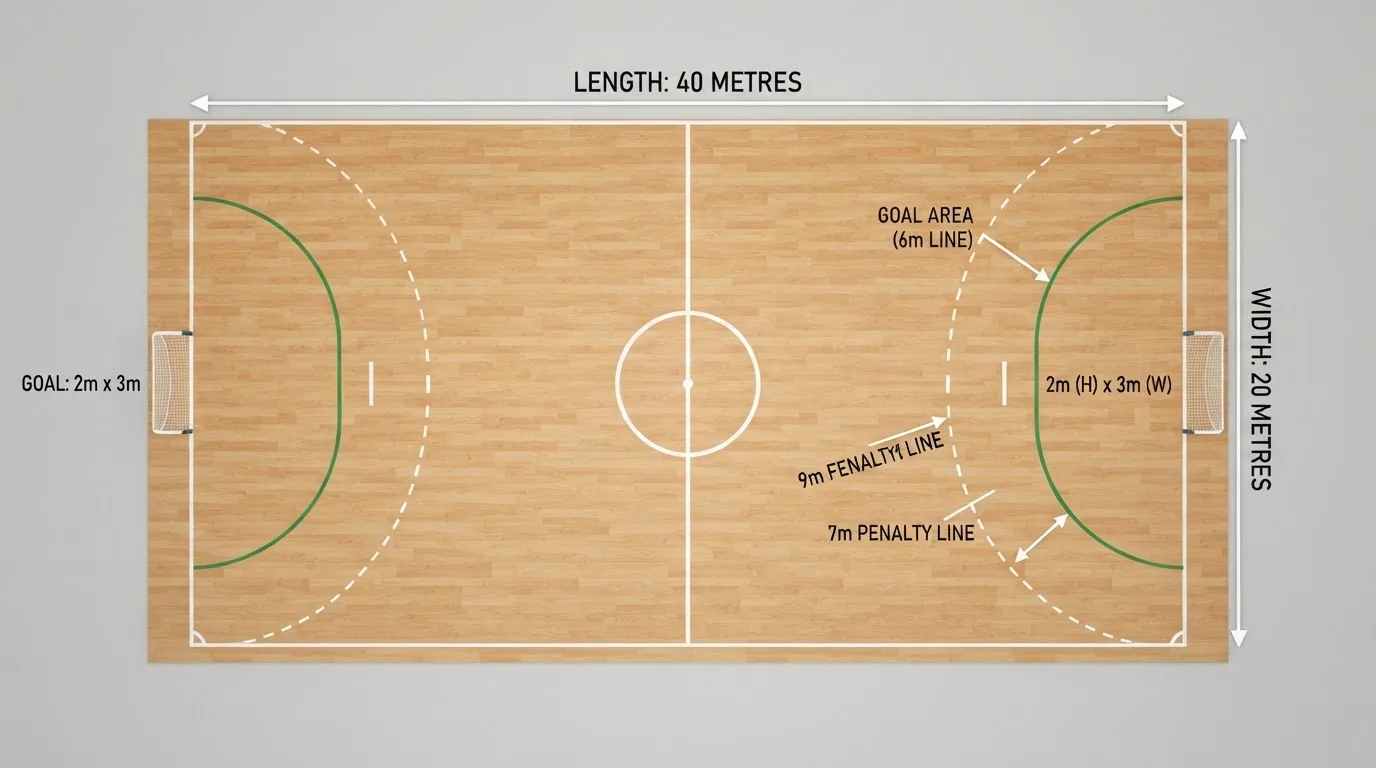
The court is 40 metres by 20 metres with goals 2 metres high and 3 metres wide; a team has seven players on court (six outfield plus a goalkeeper) and a match is two 30-minute halves. Professional teams typically score 20 to 35 goals each, which is the underlying tempo behind the live-betting section above: a match that averages 60 total goals is a market that moves every few minutes.
In decisive handball matches — a knock-out round where a draw is not enough — a drawn match goes to two 5-minute overtime periods, and if the score is still level the match is settled by a penalty shootout. That detail matters for the bettor because it changes what a “draw” market pays in a knock-out round: a draw at full-time is not the end of the event, and a betting market that pays only the full-time result needs to be read alongside the match format.
The top ten: licensed bookmakers ranked on what handball costs the punter
The ten brands below all hold a Gambling Commission remote operating licence for general betting standard (real events) at the snapshot date. The licence number and the licence holder on each row of the table are the test of the brand, and the table is the right place to start a comparison — the rest of the section is the test of the offer.
| Brand | Gambling Commission remote licence | Licence holder |
|---|---|---|
| Betway | 039372-R-319367-029 (account 39372) | Betway Limited |
| Paddy Power | 039439-R-319330-013 (account 39439) | PPB Counterparty Services Limited |
| BetMGM | 039198-R-319450-029 (account 39198) | LeoVegas Gaming PLC |
| VBet | 044662-R-324273-022 (account 44662) | SCGO Limited |
| bet365 | 055148-R-331498-002 (account 55148) | Hillside (UK Sports) ENC |
| Kwiff | 044448-R-323408-017 (account 44448) | Eaton Gate Gaming Limited |
| Matchbook | 039504-R-319407-024 (account 39504) | Triplebet Limited |
| Hollywoodbets | 053028-R-330019-013 (account 53028) | Hollywoodbets International UK Limited |
| Ladbrokes | 054743-R-330863-014 (account 54743) | LC International Limited |
| Spreadex | 008835-R-104580-022 (account 8835) | Spreadex Limited |
The brand’s own terms on what the operator offers on handball, what it costs to claim an offer, what its in-play product looks like and what the bettor should read before staking are the substance of each review. The verdicts at the end of each block are the page’s own judgement on what the offer and the licence actually buy.
Betway
Betway runs on Gambling Commission account 39372 under Betway Limited, with categories on the register for remote general betting standard (real events). The brand’s published Free Bet Club pays up to £10 in free bets every week after opt-in, and £25 or more of sports spending in a week earns 2 × £5 free bets. The structure is recurring rather than one-shot: a bettor who likes the brand has a weekly path to the £10.
Handball coverage on Betway sits inside the broader catalogue and is competitive on Bundesliga and Liga ASOBAL matchday markets. In-play is available on the major events and the cash-out product is standard. The wagering requirement on the Free Bet Club’s free bets is not established in the brand’s published terms as a flat number; a bettor claiming the offer should read the Free Bet Club terms in the account page before staking.
For the bettor who wants a recurring free-bet path and follows the European leagues week-to-week, Betway is a workable choice and the Free Bet Club is the offer that earns the comparison its place. The brand’s wider sportsbook is the more useful product on the days the handball calendar is light.
Paddy Power
Paddy Power runs on Gambling Commission account 39439 under PPB Counterparty Services Limited, and holds a remote general betting licence. The Paddy Power sports betting app covers football, horse racing, boxing, rugby, tennis, golf, darts, snooker and F1; handball is a smaller line on the same product and is most visible during the major tournaments.
The brand is best known on the British market for its price-boost promos and its money-back specials on major football events, and the same promotional engine runs through the handball calendar in the World Championship and Champions League windows. Paddy Power’s parent (Entain, via the Flutter–Entain split history) has run a sportsbook-and-exchange structure historically, and the modern Paddy Power app carries cash-out, in-play and a bet-builder on the sportsbook.
For the bettor who follows the major tournaments and likes a price boost on a marquee handball match, Paddy Power is the brand that does most to make the price itself a feature. The free-bet structure is less generous than the headline promos suggest, and a bettor chasing the promos should read the boost terms in the small print before laying the stake.
BetMGM
BetMGM runs on Gambling Commission account 39198 under LeoVegas Gaming PLC, with the appropriate remote betting credentials. The sports welcome offer for new UK customers is four £10 free bets (two football accumulators of 4+ selections and two sports multiples of 2+) on a deposit of £10 or more and a sports bet within 7 days; each free bet is valid for 7 days with minimum odds and opt-in required. The structure is concrete and the trigger is small enough that the qualifying bet is the bettor’s own call on a market they follow.
The welcome offer is paid in free bets whose stake is not returned, so the value calculation runs through the free-bet arithmetic earlier on the page. The four-leg football accumulator is a tight structure at minimum odds, and the bettor should read the minimum odds before laying the qualifying bet. The wagering requirement on the bonus is not separately stated as a flat factor in the published terms — the offer is a free bet rather than a bonus credit — and the bettor’s cost is the qualifying stake at minimum odds plus the free-bet’s expected return against the market’s margin.
For the new UK customer willing to lay £10 on a market they follow, BetMGM’s welcome is one of the cleaner structures on the British market: a clear trigger, a clear payment and a 7-day window that is workable for a weekend punter. The bigger picture is the LeoVegas Gaming PLC backing, which is a publicly listed operator with a long GB-licensed history; that is the licence-holder’s value, and it sits behind the brand.
VBet
VBet runs on Gambling Commission account 44662 under SCGO Limited, a GB-licensed operator for real events. The sports welcome offer is a £10 free bet on a first-ever bet that loses, for a new verified customer staking £10 or more. The structure is the simplest on this list: a £10 qualifying bet, a settled losing result, a £10 free bet.
The free bet is paid with the stake not returned. The qualifying bet is the bettor’s call on a market they follow, and the qualifying stake is small enough that the bettor can pick a market they actually like. The 7-day window (typical for first-bet offers on the British market) is the operative time limit; a bettor who does not place the qualifying bet within the window does not see the free bet.
For a public chain of bettors willing to back a market at minimum odds with £10 on the first stake, VBet is the cheapest entry point on the page. The brand’s wider sportsbook is a smaller product than the bigger names, and the bettor should read the VBet welcome terms for the markets that qualify and the minimum odds before claiming.
bet365
bet365 runs on Gambling Commission account 55148 under Hillside (UK Sports) ENC, licensed for remote general betting standard (real events). The brand is the official global betting partner of the UEFA Champions League and its app is the most-downloaded sports betting app in the UK. The bet365 product carries Bet Builder+ (markets from one event combined into a single bet, pre-match and in-play), Super Boosts, Winnings Boosts on Bet Builders and selected singles, and daily Bet Boosts; in-play betting is supported with live streaming of events worldwide, Match Live and a Live Golf Tracker for following bets in play.
The Champions League partnership is the headline value on handball because handball’s club competition is the EHF Champions League and bet365 has historically priced the tournament tight. The Bet Builder+ product is the structural edge on a single match: a bettor can combine match result, total goals, first-half lead and a player-prop into one bet at a combined price.
For the bettor who follows the EHF Champions League and the World Championship, bet365 is the brand whose product matches the calendar. The price is competitive on the major events and the in-play product is the most complete on the British market. The brand’s wider marketing machine — Super Boosts, Winnings Boosts and the daily Bet Boosts — is price engineering rather than fundamental value, and a bettor who treats the boosted price as the true margin often finds the real odds are tighter than the headline suggests.
Kwiff
Kwiff runs on Gambling Commission account 44448 under Eaton Gate Gaming Limited, licensed for remote general betting standard (real events). The brand describes itself as a trademark operated by Spryme Ltd, and the app carries a 17+ App Store age rating (the higher of the two App Store ratings for gambling, applied where the brand offers casino-style products alongside the sportsbook). Kwiff’s published feature is “supercharged odds” — a random multiplier on a bettor’s price that can lift the decimal odds well above the original — and the marketing pitch is the surprise upside on a settled bet.
The structural cost is the qualifier. Kwiff’s odds multipliers apply to settled bets under the brand’s own rules, and the bettor should read the published terms in the account page before claiming. The wider sportsbook is a smaller product than the bigger names, and the handball calendar is most visible on Bundesliga and Liga ASOBAL fixtures.
For the bettor who likes the structure of a surprise multiplier on the price, Kwiff is a workable brand and the supercharged odds are the feature that earns the comparison its place. The multiplier relies on a random range that can sit on minimum odds and minimum selections, and the marketing machine behind it is a feature the bettor should factor into the choice.
Matchbook
Matchbook runs on Gambling Commission account 39504 under Triplebet Limited, licensed for remote general betting standard (real events) and remote betting intermediary — the second category is the licence a betting exchange runs under, and Matchbook is the only betting exchange in the top ten. Customers on Matchbook bet against each other, with Bet Builder, multiples, in-play betting and live streaming of horse racing and greyhounds on the platform.
The exchange structure changes the cost of a handball bet. An exchange price is set by other users rather than by a trader, and the overround is the commission Matchbook charges on net winnings rather than the margin built into a bookmaker’s price. On a tight two-way market the exchange price can be tighter than the bookmaker’s, and on a one-sided market the exchange can be wider as liquidity thins out. The Bet Builder product is the structural edge on a single match, and the live streaming of horse racing and greyhounds is a separate product rather than a handball feature.
For the bettor who wants the price an exchange sets rather than the price a bookmaker quotes, Matchbook is the brand on this list that runs that model. The bettor’s cost is the platform commission on net winnings, the liquidity on handball markets, and the in-play product’s behaviour during a handball match — a market with a tight tempo and frequent lead swaps.
Hollywoodbets
Hollywoodbets runs on Gambling Commission account 53028 under Hollywoodbets International UK Limited, licensed for remote general betting standard (real events). The sports welcome offer is a free bet of up to £30 for new players depositing £10 or more by card; the trigger is a first qualifying losing accumulator of £10 or more, 3+ legs, odds of 4/1 or greater, settled within 7 days. One free bet per customer. The cap is £30, and a £10 losing treble at 4/1 returns £30 as the maximum under the offer’s wording.
The free bet is paid with the stake not returned. The 4/1 minimum odds on the accumulator is the operative number: a treble at odds shorter than 4/1 does not qualify, and the bettor should pick legs that combine to clear the 4/1 floor. The 7-day settlement window is the second operative number; an unsettled accumulator at 7 days does not pay the free bet.
For a public chain of bettors willing to lay a treble at 4/1 or greater for the chance of a £30 free bet, Hollywoodbets is a reasonable structure on the British market. The brand’s wider sportsbook is a smaller product than the bigger names, and the handball calendar is most visible during the major tournaments. The card-only deposit restriction is a small friction that some bettors will read past and others will not.
Ladbrokes
Ladbrokes runs on Gambling Commission account 54743 under LC International Limited, with categories for remote general betting standard (real events) and remote betting intermediary. The Ladbrokes Sports Betting App is published by Entain Operations Limited, sits at a 4.66 rating from 101,255 ratings in the GB App Store and runs on LC International Limited’s licence. The combination of the sportsbook and the exchange on one licence-holder is the structural point: Ladbrokes runs both products under one GB licence, and the bettor can move between a bookmaker’s margin and an exchange’s commission on the same event.
The sportsbook product is a mature British product with deep football and horse racing coverage and a handball calendar that fills in around the major tournaments. The exchange product runs under the same licence-holder and offers the same liquidity profile as the wider exchange market. Cash-out, in-play and bet-builder are standard.
For the bettor who wants the sportsbook-plus-exchange combination under one licence-holder and one account, Ladbrokes is the brand that runs both. The bettor’s cost is the wider marketing machine and the maturity of the product: the price is competitive on the major events and the in-play product is more complete than the smaller brands, but the offer around the price is less generous than the welcome offers on the newer entries to the British market.
Spreadex
Spreadex runs on Gambling Commission account 8835 under Spreadex Limited, with categories for remote general betting standard (real events). Spreadex is regulated by the FCA for spread betting and by the Gambling Commission for fixed-odds betting, and states that spread betting losses can exceed the deposit. The two-regulator structure is the structural point: the fixed-odds product is a GB-licensed sportsbook, and the spread-betting product is an FCA-regulated financial product with its own risk profile.
The Spreadex Sports Betting App combines fixed-odds and spread betting in one account, with one-click, auto and partial cash out, Bet Builder across fixed odds or spreads, and live streaming of UK and Irish horse racing, greyhounds, tennis, NFL and selected football. Handball is on the fixed-odds product; spread betting on handball is a separate product with its own settlement.
For the bettor who wants a single account for fixed-odds and spread betting, Spreadex is the brand that runs both. The bettor’s cost is the FCA-regulated spread betting product: spread losses can exceed the deposit, and the bettor should read the spread-betting terms in the Spreadex account page before opening a spread position. The fixed-odds handball product is a smaller line than the bigger names and is most visible during the major tournaments.
The page’s verdict on what handball betting actually costs the punter
The headline number on a handball market is the price. The price is a function of the bookmaker’s margin, and the margin sits inside every price the bookmaker quotes. The 5% worked figure for a 1.90 / 1.90 line is the floor a competitive two-way price sits near; the 9.5% worked figure for a 1X2 line is the cost the draw adds to a three-way price. The bettor’s first job is to know which market they are looking at.
The second job is to read the offer around the price. A welcome bonus capped at 10x wagering takes £100 of qualifying bets for a £10 bonus; a free bet whose stake is not returned is worth less than its headline number; a price boost is a marketing-engineered price with the bookmaker’s margin still inside. The brand reviews above describe each offer in its own terms; the bettor’s job is to read the brand’s own terms before claiming.
The third job is to know the protection the licence buys. A GB-licensed operator is on GAMSTOP, runs the £150 vulnerability check once the rolling 30-day deposit threshold is crossed, and is subject to the Commission’s complaints route. An offshore brand offers none of those, and the bettor who moves to an offshore brand for a bigger welcome bonus pays for the offer in loss of British consumer redress.
The fourth job is to keep the bettor’s own discipline. A bankroll rule of 1% to 2% per selection is the working range; a flat stake across the week is the right structure for the European handball calendar; a session-time limit and a deposit limit the bettor sets themselves are the right tool. GamCare, GambleAware and the NHS gambling clinics are the right place to start when the discipline turns flat.
Frequently asked questions about online handball betting
Is a handball a foul in betting?
No. “Handball” in betting refers to the indoor team sport played on a 40-by-20-metre court with two 30-minute halves and seven players per side. It is unrelated to the football offence of the same name. A bet on a handball match settles on the result of the handball match.
Does a handball count as a foul in betting?
No. The betting term and the football foul are unrelated. Bets on football are settled under the football rulebook (which defines a handball as a deliberate handling offence); bets on handball are settled under the handball rulebook (which has no such offence). A bet on a handball match settles on the match result, the score or the specific market the bettor selected.
Does handball count as a foul in betting?
No. A foul in football betting is a referee’s call under the Laws of the Game; a handball in betting is the indoor sport. The two words share a spelling but not a meaning in a betting context.
How can it be checked that a bookmaker holds a Gambling Commission licence?
The Gambling Commission’s public register can be searched by business name, trading name, account number or domain. The register lists the licence number, the categories on the licence and the licence holder; it is the whole test of whether a brand holds a licence. A footer line, a press release or a “.co.uk” domain is not a test.
How is the return on a bet worked out from the stake and the odds?
At decimal odds, the return is stake × odds, and the profit is stake × (odds − 1). At fractional odds of a/b, the decimal equivalent is a ÷ b + 1, and the same arithmetic follows. For a combination bet the legs multiply into one price, and the stake returns stake × combined odds.
What is the bookmaker’s margin and how can it be seen in the odds?
The bookmaker’s margin is the share of every unit bet on the market that the bookmaker keeps in the long run. It is calculated from the prices the bookmaker posts. For a two-way market at decimal odds o1 and o2, the payout share is 1 ÷ (1/o1 + 1/o2), and the margin is 1 minus that. For a three-way market the third term is added. The lower the margin, the better the price for the bettor in the long run.
US & other team sports – Footy Tips
Content created by the «Footy Tips» team
